18th October 2026 · 15 min
AI Chatbot for Website: A Practical UK Guide

You've added a chat widget to your website, connected some help pages and asked it a few questions. The demo looks convincing. Then a customer asks about an exception to your refund policy, the bot gives a confident but unsupported answer, and your support team has to untangle the promise it's just made.
That's the moment a UK founder realises the job isn't installing a chatbot. It's deciding what the chatbot can safely resolve, what information it can access and when it should get out of the way. Treat it as a triage and routing product, not a replacement for everyone who answers customer questions.
Table of Contents
- The Real Decision Behind an AI Chatbot for Website Success
- What UK Audits Reveal About Chatbot Effectiveness
- Choosing and Configuring the Right Chatbot Platform
- Designing Chatbot UX Around Escalation and Human Access
- Data Handling, Privacy and Trust for UK Deployments
- Why a Hybrid Bot-and-Human Model Wins in the UK
- Measuring Chatbot Performance Without Fooling Yourself
The Real Decision Behind an AI Chatbot for Website Success
The first purchasing decision shouldn't be which model to use. It should be which visitor problem deserves automation.
A chatbot that helps someone find the correct application form has a clear job. A chatbot instructed to answer anything about your business has an undefined liability. The difference affects your specification, integration work, support arrangements and budget.
For an AI chatbot for website success, start with outcomes your operations team recognises: a visitor finds the right document, completes an authorised account action or reaches the correct specialist without restarting their enquiry. A fluent conversation isn't an outcome by itself.
Answer the questions before buying
- Which problems recur? Review your support queue and group requests by intent. Separate straightforward information requests from exceptions that require someone to interpret policy.
- Where does the correct answer live? Identify the approved page, help article or business system for each intent. If your staff disagree about the answer, fix that disagreement before automating it.
- Who owns unresolved requests? Name the team responsible for receiving escalations, maintaining content and reviewing failures. Don't leave ownership with whoever installed the widget.
- What would justify keeping the bot? Define the operational improvement you want and the customer experience you won't sacrifice to achieve it.
These questions also help you decide against a chatbot. If visitors mainly need a delivery policy that's buried in your navigation, improve the navigation. If they need to choose between clearly defined services, a well-designed form may be easier to use and maintain.
Buying rule: Don't purchase a conversational interface to compensate for an unresolved service-design problem.
Budget for the service, not just the widget
Your project specification should include content preparation, integrations, testing, staff training and ongoing review. Put those activities beside the software subscription rather than treating them as optional work after launch.
Be particularly careful when a proposal promises broad automation without identifying the requests it excludes. Ask the supplier to describe the boundaries in plain language, including what happens when the knowledge base is incomplete or a connected system is unavailable.
My recommendation is to start with a bounded service that's useful even when it declines a request. A bot that accurately identifies the problem and routes it to the right person can earn its place without answering everything.
What UK Audits Reveal About Chatbot Effectiveness
UK evidence provides a useful corrective to the polished vendor demo. Adoption tells you that businesses use the technology. It doesn't tell you whether customers get satisfactory answers.
In responses collected from 3 April to 16 April 2023, the Office for National Statistics' UK AI adoption analysis recorded 16% of businesses using at least one surveyed AI technology, with chatbots reported by 4%, behind spam filters at 11%. That establishes an early business-use baseline, not a performance benchmark.
The more useful buying question is what happens when someone asks an ordinary customer-service question.
UK chatbot performance benchmarks
The results below come from the 2026 UK conversational customer-service audit, which reported 44% chatbot availability, found that 86% of chatbot providers answered questions or supplied information within a reasonable timeframe while 14% answered none of the simple questions, and recorded 45% of queries completely unanswered across the full audit.
| Metric | UK audit result | Practical target |
|---|---|---|
| Availability and basic responsiveness | Chatbot availability was limited, and some deployed bots couldn't answer straightforward questions | Verify every supported intent before public release |
| Unanswered customer queries | Unanswered queries remained a substantial problem across the audited channels | Give unresolved requests an accountable next step |
| Effective service delivery | Having a chatbot didn't guarantee useful assistance | Assess answer quality and completed resolution, not widget presence |
The distinction between chatbot-specific results and results across all audited channels matters. Don't interpret the unanswered-query finding as a failure rate attributable solely to AI. Equally, don't use a bot's ability to respond as proof that it resolved the customer's problem.
Make the supplier demonstrate failure
Ask shortlisted suppliers to work through your actual support material, including awkward wording, missing information and contradictory pages. Supply questions your staff struggle with, not just the questions already featured in the sales demo.
- Missing evidence: Can the bot acknowledge that it lacks an approved answer?
- Policy conflict: What happens when retrieved documents disagree?
- System outage: Can it explain that an account lookup failed without inventing a result?
- Operational review: Can your team inspect the information used to generate an answer?
These are acceptance tests, not requests for a more entertaining interface. A beautifully designed conversation that produces an unsupported policy answer is still a failed interaction.
My reading of the audit is straightforward: evaluate the service behind the chatbot. Content ownership, exception handling and operational visibility belong in the buying decision. Model choice belongs there too, but it shouldn't dominate it.
Choosing and Configuring the Right Chatbot Platform
Choose a platform by working backwards from the service you intend to deliver. A public-information assistant and an authenticated support agent need different permissions, integrations and safeguards.
Start with a narrow intent list: opening hours, documentation requests, order status or password-reset guidance. Keep consequential eligibility decisions outside the initial scope unless you've specified an approved decision process and suitable review.
Use this sequence to organise the build.
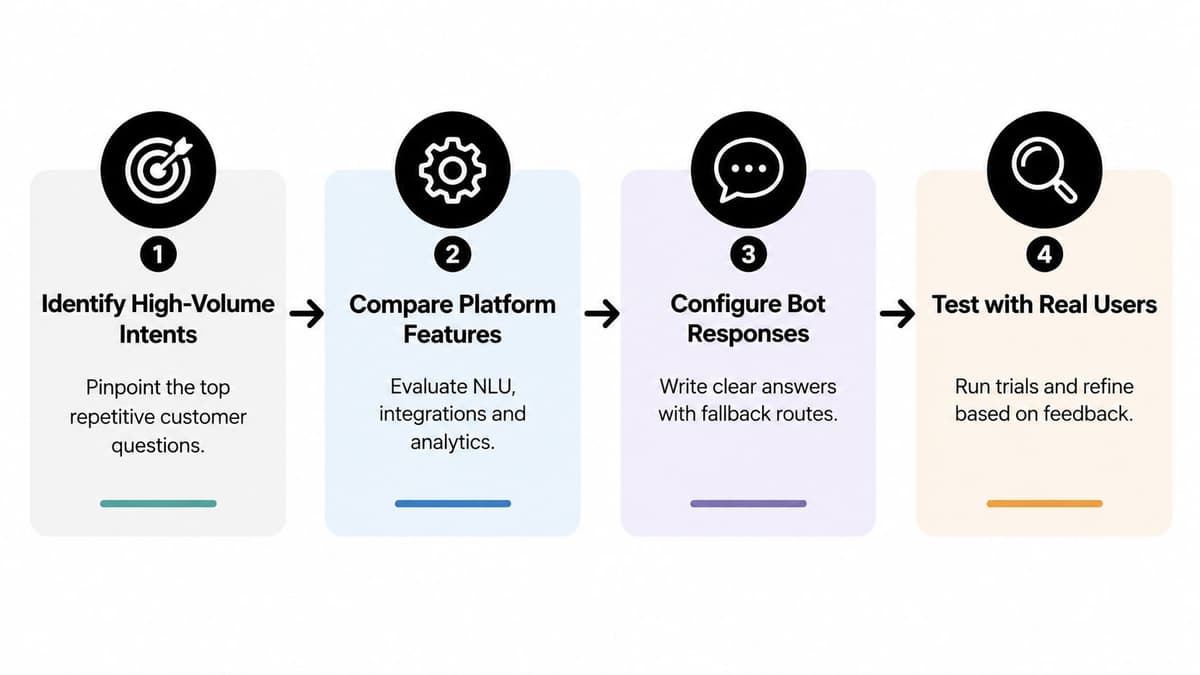
Compare capabilities against your workflow
Distinguish a configurable help-centre widget from an integrated application. The former may suit public FAQ assistance. The latter is the more appropriate specification when the bot must authenticate visitors, retrieve account information or create support tickets.
Your shortlist should address:
- Retrieval controls: Can you restrict answers to approved content, exclude obsolete pages and inspect retrieved passages?
- Integration boundaries: Can account lookups and write actions have separate permissions?
- Operational tooling: Can support staff review failed conversations, correct content and pause an unreliable feature?
- Portability: Can you export knowledge, configuration and conversation records in usable formats?
Don't pay for elaborate orchestration if your immediate requirement is finding the right help article. Conversely, don't stretch a basic widget into an account-management system because it's already installed.
Configure evidence before personality
Use retrieval-augmented generation, or RAG, to supply relevant approved material when the bot prepares an answer. Treat this as an evidence pipeline: select authoritative documents, retain their ownership and revision information, and test whether the correct passages are retrieved.
RAG isn't permission to trust every generated sentence. Require the answer to stay within the retrieved evidence, and use deterministic business rules for transactional actions.
For order status, for example, retrieve the result from the authorised order system. Don't let the model infer whether a parcel has shipped from previous conversation text. For password resets, direct the visitor through the approved recovery flow rather than collecting credentials in chat.
A useful bot can say it doesn't know. An unsafe bot turns missing information into a plausible answer.
Set acceptance thresholds around observable evidence: whether an approved source was found, whether required fields are present and whether business rules permit the action. Don't rely on the model declaring itself confident.
Create test cases for paraphrased questions, ambiguous requests, unsupported topics and unavailable integrations. Include keyboard navigation and screen-reader checks alongside answer testing.
The ICO's introduction to its AI and data-protection guidance is a useful governance reference when defining the deployment's scope and responsibilities. Keep the engineering acceptance criteria separate from the claim that a system is compliant: neither a supplier badge nor a successful demo completes that assessment.
Designing Chatbot UX Around Escalation and Human Access
The strongest commercial case for your chatbot may be faster access to the right human, not more conversations completed by AI. Design that route as part of the product rather than as an apology after automation fails.
ServiceNow's discussion of UK customer attitudes towards AI describes a 2025 survey of 2,000 UK consumers, in which 68% said chatbots had failed to meet expectations over the previous five years and 94% wanted fast responses, easy resolution and accurate answers; it also cites separate research finding 83% preferred a real person, only 4% preferred a virtual agent or chatbot, and more than 30% would accept automation if it reduced prices.
Those findings don't justify removing automation. They justify making it optional, purposeful and easy to leave.
Define when answering must stop
Build escalation rules around the request and the conversation state, not just whether the bot can produce another response.
- Explicit human requests: Transfer or offer the available human channel immediately. Don't make the customer justify their preference.
- Repeated failure: Treat rephrased questions, rejected answers and circular exchanges as unresolved service attempts.
- Sensitive requests: Route complaints, disputed decisions, financial hardship and healthcare-adjacent concerns according to an approved service policy.
- Distress or urgency: Provide an appropriate escalation route without presenting automated emotional interpretation as a diagnosis.
Emotional cues deserve cautious handling. Don't require the bot to determine someone's state with certainty before giving access to help. Allow the user's request and the subject matter to trigger the route.
The handover should feel like continuity, not rejection.
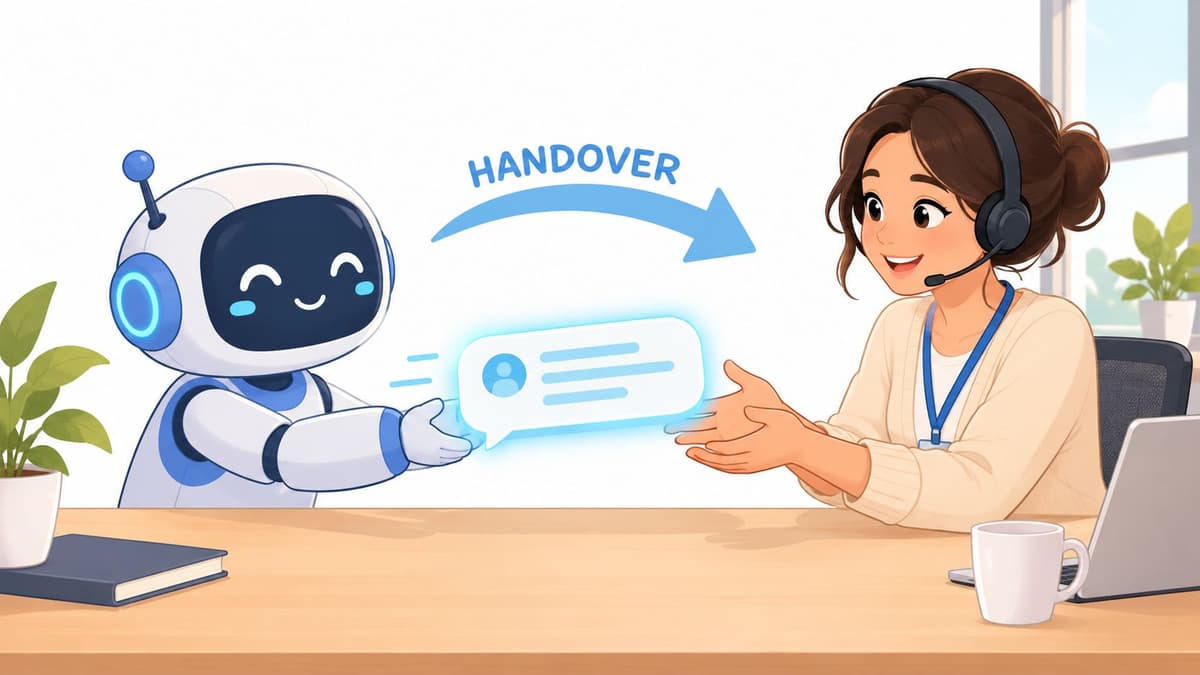
Transfer the work already done
Give the receiving agent a concise summary containing the visitor's stated problem, checks completed, relevant evidence and the reason for escalation. Clearly distinguish customer-provided statements from verified account information.
Show the visitor what happens next. Specify whether they're entering a live queue, submitting a ticket or requesting a callback, and explain availability clearly. Don't imply someone is joining the conversation when no agent is staffed.
Keep a human-contact option visible throughout the interaction. It shouldn't disappear behind an unsuccessful answer or require the visitor to guess a special phrase.
Escalation principle: The customer shouldn't have to fail at using the bot before they're allowed to contact a person.
For regulated or emotionally sensitive services, have the relevant service owner approve the escalation categories and customer-facing wording. The bot's tone matters, but the destination, context and ownership of the handover matter more.
Data Handling, Privacy and Trust for UK Deployments
Don't connect the chatbot to your entire customer database because the integration makes it easy. Begin with the minimum information required for the supported task.
The ICO's AI and data-protection guidance calls for a risk-based approach, proportionate controls, documented movements and storage of personal data, and processing limited to what the purpose requires. It also addresses lawful bases under UK GDPR Article 6 and additional conditions where special-category data is processed.
Turn those requirements into delivery decisions before sending production information to a model.
Map the processing, then approve it
Document where information enters the system, which suppliers receive it, where it's stored and how it's deleted. Identify controller and processor roles, and record a lawful basis for each distinct purpose rather than assuming the website's existing privacy notice covers everything.
Complete a Data Protection Impact Assessment before launch as part of your delivery process, and revisit the assessment when capabilities or data uses change. Have your privacy lead determine the applicable legal requirements, including whether proposed automated decisions need additional safeguards.
Use this checklist as a working prompt, not a substitute for the full assessment.
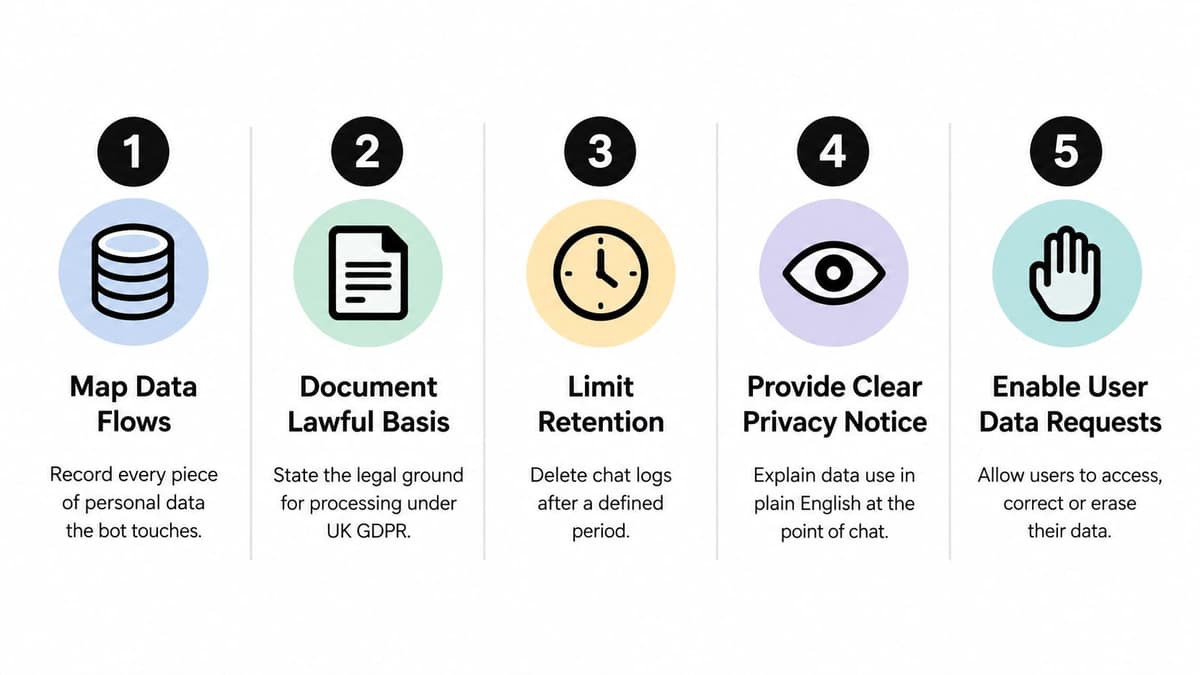
- Minimise model inputs: Remove unnecessary names, payment details, authentication secrets, health information and irrelevant free text before inference.
- Separate records: Keep identifiable conversation logs distinct from aggregate analytics, with purpose-specific retention and deletion rules.
- Restrict access: Use role-based permissions and encryption in transit and at rest. Review supplier access alongside employee access.
- Test hostile inputs: Include prompt-injection, data-exfiltration and cross-session leakage scenarios.
- Control secondary use: Don't enable transcript reuse for training without assessing the purpose, lawful basis and supplier terms.
Make personalisation earn its data
UK consumer research on chatbot personalisation and trust from Q3 2025 found 36% were uncomfortable with information being used for personalisation, 40% trusted companies to use their data responsibly and 39% considered the benefits worth the privacy trade-off; 44% would share more if collection was explained, while 47% wanted greater control over use.
My recommendation is to make anonymous help the default. Require authentication for account-specific tasks, and explain why additional information is needed at the point of collection.
Consent isn't a universal legal shortcut. Where you rely on it, provide a genuine choice and workable withdrawal route; otherwise, clearly explain the applicable processing arrangements.
Offer practical access, correction, deletion and opt-out routes where applicable. Less personalisation is often the better product decision when the additional information doesn't materially help resolve the request.
Why a Hybrid Bot-and-Human Model Wins in the UK
Choose hybrid support deliberately. It gives the bot a bounded role while keeping judgement and exceptions with accountable staff.
The earlier UK audit and consumer findings make this a defensible starting point, but they don't prove it will outperform every alternative in your business. You still need to compare operating models against your own journeys and staffing arrangements.
The visual below frames that comparison. Treat its ratings as directional considerations, not measured promises about your deployment.
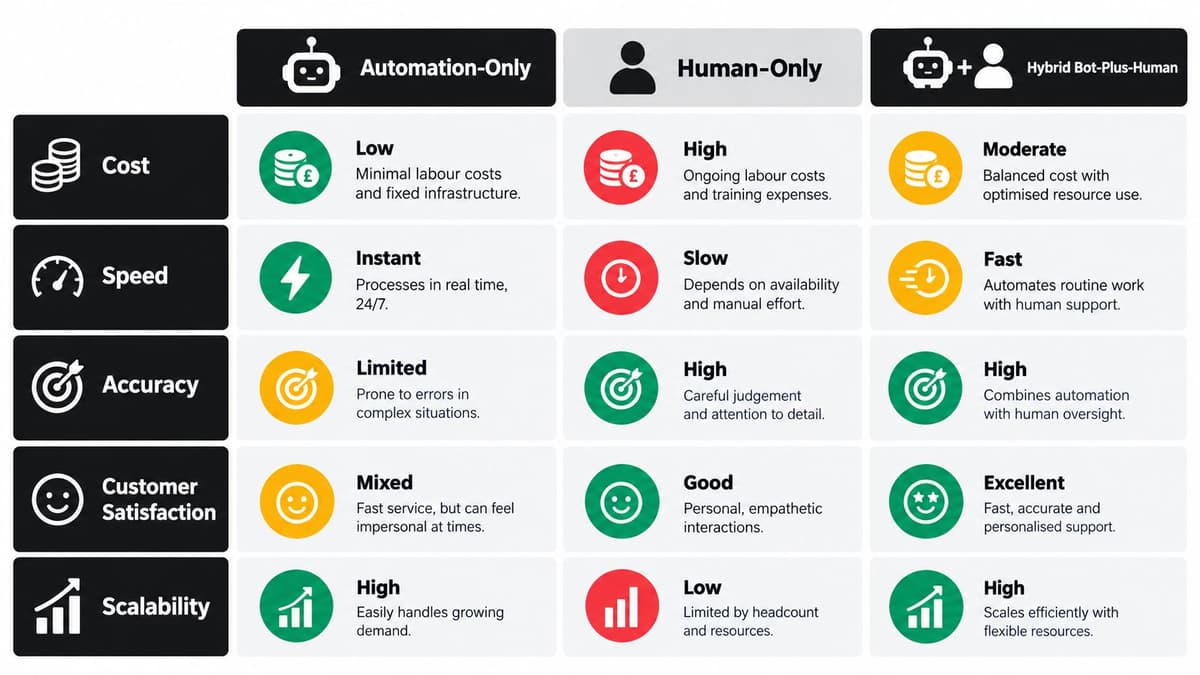
Compare the operating commitments
| Model | Appropriate use | Commitment you must fund |
|---|---|---|
| Automation-only | Bounded, low-risk assistance with a separate route for unsupported requests | Content maintenance, failure review and reliable integrations |
| Human-only | Bespoke, sensitive or judgement-heavy enquiries | Staffing, queue management and consistent service guidance |
| Hybrid bot-and-human | Mixed enquiries needing both routine assistance and specialist judgement | Coordination between automation and staffed support |
Compare first-response time with resolution time rather than substituting one for the other. An immediate acknowledgement can coexist with an unresolved problem.
Review escalation rate alongside customer satisfaction and cost per resolved query. A transfer isn't automatically wasteful, and a conversation retained by the bot isn't automatically successful. Include agent review, content upkeep and follow-up work when evaluating cost.
Brief the support team as product owners
Agree who can change answers, suspend an intent and report an unsafe interaction. Give staff a process for converting recurring escalations into approved improvements without expanding the bot's authority.
Customer-facing copy should describe the actual service: routine assistance through AI, specialist support through the human channel. Don't promise lower prices unless your business has made that pricing decision.
Use the accompanying video as an additional discussion prompt when reviewing the proposed service experience.
The hybrid model wins my recommendation because it gives an SME room to automate carefully without designing its customer service around the assumption that every request is routine.
Measuring Chatbot Performance Without Fooling Yourself
Conversation volume is a usage measure, not a success measure. Establish the existing journey's baseline, then use a controlled pilot, phased release or A/B comparison to assess the chatbot-assisted alternative.
Define acceptance before rollout
Track containment, fallback, escalation, abandonment, unsupported answers and accessibility failures by relevant user segment. Count containment only when the supported task was completed, not merely when the visitor stopped typing.
Set acceptance criteria around resolved requests, service quality and safe operation. Review results with support, product and privacy stakeholders, including the work created by unresolved conversations.
Use the first 90 days as a review window
- Pilot carefully: Release approved intents to a limited audience and inspect failed journeys.
- Compare outcomes: Assess matched customer tasks with and without the bot, accounting for differences in request complexity.
- Investigate exits: Distinguish successful departures from abandonment and later contact through another channel.
- Act on findings: Correct sources, adjust permissions or disable unreliable capabilities before expanding scope.
Don't reward deflection that leaves customers stuck. Keep the chatbot only if it reduces avoidable work without weakening resolution quality, and maintain a rollback route when it doesn't.
Digital Souls Studios LTD designs and builds website chatbots, custom AI support agents and the integrations needed to triage customer requests, with delivery from specification through launch and ongoing support. Visit Digital Souls Studios LTD to discuss a scoped pilot, bringing your recurring support questions, current systems and requirements for human escalation.