2nd October 2026 · 19 min
Web Application Architecture for SaaS

Most advice about web application architecture for SaaS starts with the wrong question. It asks whether you should use microservices, serverless, headless delivery, or a particular cloud platform before asking who will operate the system when something breaks at an inconvenient time.
A startup doesn't experience architecture as a diagram. It experiences architecture through deployment failures, confusing alerts, slow incident response, security reviews, cloud bills, and the amount of specialist knowledge required to make a safe change. The right design is the one your team can ship quickly, understand clearly, secure properly, and evolve without turning every release into an operations exercise.
Table of Contents
- The Hidden Cost of Fashionable Architecture
- Core Components of Modern Web Applications
- Monolith Versus Microservices for SaaS Growth
- API Design and Data Integration Strategies
- Infrastructure and Performance Trade-offs
- Security and Observability as Structural Controls
- Choosing the Right Architecture for Your MVP
The Hidden Cost of Fashionable Architecture
Microservices and serverless platforms can be excellent tools. They can also create a support burden that an early-stage team can't carry. A system split into many independently deployed services needs service ownership, contract testing, centralised logging, distributed tracing, secrets management, deployment automation, failure handling, and a clear answer to the question, “Which team fixes this at two in the morning?”
That operational load arrives before product-market fit. A founder may believe the business is buying scalability, while the engineering team is buying more deployment units, more permissions, more network paths, more dashboards, and more opportunities for configuration drift. None of those costs appears in the first architecture diagram.
UK survey data captures the gap between fashionable architecture advice and delivery reality. 95% of respondents reported some operational difficulty connected to architectural issues, while 54% reported security and compliance issues, according to UK web development architecture research. The same source reports that 64% of UK respondents had implemented OpenTelemetry either fully or in part, which suggests that observability has moved from an optional enhancement to a practical requirement for distributed systems.
Complexity is a staffing decision
A microservice isn't just a piece of code. It's a long-term operational commitment. Someone must define its boundaries, own its runtime behaviour, manage its dependencies, test its integration points, and understand what happens when it becomes unavailable.
For an MVP, a modular monolith usually offers a better trade-off. Keep billing, accounts, permissions, reporting, and the core product in one deployable application, but separate them into clear modules with explicit interfaces. You get one release process and one primary runtime while preserving the boundaries that may support later extraction.
Practical rule: Choose the simplest architecture that preserves the decisions you know you'll need to make later.
That doesn't mean ignoring security or scalability. It means putting effort into the controls that protect the product's future rather than distributing code just to look modern. A modular monolith can use background workers, queues, caching, object storage, managed databases, and an API layer without becoming a tangled codebase.
Compliance magnifies weak decisions
Compliance pressure exposes architectural shortcuts quickly. If customer data is spread across loosely governed services, a subject access request becomes a search across databases, logs, queues, backups, and third-party systems. If permissions aren't modelled centrally, each service may interpret access differently. If deployment history and audit events aren't easy to retrieve, a routine review becomes an engineering investigation.
Founders should therefore evaluate an architecture against team capacity, data sensitivity, recovery expectations, and auditability, not against trend reports. A fashionable pattern that nobody can operate is not an advanced architecture. It's deferred risk.
Core Components of Modern Web Applications
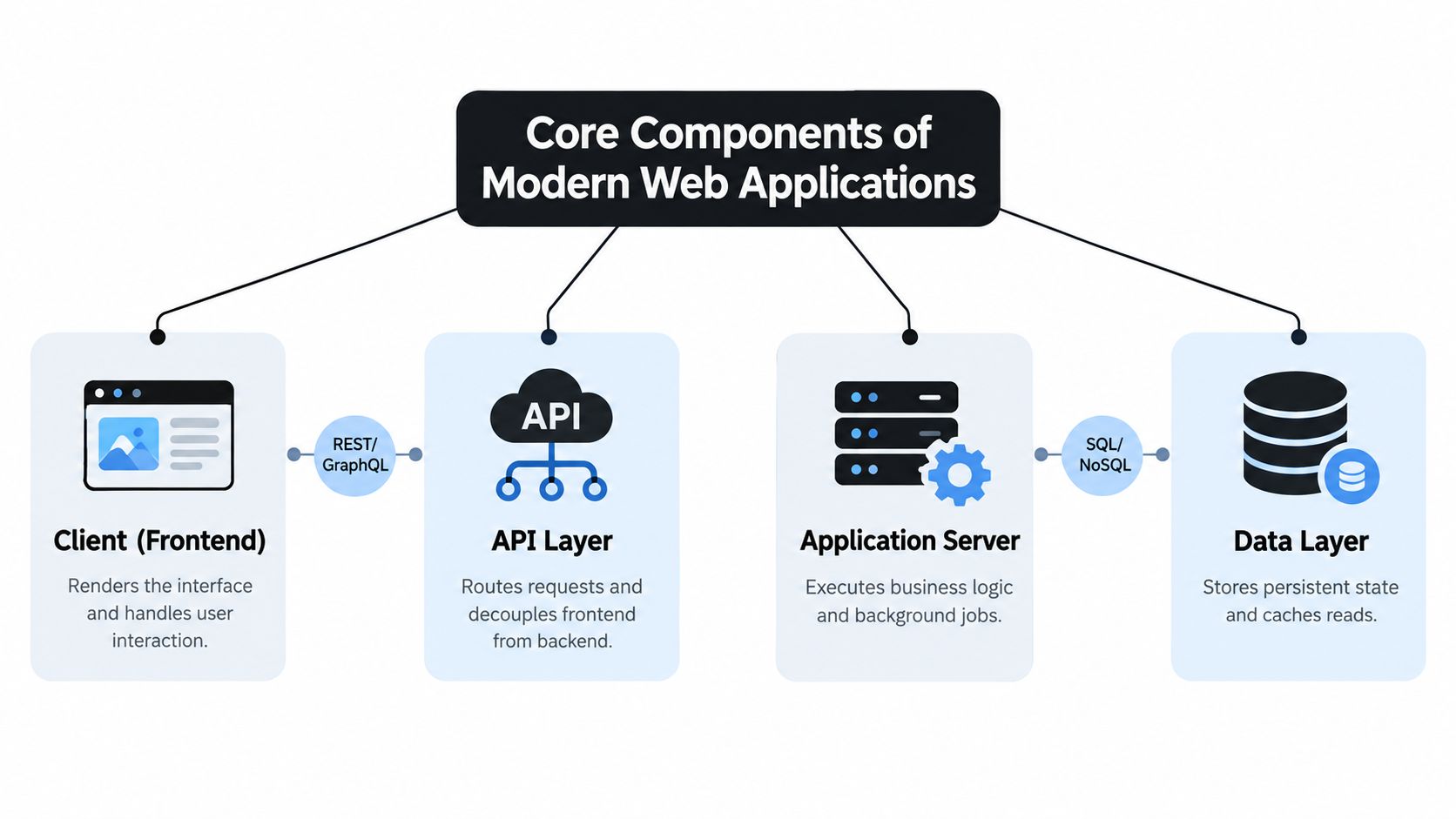
A useful mental model starts with a request from a customer. The browser is the front desk, the API is the reception process, the application server is the team doing the work, and the data layer is the organised record system behind the business.
The client presents the product
The client, usually a browser or mobile interface, renders screens and handles interaction. It manages local concerns such as form state, loading states, navigation, validation, and sometimes a local cache. Frameworks such as Next.js can render content on the server, in the browser, or through a combination of both.
The client shouldn't own business rules that must be trusted. A browser can improve the user experience by checking whether a form appears complete, but the server must still validate permissions, prices, subscription status, and data integrity. Treating client-side checks as security controls creates an obvious route around them.
The API controls the conversation
The API layer gives the client a stable way to ask for data or request an action. A REST API may expose resources such as users, projects, invoices, or documents. GraphQL can suit interfaces that need related data assembled according to the screen's requirements. WebSockets are appropriate when the server must push continuous updates, such as chat messages or collaborative editing events.
The API should translate between user-facing needs and internal application rules. It should authenticate requests, authorise actions, validate input, apply rate limits where necessary, and return consistent errors. A clear API boundary also lets a future mobile client use the same core capabilities without copying business logic into another application.
The application server makes decisions
The application server executes business logic. It decides whether a user can invite a colleague, whether an invoice can be issued, whether a workflow can advance, or whether a background task should be queued rather than handled during the request.
This layer is where domain modules earn their keep. A billing module can own billing rules, while an access module owns roles and permissions. They may live in the same repository and process, but their responsibilities remain distinct. Background workers can handle email, imports, document processing, notifications, and other work that doesn't need to delay the user's response.
The data layer preserves state
The data layer stores persistent state in systems such as PostgreSQL, a document database, object storage, or a cache such as Redis. Most SaaS products benefit from treating the relational database as the authoritative source for transactional business data, while using specialised stores for specific access patterns.
Caching reduces repeated work, but it introduces invalidation and consistency decisions. Cache only data that the team can safely rebuild or refresh. Store files in object storage rather than forcing a transactional database to serve large binary content. Keep audit events and operational logs distinguishable from the records that power the product itself.
A request typically travels through these components in sequence, but the architecture shouldn't force every request to perform every step. Static assets can be served from an edge cache, frequently read data can use a cache, and slow processing can move to a queue. The design is successful when each component has a clear responsibility and the team can trace a customer action from interface to outcome.
Monolith Versus Microservices for SaaS Growth
A monolith and a microservices platform can both support a serious SaaS product. The difference is not whether one is capable of scale. The difference is where complexity lives.
A monolith concentrates complexity inside one application and deployment unit. That makes local development, debugging, transactions, and release coordination easier, although a poorly organised monolith can become difficult to change. Microservices distribute complexity across runtime boundaries. That can improve independent scaling and team autonomy, but it also creates network failure, versioning, observability, and operational overhead.
For a small product team, a modular monolith is often the sensible starting point. It keeps the main workflow close together, simplifies database transactions, and lets engineers deliver product changes without coordinating a fleet of services. The team can still establish internal interfaces, publish domain events, and isolate modules so that extraction remains possible when a genuine need appears.
A practical comparison
| Feature | Modular Monolith | Microservices |
|---|---|---|
| Deployment | One primary application deployment | Multiple independently deployed services |
| Local development | Usually straightforward | Requires service orchestration and representative dependencies |
| Transactions | Easier across related business operations | Often requires sagas, events, or eventual consistency |
| Team autonomy | Strong module ownership within one codebase | Strong service ownership when teams are large enough |
| Failure behaviour | Fewer network boundaries, larger application blast radius | More isolated components, more distributed failure modes |
| Scaling | Scale the application, then separate hotspots | Scale services independently from the beginning |
| Observability | Simpler request tracing | Distributed tracing and correlation become essential |
| Cost profile | Lower platform and operational overhead | Higher baseline complexity, potentially more targeted resource use |
| Best fit | MVPs and early-stage SaaS products | Mature domains with clear ownership and independent workloads |
When extraction makes sense
Don't extract a service because a module has a fashionable name. Extract it when the separation solves a measurable organisational or operational problem.
Useful triggers include:
- Independent scaling: A workload such as media processing or search needs a different scaling profile from the core application.
- Failure containment: A non-critical feature must not exhaust the resources needed by customer transactions.
- Team ownership: A stable team can own the service from code through production support.
- Release independence: A domain changes often enough that coupling its releases to the main application slows delivery.
- Technology fit: A specialised workload benefits from a different runtime or storage model.
- Security isolation: Sensitive processing needs a distinct trust boundary and access policy.
The migration path should be incremental. Start by defining a module boundary, then expose an internal interface, move asynchronous work behind a queue, and measure the operational effect. Only then consider a separate deployable service.
A service boundary should remove a constraint, not create an impressive diagram.
Microservices become more attractive when the product has several mature domains, reliable deployment automation, centralised observability, and people who can own production operations. Without those foundations, the team may spend more time maintaining the architecture than improving the product.
API Design and Data Integration Strategies
An API is not merely a collection of endpoints. It is a contract between parts of the business that need to change at different speeds. Good API design makes those changes predictable. Weak design spreads assumptions about database tables, status values, permissions, and error handling throughout every client and integration.
The first decision is to identify the domain model behind the API. A subscription, workspace, invoice, report, or compliance record should have a clear owner and lifecycle. Avoid allowing every service to define its own interpretation of the same customer or account. That approach creates duplicated records and forces reporting teams to reconcile incompatible definitions later.
Contracts should be explicit
Define request and response schemas, authentication requirements, validation rules, error formats, pagination behaviour, and versioning expectations. OpenAPI can document REST interfaces and support generated clients, contract checks, and review workflows. GraphQL schemas can provide a typed contract when clients need flexible access to related data. gRPC and Protocol Buffers can suit internal, performance-sensitive communication where the team accepts tighter coupling.
The protocol matters less than the discipline. An API that returns inconsistent shapes or changes the meaning of a field without warning will cause more damage than an API using a less fashionable technology.
Design the contract around a business capability, not around whatever tables happen to exist today.
The UK government's digital service research points to the scale of the integration problem. Only 27% of respondents said their current data infrastructure provides a complete view of operations or transactions, while 70% said their data environment isn't well coordinated, interoperable, or able to provide a unified source of truth, according to the State of Digital Government Review. Those findings support treating shared domain models and explicit data contracts as structural controls rather than documentation tasks.
Events reduce unnecessary coupling
Synchronous APIs are appropriate when the caller needs an immediate answer. Use events when another process needs to know that something happened but doesn't need to block the original request. A SubscriptionActivated event might trigger provisioning, an email, a reporting update, and an internal notification without forcing the checkout request to wait for every downstream action.
Events need governance. Define event ownership, payload versions, delivery guarantees, retry behaviour, idempotency, and dead-letter handling. Don't use a queue to hide unclear business logic. If the team can't explain what happens when an event arrives twice or arrives late, the integration isn't ready.
A shared reporting model can combine operational data without giving every reporting query direct access to every service database. This matters for audit trails, customer support, finance, and compliance workflows. Teams planning AI features should also consider how clean contracts and reliable events support automation, as described in AI and automation for SaaS.
Infrastructure and Performance Trade-offs
The UK audience is close to universally connected. By October 2025, the United Kingdom had an estimated 68.1 million internet users, representing 97.8% of the population, with the total rising by 396,000 people in one year, according to Digital 2026 United Kingdom data. The same source reports median fixed-line download speeds of 143.83 Mbps and median mobile speeds of 68.55 Mbps.
Those figures support richer interfaces, but they don't remove the need for careful performance engineering. A median is not a guarantee for every user, and a fast connection doesn't fix a large JavaScript bundle, a slow API, an inefficient query, or a page that waits for too many sequential requests.
Design for the slow path
Server-side rendering can deliver useful content before the browser downloads the full application. Client-side rendering can create smooth, app-like interactions after the initial load. Most SaaS products need a deliberate mix rather than an ideological choice.
Use edge caching for content that can safely be shared. Keep authenticated responses private and explicit. Compress assets, split bundles by route, optimise images, and avoid loading an analytics library or feature module before the user needs it. A responsive interface should also expose progress and failure states, because a technically fast service can still feel broken if it gives no feedback during an operation.
Choose infrastructure by workload
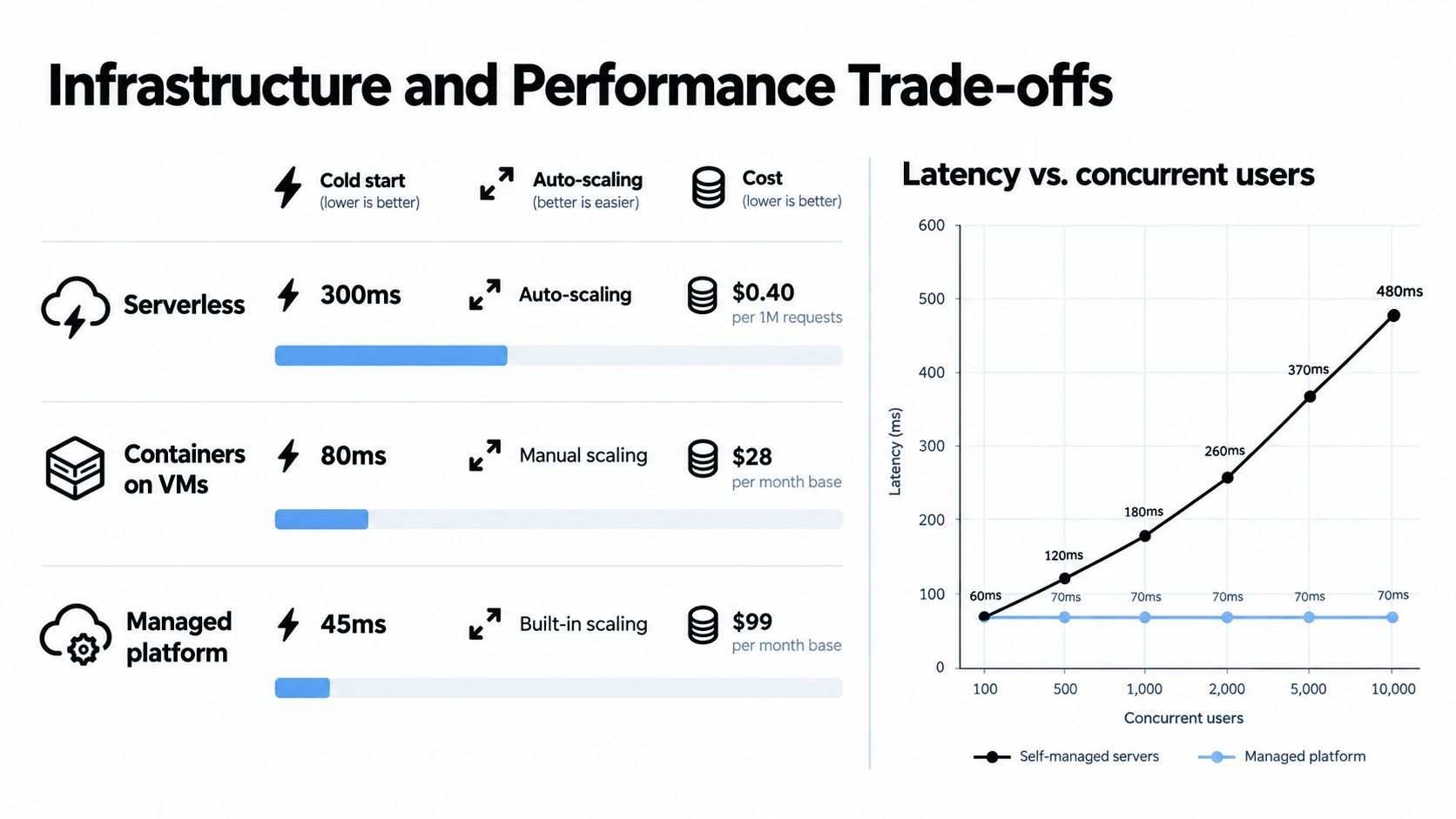
Serverless functions are attractive for bursty tasks and small event handlers, but teams must understand execution limits, cold-start behaviour, vendor-specific services, and debugging across short-lived invocations. Containers offer more control and predictable runtime behaviour, but someone must manage images, patching, orchestration, scaling, and capacity. Managed application platforms reduce infrastructure work, although they may impose platform constraints and become expensive when workloads or vendor dependencies grow.
A sensible early architecture often combines a managed relational database, a managed application runtime, object storage, a CDN, and a queue. That arrangement removes routine infrastructure tasks while preserving clear escape routes. Kubernetes can be appropriate for teams with a real need for orchestration and the skills to operate it, but it shouldn't be the default hosting decision for an MVP.
Performance work should begin with user journeys. Measure time to useful content, API latency, database query duration, queue delay, and error rates. Then improve the slowest meaningful path. Optimising infrastructure in the abstract often produces a technically interesting system without making the product faster for customers.
Security and Observability as Structural Controls
Security isn't a final review before launch. It shapes the trust boundaries, data flows, permissions, dependencies, and operational procedures that the team will live with after launch.
Start with secure defaults. Enforce authentication and authorisation on the server, keep least-privilege permissions, encrypt data in transit and at rest, validate input, protect secrets, and maintain an inventory of dependencies. Threat modelling should focus on real abuse paths, such as account takeover, insecure file access, privilege escalation, data leakage through logs, and compromised third-party packages.
The UK's Software Security Code of Practice sets out 14 principles for software vendors, while Home Office engineering guidance emphasises secure defaults, threat modelling, least privilege, encryption, and supply-chain risk management, as reflected in UK secure engineering guidance. These requirements affect architecture directly. A system that's difficult to audit or isolate will demand more work during procurement, certification, and incident response.
Observability belongs in the request path
Logs alone rarely explain a distributed failure. Instrument requests, database calls, queue operations, external API calls, and background jobs with consistent correlation identifiers. OpenTelemetry can provide a common approach to traces, metrics, and logs, but the tooling is only useful when the team defines what to measure and who responds to the signal.
A useful baseline includes:
- Request traces: Follow a customer action across the client, API, application, database, and worker.
- Business metrics: Track events such as successful sign-ins, completed payments, failed imports, and delayed jobs.
- Structured logs: Record searchable fields without placing secrets or unnecessary personal data in log output.
- Actionable alerts: Alert on customer impact and service degradation, not every unusual line in a log file.
- Runbooks: Document the first checks, rollback path, escalation route, and communication responsibilities.
Observability also supports analytics and operational reporting. Teams building data products can connect these foundations to AI, data analytics, and business intelligence workflows, provided they separate operational telemetry from sensitive customer records and apply appropriate retention controls.
Resilience limits the blast radius
UK cyber guidance for essential services recommends designs that continue operating during failure or compromise, with diverse technologies, geographic locations, and multi-region or multi-datacentre hosting to reduce outage risk, as described in guidance on resilient networks and systems.
An MVP may not need active-active deployment across regions. It should still identify its single points of failure. Externalise state where practical, make application instances replaceable, back up critical data, test restoration, and define what the product does when a dependency is unavailable. Resilience is a business decision about acceptable interruption, data loss, and recovery effort. Architecture makes those decisions possible to execute.
Choosing the Right Architecture for Your MVP
Founders do not need to predict the product's final shape. They need an architecture the team can explain today and change without creating a support burden tomorrow. Fashionable patterns often hide costs in deployment, monitoring, incident response, compliance reviews, and specialist skills. Those costs matter more to a small UK startup than the theoretical scalability of an architecture it cannot operate confidently.
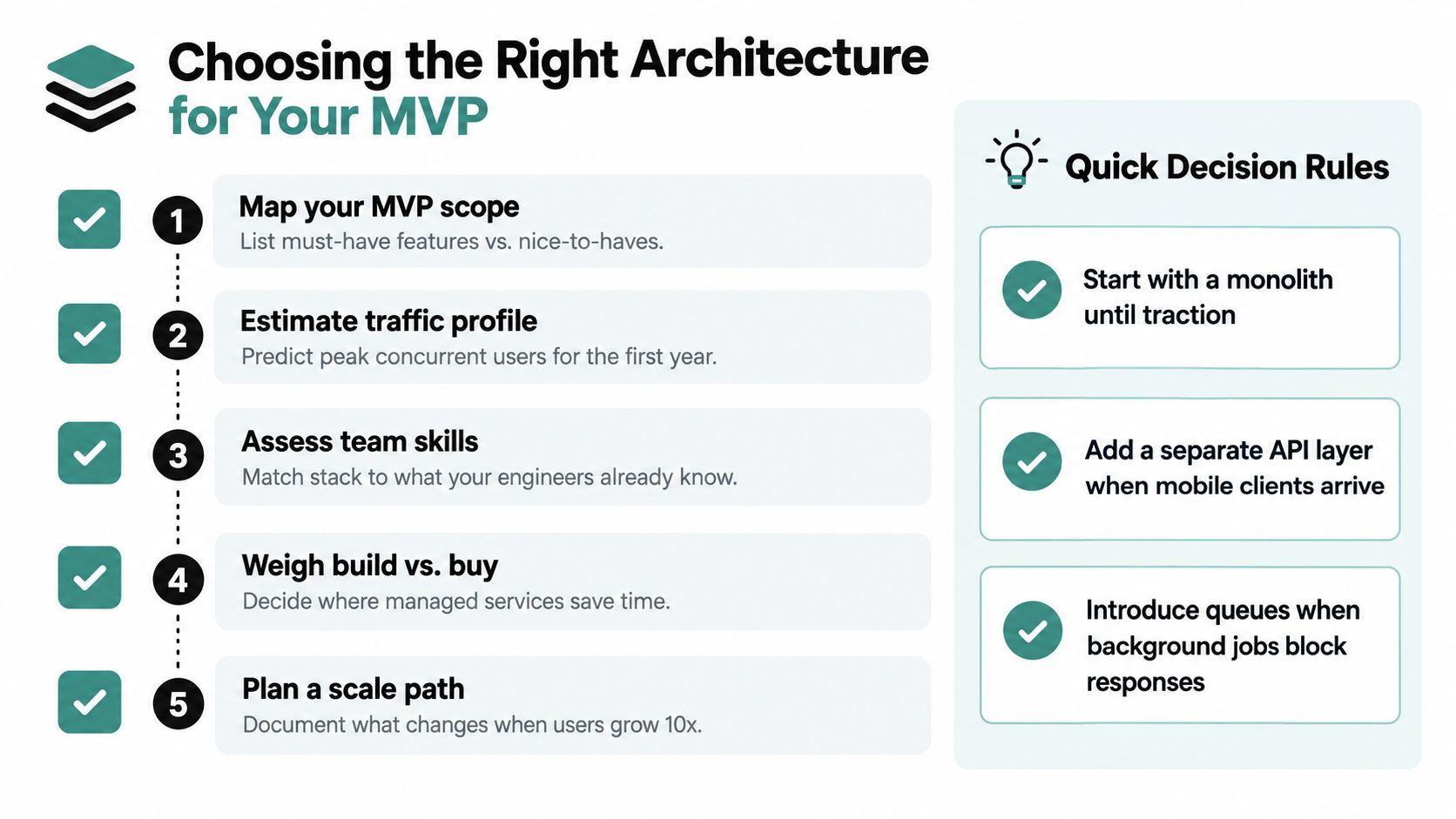
Start with the product boundary. List the workflows the MVP must support, the data each workflow creates, the permissions involved, and the actions that can run asynchronously. This keeps the team from buying infrastructure for hypothetical features while missing the controls required by the features that will launch.
Match the design to the team
A practical decision matrix looks like this:
| Situation | Sensible starting point | Why |
|---|---|---|
| Small team validating a focused SaaS idea | Modular monolith with a managed database | Fast delivery, simple debugging, clear ownership |
| Product with mobile and web clients | Modular monolith behind a documented API | Shared business logic and a stable client boundary |
| Heavy imports, notifications, or document processing | Core application plus workers and a queue | Keeps slow jobs out of user-facing requests |
| Sensitive data or regulated workflows | Modular application with explicit audit events and access controls | Makes review, investigation, and reporting manageable |
| Several mature domains with independent teams | Carefully selected services around proven boundaries | Supports ownership and targeted scaling |
| Real-time collaboration or live updates | Standard API plus a focused real-time component | Limits stateful complexity to the feature that needs it |
Use managed services when they remove routine operational work, but document the exit path before committing. A managed database can work well if the team understands backups, restoration, access controls, monitoring, and data export. A platform that hides runtime behaviour can become difficult to troubleshoot during an incident, while its logs, access records, and retention settings may still need review for compliance.
Build the scale path before you need it
Write down the conditions that justify architectural change. A separate worker may be needed when background jobs delay customer responses. A dedicated search system may be justified when database queries no longer provide an acceptable experience. Service extraction may make sense when a domain has independent ownership, different scaling requirements, or a distinct security boundary.
Do not write “scale when traffic grows” as the plan. Record the observable symptom, likely constraint, proposed change, migration risk, and owner. This turns architecture from a prediction exercise into an operating plan.
The same discipline applies to costs and carbon. Cloud-first is not automatically efficient, and serverless is not automatically cheap. Reduce unnecessary compute, set sensible data retention, avoid duplicating large datasets, and review idle resources. Lower operational waste can improve both margin and environmental performance.
A delivery partner such as Digital Souls Studios LTD can support specification, web application and SaaS engineering, API development, cloud integration, security implementation, performance work, and post-launch maintenance when a startup lacks those disciplines internally. The team still needs to understand how the system works, how it fails, and how changes will be made.
The following walkthrough shows how a modular monolith can be decomposed in practice:
Review the architecture after real users expose its assumptions. Keep choices that make delivery safer, remove ceremony that adds no protection, and extract components only when evidence shows that separation will improve the product or the team's ability to operate it. This approach is less fashionable than starting with a distributed platform, but it gives an MVP a stronger chance of becoming a durable SaaS business. The EveryTalk AI case study offers a product-focused delivery example.
If you are planning a SaaS MVP or simplifying an existing web platform, Digital Souls Studios LTD can help with architecture, product engineering, APIs, infrastructure, security, performance, and ongoing support. Share the product scope and operational constraints with the studio to define a delivery plan that moves quickly without leaving the team with an unmanageable system.