2nd November 2026 · 15 min
App Development Cost in 2026: UK Ranges and Budget Guide

A simple app starts near £10,000, a lean UK MVP typically costs £40,000 to £90,000, a mid-market product £90,000 to £220,000, and a complex or compliance-heavy app £220,000 to £600,000 or more. Those are build ranges, not the full cost of owning and running the product.
The upper band is a reminder that “an app” isn't one standard purchase. The right estimate depends on what you're building, which risks need solving before launch, and what you'll need to keep the product secure and usable afterwards.
Table of Contents
- UK App Development Cost Ranges by Project Type
- Cost Drivers That Move Your Quote
- Labour Costs Behind Your App Quote
- How to Build a Defensible Budget Range
- Pricing Models and When Each Fits
- Running Costs After Launch
- Choose Your Build Approach Before You Request Quotes
UK App Development Cost Ranges by Project Type
A simple single-platform app can start near £10,000, while a UK product with real users, integrations or compliance requirements can cost much more. Recent UK guidance places a lean MVP at £40,000 to £90,000, a mid-market product at £90,000 to £220,000, and a complex or compliance-heavy app at £220,000 to £600,000 or more, according to Emerline's UK app development cost guide.
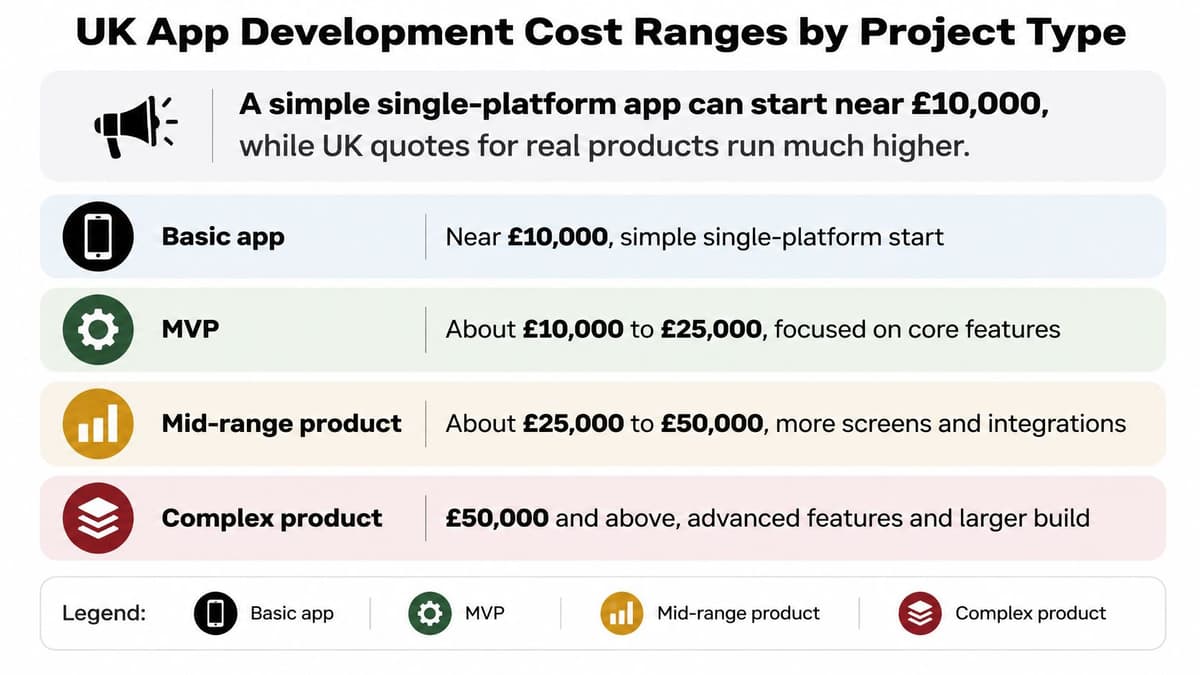
| Project type | Typical scope | Typical UK build cost | Excluded by default |
|---|---|---|---|
| Simple single-platform app | Basic screens, no integrations, light design | From about £10,000 | Hosting, maintenance, legal review |
| Lean MVP | Core features on one platform, limited integrations | £40,000–£90,000 | Post-launch support, scaling |
| Mid-market product | Accounts, payments, several integrations, cross-platform | £90,000–£220,000 | Marketing, large user growth |
| Complex or compliance-heavy app | Regulated or sensitive data, many integrations, high security demands | £220,000–£600,000 or more | Ongoing compliance audits, enterprise support |
A basic app in the first band might present information, collect simple form submissions or perform one limited task. The price assumes a restrained feature set and doesn't mean every production detail is covered. Get the proposal to specify whether discovery, design, testing and release preparation are included, rather than assuming “build” covers everything.
A lean MVP usually adds a working core journey, such as user accounts and a key product feature, without trying to serve every audience or workflow at launch. At the mid-market level, payments, several integrations and support for more than one platform can create more coordination and testing work. The complex band is for products where security, sensitive information, complex connections or compliance obligations materially affect architecture and delivery.
The overall range is more than fifteen-fold, so comparing the cheapest quote with the most expensive one tells you little unless the scope matches. Build estimates commonly cover work such as discovery, design, implementation, testing and launch, but hosting, maintenance, legal review and marketing should be treated as separate budget lines unless the quote explicitly includes them. Find the band closest to your feature list, then assess which factors could push your own estimate higher or lower.
Cost Drivers That Move Your Quote
The biggest cost decision is usually what the first release must do. Each feature requires a combination of specification, design, engineering, and testing. A login, user profiles, and an admin area involve distinct work; a landing page does not require those systems. Cutting features that don't test your core idea can reduce scope, but removing essential foundations can delay engineering until after launch.
Platform choices affect how the product is built and tested. Separate native iOS and Android applications involve separate implementation work, while a cross-platform approach shares much of the code. The best fit depends on device capabilities, performance needs and the product's users, so compare the delivery approach and trade-offs rather than assuming one option is always cheaper.
External connections add work that feature lists often hide. A payment gateway, CRM or ERP link can require API implementation, data mapping, testing and handling for errors or service outages. Before accepting a quote, name each system the app must communicate with and clarify whether vendor charges are included.
A 2025 European market study of UK app development costs put typical costs at around £10,000 to more than £150,000, with variation linked to complexity, platform, design, features, integrations and development-team location. That range is more than fifteen-fold. It's why an MVP and an enterprise platform shouldn't be compared against a single “average app” price.
| Cost driver | How it changes the price | Example |
|---|---|---|
| Feature scope | Each feature adds design, build and test work | Login and profiles require more work than a landing page |
| Platforms | Separate native builds require separate platform work; cross-platform shares code | Two native apps cost more than one cross-platform build |
| Integrations | Each external system adds API work, testing and failure handling | Payment gateway, CRM or ERP link |
| Compliance and security | Data protection, audits and penetration testing add work | App handling health or financial data |
| AI features | Model integration, data pipelines and usage fees add costs | Custom AI support agent costs £3,000 once, plus third-party subscriptions and usage |
| Design depth | Bespoke UX research and interface work take more time | Template interface versus custom design system |
| Team location | Rates vary by location and seniority | UK-based team versus offshore team |
For AI, separate the initial build from ongoing usage. Our custom AI support agent costs £3,000, paid once, while the client pays separately for third-party agent subscriptions and usage. That distinction matters when estimating the cost of a feature that relies on external services.
Before you trim the budget, rank your project's main drivers: feature scope, platforms, integrations, security, AI and design. Then decide which non-essential feature or platform you could defer without weakening the product's core purpose.
Labour Costs Behind Your App Quote
An app budget pays for a mix of people, not just coding hours. Totaljobs' 2025 UK salary analysis reports median annual salary ranges of £42,900 to £48,900 for software developers, £52,100 to £58,400 for software engineers, and £53,600 to £58,500 for data engineers. Work involving architecture, APIs and data infrastructure may need more specialised engineering than a presentation-focused build.
| Role benchmark | UK median annual salary range |
|---|---|
| Software developers | £42,900–£48,900 |
| Software engineers | £52,100–£58,400 |
| Data engineers | £53,600–£58,500 |
A separate compilation citing Office for National Statistics data gives a median gross annual salary of £56,914 for full-time programmers and software-development professionals. At that salary, two developer-years represent £113,828 in gross pay, before employer National Insurance, pensions, equipment, management, design, quality assurance, hosting, licences and commercial overheads are added. The same compilation reports a median hourly rate of £29.29 for the occupational group, based on a separate jobs measure. These benchmarks are useful for understanding the labour beneath a quote, but they aren't an agency's selling rate or a full project budget. See the ONS salary figures and supporting analysis.
Consider a five-person team with three developers, one senior engineer and one product or design lead. The team's underlying employment cost will exceed that of a group made up entirely of generalist developers, because senior technical decisions and product work are part of delivery too. An agency estimate must also allow for discovery, coordination, quality assurance, infrastructure and time spent on work that isn't billed as uninterrupted coding.
Quote check: Ask for the estimated roles and days behind each phase. You should be able to trace a line item to a kind of work, such as API engineering or design, and the time allocated to it.
This breakdown also helps you spot a mismatch. If the product includes sensitive data or complex integrations but the estimate allocates no specialist engineering or security work, ask how those requirements will be handled before signing.
How to Build a Defensible Budget Range
A good app estimate is a range with stated assumptions, not a single confident number. The UK Government's cost-estimating guidance recommends an anticipated final cost alongside a range reflecting risk and uncertainty. Use these six steps to make that range useful:
Write a one-page scope. List the must-have features, platforms and external systems the app needs to connect to. This gives providers something concrete to estimate. Avoid: treating a feature count or one-sentence idea as a complete scope.
Split the estimate into phases. Show discovery, UX, implementation, quality assurance, infrastructure, launch and post-launch support separately, with an assumption for each. You can then identify what a quote includes and what remains unpriced. Avoid: leaving assumptions unwritten.
Isolate high-risk components. Flag subscription billing, identity, third-party APIs, data migration, AI model inference and regulated reporting. These may need investigation before anyone can estimate the build reliably. Avoid: spreading senior engineering time evenly across low-risk screens.
Price three release scenarios. Compare a prototype for testing an idea, a market-test MVP for paying users and a production-ready release. Show what it would take to upgrade each version to the next. Avoid: treating a prototype quote and a production quote as competing prices for the same product.
Reserve contingency for named risks. An API with unknown rate limits, for example, may need investigation or additional failure handling. Connect any allowance to the risk it covers. Avoid: adding an unexplained lump sum.
Set change-control triggers. Agree how a new integration, changed regulatory requirement, added device support or higher traffic or AI usage affects price and schedule. Avoid: absorbing changes informally until the budget no longer reflects the agreed scope.
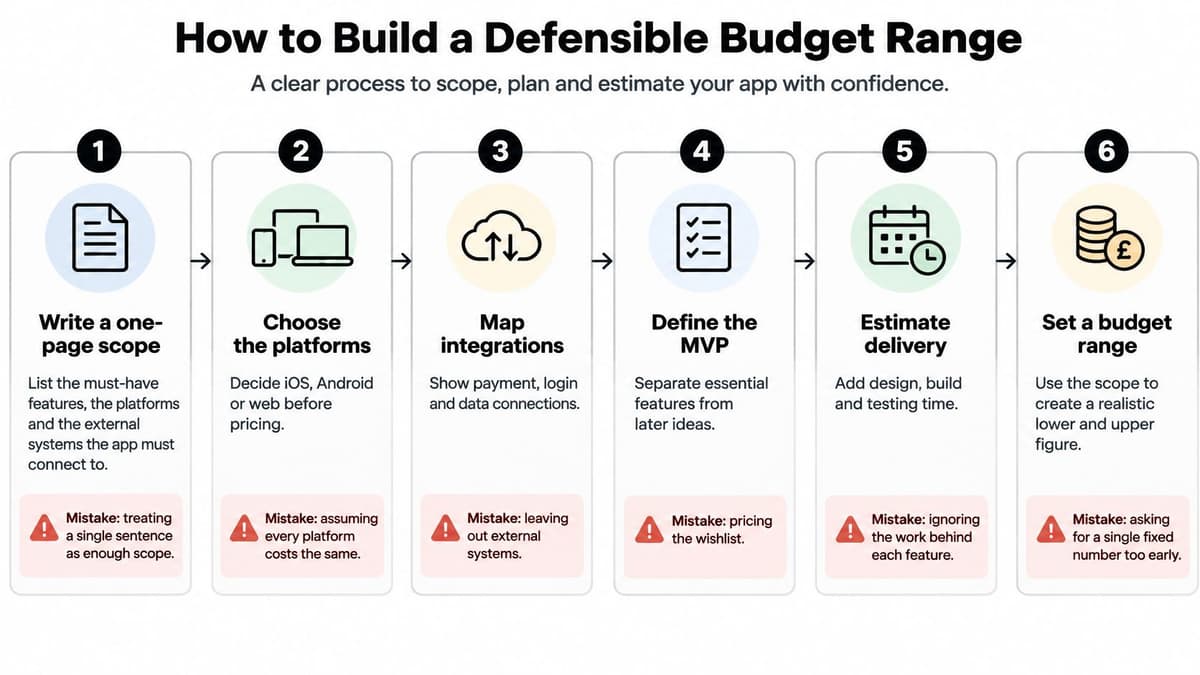
This approach helps because uncertainty can accumulate across requirements, architecture, external APIs, data migration, security, testing and deployment. A fixed-price discovery phase followed by a prioritised MVP backlog and staged delivery can make those unknowns visible before the main build begins. At Digital Souls Studios, our project process moves through Specification, Production, Launch and Support, so the work and decisions can be organised around clear stages. If you're still shaping the first release, our guide to building a minimum viable product can help you distinguish essential work from features that can wait.
Watch the cost-estimating walkthrough before you put your scenarios in front of providers.
A defensible estimate leaves a paper trail: each cost line connects to a named piece of work, an assumption or a risk. If a proposal can't explain what its upper and lower figures include, it isn't yet a useful basis for a funding decision.
Pricing Models and When Each Fits
The pricing model determines who carries the risk when requirements change. A fixed-price project gives you one agreed price for a defined scope, but changes after agreement can require a re-quote. Time and materials charges for hours or days worked, which can suit a product whose requirements are still being tested, but you'll need a budget cap and regular reviews to control spend.
| Pricing model | How you pay | Best when | Main risk |
|---|---|---|---|
| Fixed-price project | One agreed price for a defined scope | Scope is stable after discovery | Changes trigger costly re-quotes |
| Time and materials | Billed by hours or days worked | Scope is still uncertain | Budget can overrun without caps |
| Dedicated team | Monthly fee for a team working on your product | Long roadmap with ongoing changes | Needs strong internal product management |
| Retainer or managed service | Monthly fee covering build, support and changes | Continuous improvement after launch | Fee moves with requirements |
A dedicated team suits a continuing roadmap when you need people focused on the product over time. It also requires someone on your side to set priorities and make timely decisions. A retainer or managed service is a monthly arrangement for ongoing delivery and support; the work covered, and therefore the fee, changes with requirements. Our all-in-one retainer costs £1,000 to £15,000 a month, depending on requirements. It includes maintenance, research, A/B experiments, marketing material, documentation, servers, deployments, meetings, customer support, design and consultation.
Match the model to how certain the scope is: use fixed price after discovery has made the deliverables clear, time and materials while important requirements remain open, and a team or retainer when the product has an ongoing roadmap. Our automated development team package costs £5,000, paid once, and sets up infrastructure so a client can run an AI-agent development team.
Before choosing, list what the commercial offer bills separately. Hosting, third-party subscriptions, app-store fees and usage-based AI charges can sit outside the development arrangement. A clear payment model won't protect you from an incomplete scope, so make sure the contract explains what triggers a change and how additional work is approved.
Running Costs After Launch
A build quote covers the work up to release day. The years after launch carry their own budget, and that budget often decides whether the product survives. Maintenance covers bug fixes and operating-system updates, but a live product can also need security assurance, hosting, monitoring, incident response, legal review, accessibility testing and continuing compliance. A UK Government survey of app developers found reported annual penetration-testing costs ranging from £3 to £300,000, while respondents aware of the App Store security and privacy code estimated £500 to £5,000 for familiarisation and legal work and £1,500 to £10,000 for scoping and development.
| Cost line | Typical figure or basis | What to plan for |
|---|---|---|
| Penetration testing | £3 to £300,000 a year across survey respondents | Security assurance scaled to the data the app holds |
| Hosting and infrastructure | Separate line that scales with traffic and storage | Usage-based scenarios over three years |
| App-store security and privacy work | £500 to £5,000 for familiarisation and legal work | Legal review before launch and major updates |
| Scoping and development changes | £1,500 to £10,000 | Updates after operating-system or policy changes |
| Accessibility testing and fixes | Separate line, priced per audit and remediation round | WCAG 2.2 AA audit, fixes and retesting |
Read those survey figures as directional rather than a price list. A spread from £3 to £300,000 tells you security spend tracks what the product handles: an app processing payments or health data sits in a different world from a content tool. A low build figure says nothing about which world yours is in.
Accessibility needs its own reserve. Auditing against WCAG 2.2 AA, fixing what the audit finds and retesting after each release all take real budget, and an app that ships without an audit carries hidden debt into every later update. Schedule accessibility work alongside major releases the same way you schedule security testing.
Build a three-year total-cost-of-ownership view with separate lines for hosting, support, security, accessibility and compliance. Model hosting on usage scenarios rather than assuming launch-day traffic holds, since growth, seasonal spikes and new integrations all move the bill. Our support packages cover maintenance after launch alongside a scoped project, and our all-in-one retainer can also cover items such as servers, deployments, customer support and design. For how delivery runs once planning ends, see the stages of software development.
One question disciplines every quote: which running costs are included, and for how long?
Choose Your Build Approach Before You Request Quotes
Choose the smallest release that can answer your business question without postponing essential engineering. A lean MVP suits a founder testing demand with a limited budget and a narrow feature set. That's a sound choice only if the release still handles the authentication, payments, data protection and accessibility that real users need.
A production-ready first release makes more sense when the app takes payments, stores personal or regulated data, or needs to satisfy enterprise buyers. In those cases, a cheap prototype may prove the interface but leave the foundations to rebuild. A full product suits a business with demonstrated demand and a longer roadmap, where a dedicated team or retainer can support ongoing changes.
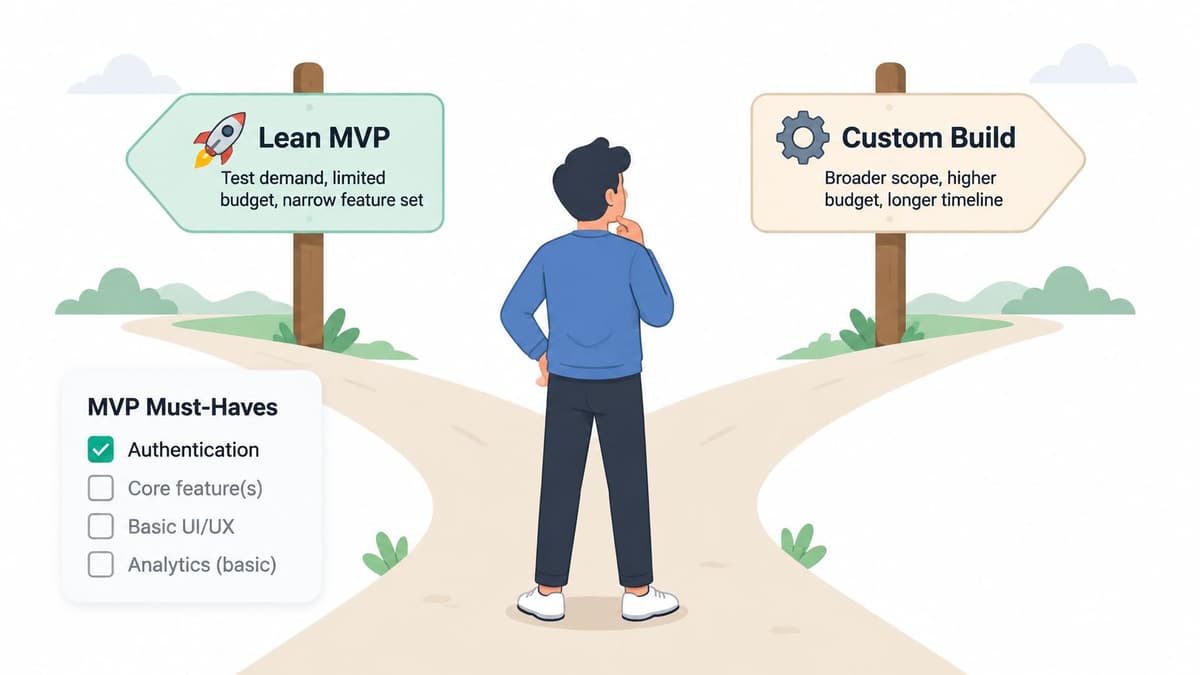
Make the choice against five practical criteria:
- Goal: Are you validating demand, or scaling a product people already use?
- Budget ceiling: Can you fund a production-ready release, including its ongoing obligations?
- Timeline: Which features must be ready at launch, and which can follow?
- Risk exposure: Does the app handle payments, sensitive information or regulated reporting?
- Change rate: Will the product need frequent experiments and updates, or is the scope relatively stable?
Platform choice should be part of that decision. A cross-platform application approach can support delivery across iOS and Android with shared code, while the right implementation still depends on device needs and product requirements. Whatever you choose, make the release assumptions explicit before you compare supplier prices.
This week, write a one-page scope, request three quotes for a prototype, market-test MVP and production-ready release, and ask each provider which running costs are included. Compare the proposals by scope and assumptions, not by headline price, then decide on paper before your first development conversation.
Digital Souls Studios LTD designs and builds web applications, SaaS products and AI automation, with delivery spanning specification, production, launch and ongoing support. If you're planning an app and need a scope-led estimate that accounts for both the build and its running costs, talk to Digital Souls Studios LTD about your project.