28th November 2026 · 17 min
MVP vs Prototype: Costs, Goals and When to Use Each

Which one comes first, and which one costs more? Those are the two questions almost every team asks about MVP vs prototype, and neither is the one that decides whether the project works. The question that matters is simpler and less comfortable: what is the next thing you need to find out, and which of the two will tell you?
A prototype and an MVP answer different questions. One proves that people can follow a process. The other proves that real customers will use, pay for or come back to a working product. Treat them as competing sizes of the same deliverable and you'll buy the wrong one at the wrong moment.
Table of Contents
- MVP and Prototype Side by Side
- What a Prototype Is For
- What an MVP Must Prove With Real Customers
- Test Demand Before Committing to Either
- Cost, Time and Team for Each Route
- Which Route Fits Your Situation
- Common Mistakes When Mixing Them Up
- Pick Your Next Step Before You Brief a Supplier
MVP and Prototype Side by Side
A prototype is a model of the product, usually clickable screens or a paper-style mock-up, that lets people try a process before anything is built for live use. An MVP, or minimum viable product, is the smallest working version that a real customer can use to get the core job done, with live data and, where it applies, real payments.
Four situations run through the rest of this article: a support team reworking how it sorts tickets, an online shop launching a product line, a finance team automating invoice handling, and a founder with no technical team. None of them needs the same first step.
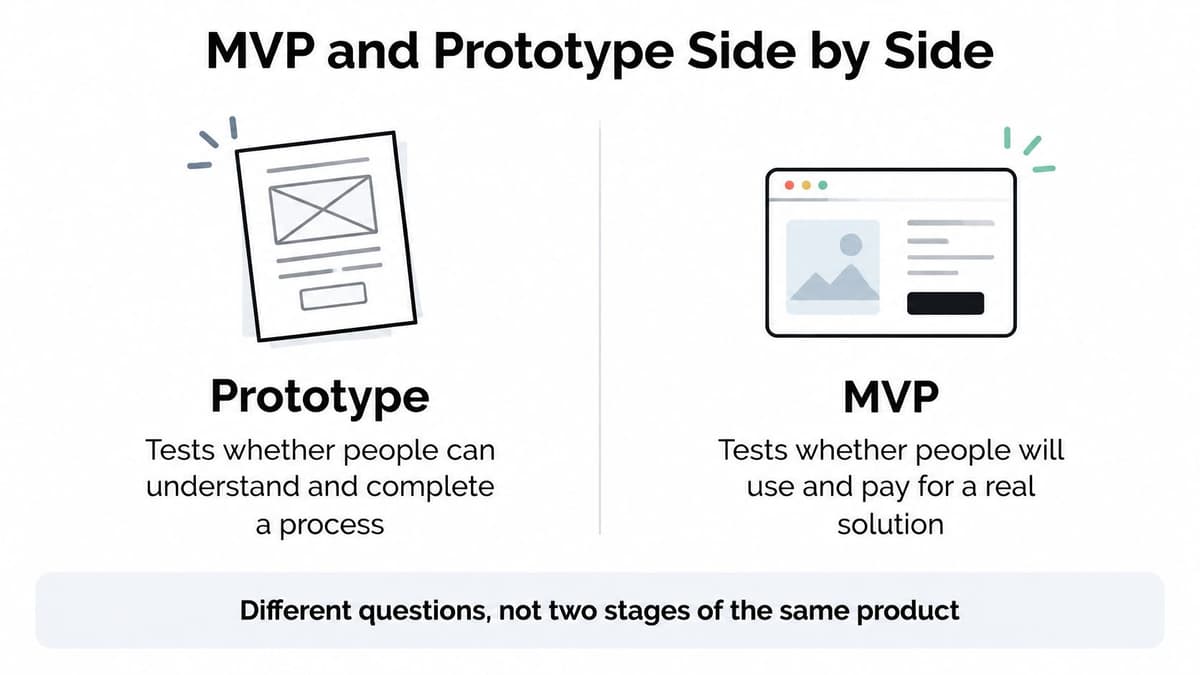
The table below is the reference point for everything that follows. Come back to it whenever a supplier's proposal uses either word.
| Feature | Prototype | MVP |
|---|---|---|
| Main question it answers | Can people understand and complete this? | Will real customers use, pay for or return to this? |
| Who tests it | A small group of representative users | Real customers in live conditions |
| What it contains | Screens, flows or mock-ups, often with dummy data | The smallest working product that delivers the core outcome |
| Live data and operations | None needed | Hosting, monitoring, data handling and support |
| Evidence it produces | Task completion, time on task, unprompted understanding | Activation, repeat use, conversion, support volume and error rates |
| Typical UK cost range | £8,000 to £25,000 | £30,000 to £80,000 |
| What happens next | Refined, then used to brief an MVP, or dropped | Continue, change direction or stop, based on rules agreed in advance |
The cost bands are wide because scope and delivery time move them, and the next sections break down what sits inside each one. Most bad decisions come from confusing the two questions, not from the size of the budget.
For a wider view of how a proof of concept sits alongside both, RapidNative's MVP vs prototype breakdown sets the three side by side and is worth reading before a first supplier conversation.
When a supplier uses either word, ask which row of the table their proposal is promising to fill.
What a Prototype Is For
A prototype earns its keep when the risk sits inside the process rather than in the market. An operations manager at a 40-person insurance firm, for example, wants a new claims intake form and has two versions in mind, one that asks for the policy number first and one that asks for the incident date first.

She asks six claims handlers to each complete a test claim on the clickable version while she watches, one at a time, without helping. Two handlers stall at the same field because they read "date of loss" as the date the claim was reported. One gives up and asks whether the form saves progress. None of that shows up in a meeting where someone presents screens.
What to Measure in a Prototype Test
The numbers that matter are cheap to collect and easy to argue about:
- Task completion rate. How many of the six finished without help, and where did the others stop?
- Time on task. A field that takes 40 seconds to understand is a field that will generate support calls.
- Hesitation and error points. Note the exact screen where people pause, back-track or type the wrong thing.
- Unprompted understanding. Ask each person to explain in their own words what the form is asking for, before you explain anything.
This short walkthrough shows how much of a real process a clickable prototype can carry before any code exists.
What a Prototype Cannot Prove
It won't tell you whether the system stays reliable with hundreds of users, whether it connects cleanly to the policy administration software, or whether anyone will pay for the result. A support team can test a reply-template flow with five agents and record where people pick the wrong template, but that tells you nothing about whether customers renew.
Because a prototype can be set aside once its findings are written down, the cost of learning stays low. Teams that want to test a flow before opening a design tool can start on paper, and build a paper prototype playtest covers how to structure one so the feedback is usable.
The product designer at Digital Souls Studios LTD turns defined requirements into user flows, wireframes and interface designs, keeping the design system consistent from the first prototype to launch, and a working set of wireframes is usually the first artefact in that chain.
Use a prototype when the main risk is whether people can follow the process. If the risk is whether they'll pay, a prototype will stay silent on it however polished the screens look.
What an MVP Must Prove With Real Customers
The UK Government's guidance on testing and validating your business idea describes an MVP as a basic, market-ready version that contains the essential features but lacks full polish and functionality. It recommends setting a development budget, launching quickly, collecting user feedback and iterating, rather than building the complete product first.
The rule that follows is narrower than expected. An MVP must deliver the complete core outcome for a small group of real customers, and leave out everything secondary. An online shop launching a new product line, for example, should ship one range with real checkout, real delivery and real returns, not a trimmed version of the entire catalogue with a fake payment step.
The Decision Gate
Use an MVP when the open question is whether people will keep using, paying for or gaining value from the workflow, not whether they can understand it. That single sentence separates the two purchases.
From day one, five numbers decide whether the experiment worked:
- Activation. The share of customers who complete the first useful action, such as placing a first order or connecting an account.
- Repeat use. How many come back a second time within a defined window.
- Conversion. The share of visitors who buy.
- Support contacts per order. A high number usually means the product is confusing rather than broken.
- Orders that go wrong. Refunds, failed payments, missing deliveries, failed jobs.
A prototype shows people can use it. An MVP shows they keep using it, or pay for it.
That distinction is the whole argument. Everything else is packaging.
Why Visual Approval Proves Nothing
The most expensive mistake in this area is treating a signed-off design as evidence. Stakeholders approving a visual design does not prove the system will run reliably, connect to existing tools, earn money or bring customers back. A prototype is a low-commitment representation built to test interaction design and comprehension, and it may contain simulated screens or no working backend at all. An MVP has to survive contact with real behaviour.
If you're planning the build itself, this guide to how to build a minimum viable product covers the scoping decisions in more detail.
Test Demand Before Committing to Either
What evidence would justify paying for a build? Before choosing a prototype or MVP, test whether the offer attracts interest. A landing page, customer interviews or a small pre-order or deposit offer can help you judge demand without commissioning software.
Take an online shop owner adding a product line. A one-page advert showing the product, price and buy button, promoted to a small audience, tests whether visitors click with intent. GoMVP's UK startup validation guide treats fewer than 3% of visitors taking the intended action as a signal to revisit the audience, messaging or value proposition.
Use that threshold as a screening measure. Traffic source, price and button wording affect the result, so cold social visitors and an existing email list need different interpretations. A click is a raised hand; a deposit asks someone to commit money. Be clear about which evidence your test collects.
For a founder without a technical team, interviews help clarify the offer before either build. Ask target customers what they currently pay to solve the problem, what they have tried and what would make them switch. Record the answers and look for recurring needs rather than relying on one enthusiastic reply.
Keep test spending in the acquisition budget, separate from the build quote. This guide to validate ideas before building explains how to structure a fake-door test so the clicks answer a useful question. Include that learning budget when considering whether you can afford to run the product for six months, rather than spending everything on delivery.
Demand and technical feasibility require different evidence. If the uncertainty is whether the proposed technology can work, proof of concept testing addresses that question; it does not establish customer demand.
If demand is weak, revise the offer or audience before paying for a prototype.
Cost, Time and Team for Each Route
Available UK-focused guidance places prototypes at roughly £8,000 to £25,000 and MVPs at £30,000 to £80,000, depending on scope and delivery time, as set out in Tulip Tech's comparison of MVP, prototype and proof of concept. Those are build figures. They are not the cost of running the thing.
What the Price Bands Leave Out
A quote for either route usually excludes customer acquisition, analytics and tracking, hosting, payment and software subscriptions, legal work, support, maintenance, accessibility, security and the founder's own time. A technically successful MVP can still fail commercially if the business can't afford enough learning cycles or enough users to produce evidence anyone can trust.
What Moves a Price Within the Band
Five things push a project from the bottom of a band to the top:
- User roles. Each additional role, such as administrator, approver or finance viewer, needs its own permissions and screens.
- Integrations. Connecting to an existing CRM, accounting package or stock system is where estimates go wrong most often.
- Real customer data. Personal and financial records bring privacy work, access controls and testing.
- Payments. Handling money brings fees, reconciliation and refunds.
- Devices and security. Mobile support, single sign-on and audit logging all add work.
Because the bands depend on delivery time, ask each supplier for a dated plan rather than a general estimate. A BCS study of 214 information-systems projects found nearly one in four was abandoned after the feasibility stage and about one in three ran over schedule or budget, with an average duration of just over 26 months and an average budget of roughly €6 million. Those are larger projects than a small UK MVP, so read the finding as a warning about uncontrolled scope rather than a price.
| Budget line | Prototype | MVP |
|---|---|---|
| Design and build | Within the £8,000 to £25,000 band | Within the £30,000 to £80,000 band |
| Analytics and event tracking | Not needed | Set up before launch |
| Hosting and monitoring | Not needed | Running costs from launch |
| Software subscriptions and payment fees | Prototyping tool seats only | Payment fees and third-party agent subscriptions, paid by the client |
| Legal and data protection review | Dummy data, light review | Full review if real personal data is used |
| Customer support and fixes | None | Named person and escalation route from launch |
| Acquisition test budget | Small landing-page or interview test | Set by the founder's test plan |
| Founder or staff time | Two to four days a week of one manager's time during the test | A named product owner plus support cover from launch |
Why the Cheapest Build Is Rarely the Cheapest Experiment
Compare routes on cost per validated learning: total spend divided by the number of answers the business can trust. A smaller but production-ready MVP with measurement and support often beats a low-cost build that generates data nobody believes. A prototype that answers four questions can be better value than an MVP that answers none.
Digital Souls Studios LTD runs most work as a scoped project from specification through launch, and where a project relies on third-party agents, the client pays for those subscriptions and their usage. Agree in advance whether the result means continue, change direction or stop.
Which Route Fits Your Situation
The four situations below are the ones that come up most often, and each has a first step that costs far less than jumping straight to a live product.
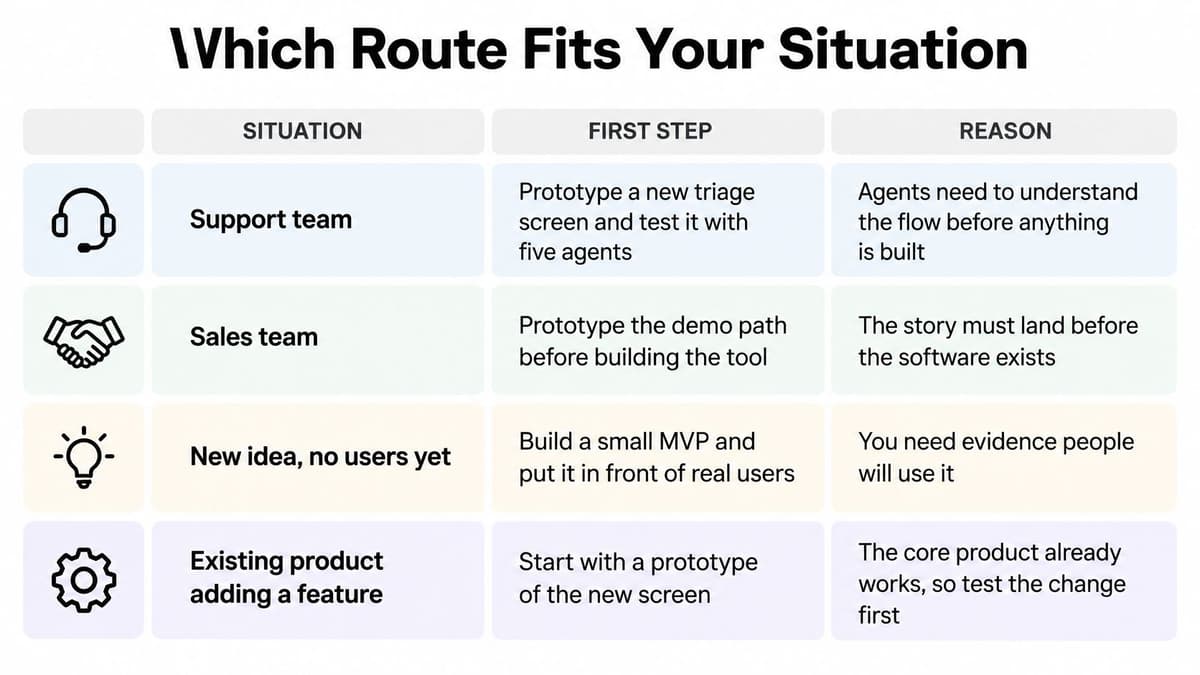
Support team with a new triage screen. Start with a prototype tested with five agents, because the open question is whether agents can sort tickets without being taught the screen. Move to an MVP only once agents rely on it for live tickets, with logs of what happened, a route for escalation to a person and a named owner. A triage tool nobody escalates from is a queue with extra steps.
Online shop launching a product line. Prototype the checkout and the product page first to find where shoppers hesitate, then launch a limited MVP with real payments and measure repeat orders. The catalogue can wait. The returns process can't.
Finance team automating invoice handling. Prototype with dummy invoices, because real invoices carry personal and financial data. Move on only after a data protection review is done and access controls are agreed, and keep a human approval step for anything above an agreed value.
Founder with no technical team. Prototype to confirm customers understand the offer, then run an MVP to see whether they pay, with hosting and support budgeted from the start rather than after launch. Founders who budget only the build tend to run out of money in month two of a six-month test.
| Situation | First step | Move to an MVP when |
|---|---|---|
| Support team with a new triage screen | Prototype tested with five agents | Agents rely on it for live tickets, with logs, escalation to a person and a named owner |
| Online shop launching a product line | Prototype checkout and product page | A limited MVP with real payments shows repeat orders |
| Finance team automating invoice handling | Prototype with dummy invoices | A data protection review is done and access controls are agreed |
| Founder with no technical team | Prototype to test whether customers understand the offer | Customers pay, with hosting and support budgeted from the start |
Read each row as a pair. The first step buys evidence, and the second step is only justified once that evidence exists.
Common Mistakes When Mixing Them Up
Most of these cost money in a predictable way, and each has a check you can run before signing anything.
Treating a prototype as proof of demand. People are polite about screens in a meeting, and politeness is not a purchase order. The cost is a full build on a proposition nobody wanted. The check: ask what real customers have done so far, not what they said.
Building the full MVP before the workflow is tested. This locks in the wrong process, and rebuilding a live workflow costs more than prototyping it. The check: name the riskiest screen and confirm it has been tested with representative users.
Choosing the cheapest build with no analytics. Without event tracking, the business can't tell whether the launch worked, so the spend produces an opinion rather than evidence. The check: list the five events you need to see before anyone writes code.
Launching without a stop rule. Projects continue by default when nobody agreed what failure looks like, and the budget becomes the deadline. The check: write the continue, change and stop conditions into the brief.
Using real customer records in a test without a privacy check. The Information Commissioner's Office guidance on explaining AI decisions states that personal-data protection obligations apply when personal data is used to train, test or deploy an AI system, and that organisations must tell people when their data will be used to train one. A visual prototype can run on dummy data; a live MVP needs a lawful purpose, privacy information, access controls and a human escalation route. The check: ask where the data sits and who owns the compliance work.
Accepting a clickable mock-up labelled as an MVP. Some proposals use the word to describe a prototype, and the invoice follows the word. The check: ask what is live, what data it touches, and what will be measured in week one.
Most of these come from a missing agreed decision rather than from a bad choice of word.
Pick Your Next Step Before You Brief a Supplier
The decision rule is settled. What's left is the conversation with whoever builds it.
The Checklist to Agree Before Work Starts
- The single learning goal. One question the work must answer, written in a sentence a non-technical board member would understand.
- Fixed deliverables with dates. Include the timeline, because published cost bands don't give you one and delivery time is what moves a price.
- Review points. The dates where the team stops, examines the evidence and decides, rather than rolling on.
- Exit criteria. Which result means continue, which means change direction and which means stop.
- Ownership. Who owns the data, the privacy checks, the third-party tool accounts and the subscription costs attached to them.
Digital Souls Studios LTD builds both routes. SaaS and software work covers end-to-end product builds and MVPs, a first version limited to the core features is a normal starting point, and UI/UX design includes Figma interface design with wireframes, handoff and clickable prototypes. The services page sets out what's offered.
Describe the project, the risk you most need to reduce and the budget band at the contact page, and the team can recommend a first step rather than a bigger one.
Digital Souls Studios LTD builds clickable prototypes that test a process before code exists, and first versions of products limited to the core features, run as scoped projects from specification through launch. If you're weighing MVP vs prototype and want a straight answer on which evidence you need next, the studio can scope the smaller experiment first and keep the larger build for when the numbers justify it. Describe your project at Digital Souls Studios LTD and you'll get a reply within 24 hours.