14th November 2026 · 16 min
Product Development Roadmap: What It Is and How It Works

Someone senior asks when it launches, and the honest answer lives in a spreadsheet with sixty rows, no order and no owner. Half the rows are features, a few are fixes, two are "the API thing", and nothing on the sheet says what has to be true before any of it counts as done.
The instinct is to add dates to the spreadsheet. That produces a calendar. The UK software-development market is large and still growing, and work at that scale rarely survives a plan built from guesswork.
A roadmap does a different job. It treats development as a sequence of outcome gates: which result comes first, what evidence proves it arrived, and which decision that evidence informs. The sixty rows become ordered checkpoints instead of a pile, and even "the API thing" gets a definition of done.
Table of Contents
- What a Product Development Roadmap Actually Is
- The Core Components and How They Fit Together
- How Stages Turn Ideas into Released Products
- Running Product and Process Work on Separate Tracks
- A Worked Example for an Early-Stage SaaS Product
- Common Roadmap Mistakes and How to Avoid Them
- Build Your First Roadmap This Quarter
What a Product Development Roadmap Actually Is
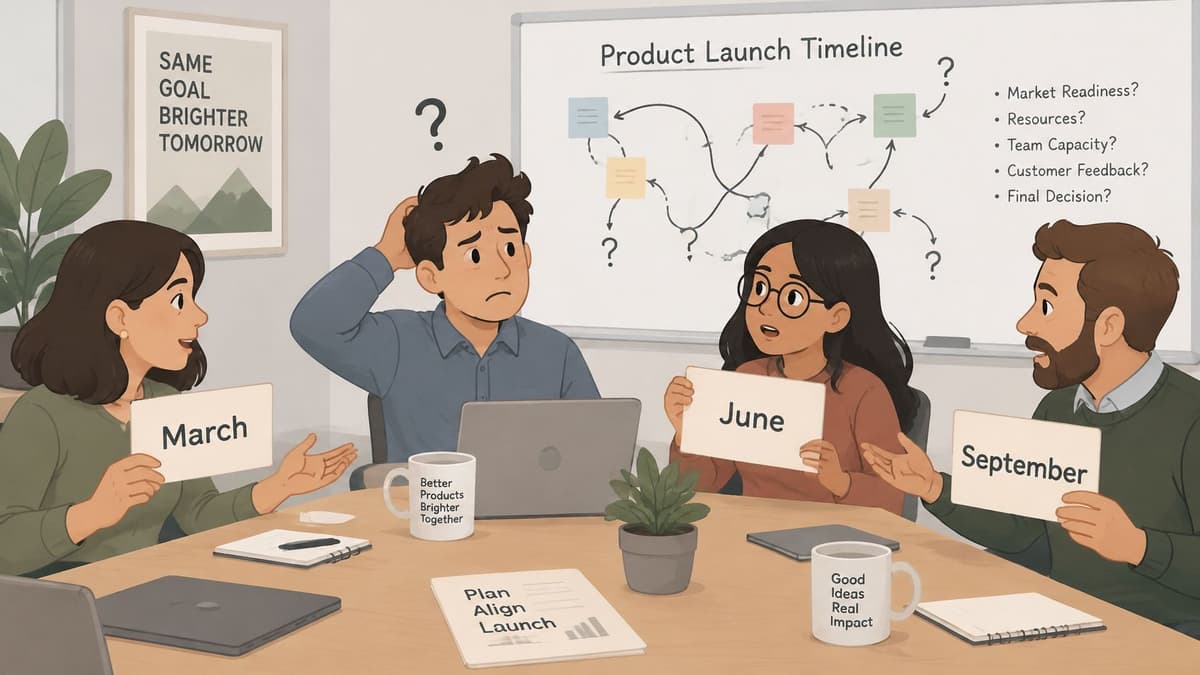
Picture the planning meeting. The sales lead says March because a prospect asked. The founder says June because engineering is short-handed. The engineer who owns the calendar integration says nobody mentioned a date at all. Four people, three answers, one product. The argument isn't really about dates. It's about the absence of a shared sequence.
A product development roadmap is a time-sequenced plan that links what a product should achieve to the work, decisions and checkpoints needed to reach it. Read that definition twice, because the second half does the heavy lifting. The plan doesn't only name destinations. It names the checkpoints where you decide whether you've arrived.
Three documents people confuse
A travel analogy keeps them apart. The roadmap is the route with the stops on it and the points where you check the fuel gauge. It is not a timetable of every turn of the wheel, and it isn't the sat-nav recalculating mid-journey either.
- The backlog is a list of possible work with no order. It's the drawer of brochures you might one day use.
- The project plan schedules tasks for one delivery, with hours and assignees. That's the driving directions for a single leg of the trip. It answers a different question from software project plans, which take over once the route is agreed.
- The roadmap sets direction, sequences the work, and states what evidence advances the next stage.
That discipline matters more than it sounds. UK businesses spent £55.6 billion on business-performed research and development in 2024, with software development accounting for £10.3 billion, or 18.5% of the total, according to the Office for National Statistics. Money on that scale doesn't get spent well by accident, and it doesn't get defended to a board without a sequence that shows what each stage bought.
Three things a good roadmap does, then. It fixes the direction so competing requests can be judged against it. It orders the work so the riskiest assumptions get tested while mistakes are still cheap. And it names the evidence that closes each stage, so progress is a fact rather than a feeling.
The Core Components and How They Fit Together
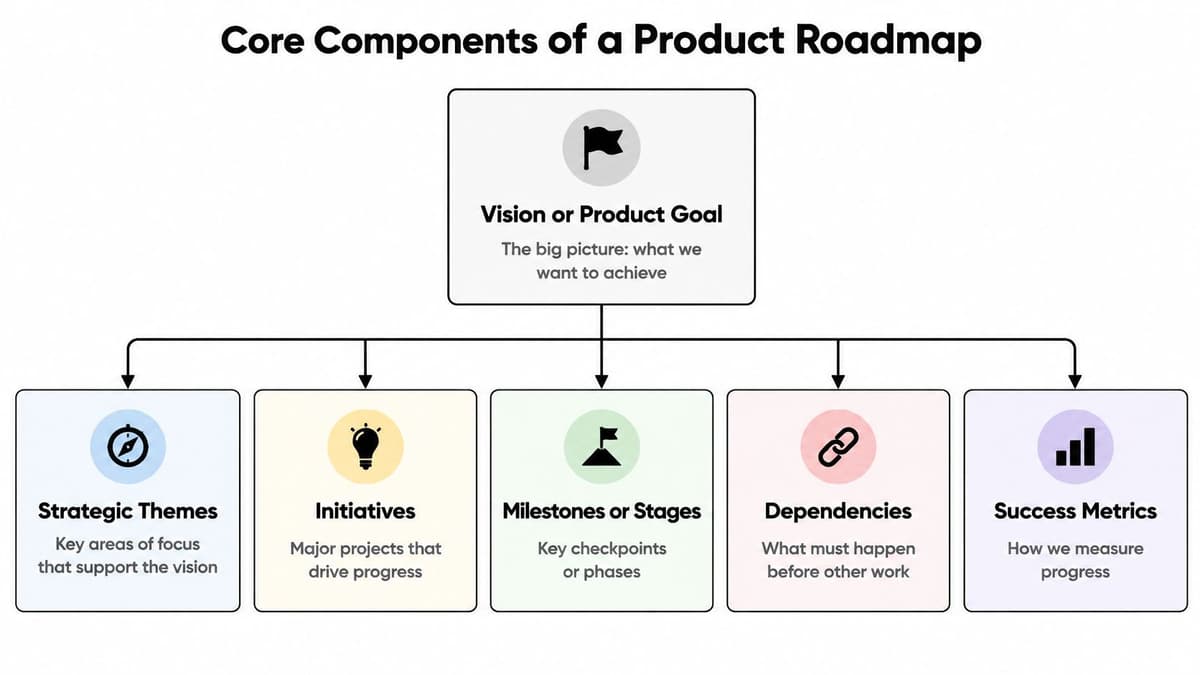
Six parts make up a roadmap, and each one answers a different question. Leave any of them out and the document wobbles.
| Component | Question it answers | Example entry |
|---|---|---|
| Vision or product goal | Why does this product exist? | Customers set up their account in under ten minutes |
| Strategic themes | Which areas of value do we focus on? | Faster onboarding |
| Initiatives | What work delivers the theme? | Guided setup wizard |
| Milestones or stages | When is each stage complete? | Private beta with 50 users in Q2 |
| Dependencies | What must be ready first? | Access to the payment provider API |
| Success metrics | How will we know it worked? | Median setup time below ten minutes |
The nesting, in plain terms
Read the table from the top and you have a hierarchy, not a shopping list. Themes group initiatives. Initiatives are delivered through milestones. Each milestone carries a measure that says whether it landed.
A restaurant makes the nesting obvious. The vision is the kind of restaurant you're opening, a small neighbourhood place serving lunch, say. The themes are the menu sections. The initiatives are individual dishes. Milestones are the weeks those dishes go live. Metrics tell you whether people order them twice. Nobody opens a restaurant by writing a list of forty dishes and hoping the kitchen finds a rhythm.
One chain, followed all the way through
Take the entry in the table and trace it. The goal says account setup should take under ten minutes, because support tickets show people abandon the form. That fixes a theme, faster onboarding, and rules out two competing requests for the quarter. Under the theme sits one initiative, a guided setup wizard, owned by the product lead.
The milestone is a private beta with fifty users in the second quarter. The dependency is access to the payment provider's API, which sits with a third party and therefore needs requesting early. The metric is median setup time below ten minutes, measured in the same way the baseline was measured.
A useful rule that saves arguments later.
Where dates go: dates belong inside milestones, never inside themes. A theme with a deadline attached has quietly become a feature release, and the strategic thinking behind it disappears.
Add an owner to each initiative where accountability is unclear. Once the sequence is settled, the task-level detail belongs in software project plans, not on the roadmap. Then run the check: list the six components and mark which ones your current plan is missing. Most first drafts are missing dependencies and metrics, and those are exactly the two that turn a wish list into a plan.
How Stages Turn Ideas into Released Products
A roadmap built around a fixed feature list ages the moment somebody changes their mind. One built around stages with exit tests survives, because the stages stay the same even when the contents shift.
The Digital, Data and Technology Playbook recommends defining milestones, stages or product iterations, each with a specific objective that advances the intended outcome, then monitoring progress against that roadmap continuously.
| Stage | Purpose | Exit evidence |
|---|---|---|
| Discovery | Confirm the user problem | Prioritised problem statement and baseline metrics |
| Alpha | Test a prototype with a small user group | Prototype task success and architecture-risk findings |
| Private beta | Expose critical bugs to a restricted group | Reliability, security and usability results |
| Public beta and launch | Test at larger scale before wide release | Performance, accessibility and analytics checks in place |
| Live support | Measure adoption and plan the next iteration | Retention, support volume and workflow completion |
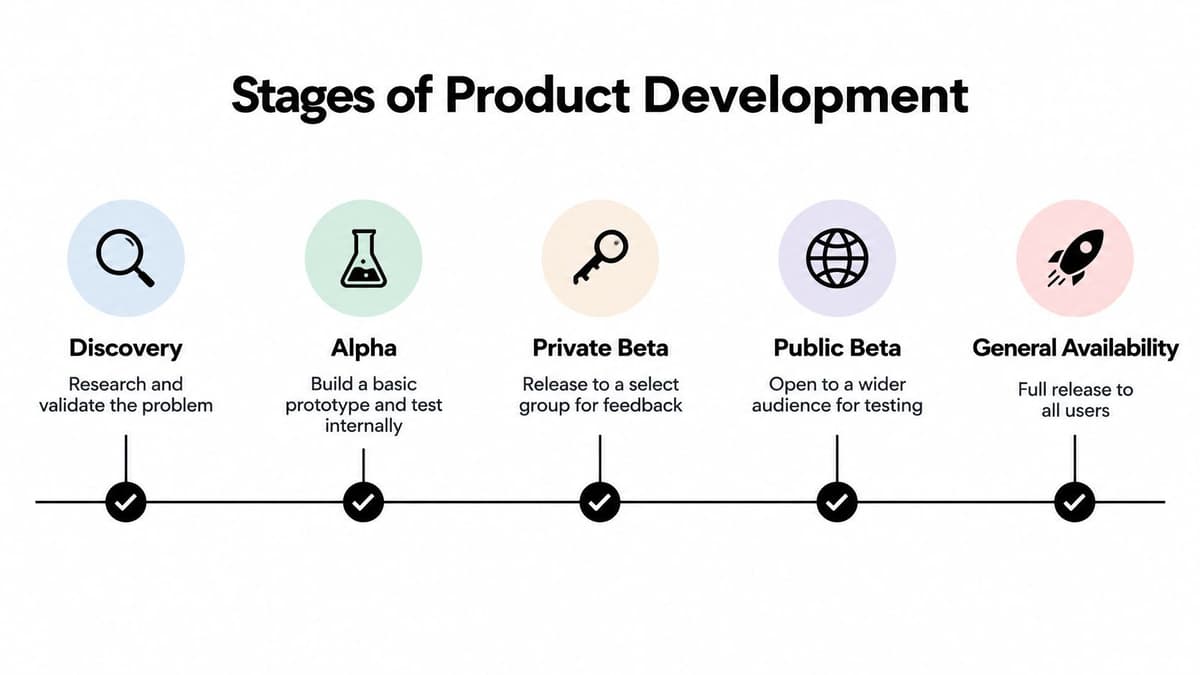
The five steps a team actually works through
- Write the problem statement and record the baseline before building anything. If the current setup time is unknown, you can't later prove it improved, and the whole roadmap becomes a matter of opinion.
- Test a prototype with a small group and record task success. The gate exists because a clickable screen costs days, while a wrong data model costs a quarter.
- Release to a private beta and close critical bugs. A restricted group finds the failures that would be embarrassing in public, while the audience is still small enough to talk to individually.
- Widen access in a public beta while tracking reliability, security and accessibility. Each check catches a different class of failure, and none of them can be assessed by looking at a sprint board.
- Launch, then review adoption and support volume against the targets from step one. This is the gate that is often skipped, and skipping it is how the same mistake reaches the next quarter's plan.
The reason for every gate is the same. It separates genuine progress from activity. A team can close forty tickets in a fortnight and still not know whether anyone's setup time fell below ten minutes.
The sequence maps closely onto the wider stages of software development, with the difference that each stage here closes on written evidence rather than a delivery date.
Practical rule: if you can't write the evidence that closes a stage, you haven't defined the stage. You've renamed a date.
Attach a written exit test to every stage in your own roadmap this week. One sentence each is enough.
Running Product and Process Work on Separate Tracks
Most roadmaps mix two kinds of work. One kind is what customers see: a new feature, a changed workflow, a redesign. The other is what the team needs: automation, workflow redesign, infrastructure upgrades, compliance controls. Both are real. Only one tends to get written down.
The UK Innovation Survey 2025 found that 19% of UK businesses were product innovators during 2022 to 2024, while 25% were business-process innovators, according to the Department for Business and Trade. Process change is the more common activity, and it's the one a feature-only roadmap loses first.
| Track | Holds | Measure |
|---|---|---|
| Product track | Customer-facing releases such as new features and workflow changes | Adoption or revenue |
| Process track | Automation, workflow redesign, infrastructure upgrades and compliance controls | Operational efficiency, risk reduction or technical readiness |
| Shared item: reporting dashboard | Feature release on the product track and data-quality capability on the process track | Adoption on the product track and efficiency on the process track |
Where the two tracks overlap
A reporting dashboard is the clearest case. Customers see a screen that exports a report, so it belongs on the product track, judged by how many accounts use it weekly. Underneath, someone had to fix inconsistent timestamps and duplicate records before the numbers could be trusted, and that work belongs on the process track, judged by the share of records that reconcile cleanly.
One item, two entries, two measures. The team that tracks only the screen ships a dashboard nobody trusts. The team that tracks only the data cleanup builds something no customer ever sees.
One measure per item, or it comes off
Give every roadmap item exactly one primary measure: adoption, revenue, operational efficiency, risk reduction or technical readiness. A single measure forces the argument about why the item exists at all. Two measures let everyone claim success.
The exercise takes an afternoon. Sort your current backlog into the two tracks, then delete anything you can't attach a measure to. What's left is usually shorter than expected and far easier to defend.
A Worked Example for an Early-Stage SaaS Product
Two quarters, one product, one team of four. A scheduling tool for small clinics, built by people who've spent a fortnight watching reception desks.
Quarter one, discovery, and the assumption that could sink it
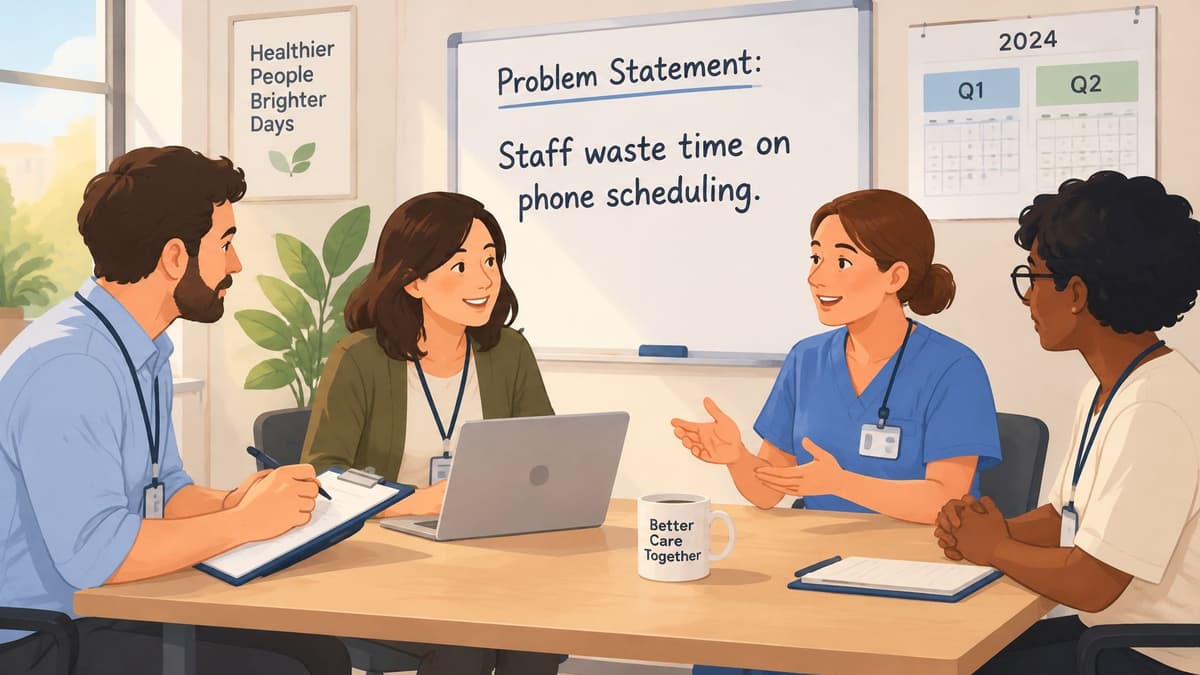
Fifteen clinic staff get interviewed. The problem statement they produce is blunt: reception spends roughly an hour a day untangling double bookings, and the workaround is a paper diary next to the software everyone already pays for. Baseline recorded, before a line of code.
Then the team does the uncomfortable thing and tests the riskiest assumption first. The calendar integration has to answer within about 300 milliseconds at peak load, when three receptionists open the same day view at 9am. If it can't, the whole product is a slow spreadsheet.
Government guidance on digital evaluation and performance analysis maps the same lifecycle, with feedback and evaluation continuing from discovery through alpha, private beta and live operation. The sequencing follows from it: test the assumption that would hurt most to get wrong.
Week six brings a clickable prototype tested with eight clinic staff, timed on a single task, booking a follow-up appointment without creating a duplicate. Six of the eight finish unaided. The two failures point at the same missing confirmation step.
The cheapest place to find a broken assumption is a prototype, where fixing it costs days.
If you're weighing how much to build before that test, the guidance on how to build a minimum viable product covers the same trade-off between scope and evidence.
Quarter two, private beta, and a decision written down
Thirty accounts enter a private beta. The gates are fixed in advance: double bookings reduced by half against baseline, and time to first booking under two minutes for a new account. The latency budget is measured weekly, not assumed.
For a walkthrough of the same journey from idea to release, this short video covers the sequence.
The go decision at the end of the quarter is recorded with three things: the metric that passed, the metric that didn't, and what the team chose to drop. In this case the SMS reminders feature is cut, because the beta showed staff already live in the tab and the dependency on a messaging provider would have added a compliance review. Public beta follows once open critical bugs hit zero.
The point isn't the clinic. It's that every gate produced a written decision, so nobody had to reconstruct the reasoning later.
Common Roadmap Mistakes and How to Avoid Them
Four beliefs cause most of the damage. Each sounds sensible, and each is wrong in a specific way.
"A roadmap is a promise of fixed dates." It isn't. A roadmap sets sequence and evidence. Dates are estimates that move when a gate is missed, and the useful conversation is about which evidence is missing, not whose fault the slip is. Warning sign: a date you're not allowed to question.
"A roadmap is a feature list." Outcome statements tell the team what success looks like. Features are only the means, and half of them get replaced once the outcome is clear. Warning sign: every item starts with a noun and no verb.
"AI features can be added like any other feature." They can't. The UK government's 2025 AI adoption research found that 61% of businesses using or planning to use AI were working with natural-language processing or text-generation systems, per the AI Adoption Research Report. Probabilistic output needs its own trust milestones: a defined intended use, an evaluation dataset, accuracy and escalation thresholds, a documented data provenance record, and a named person who approves each release.
"A broad feature set wins." ONS analysis shows 28% of businesses with 0 to 9 employees used at least one AI technology, against 49% of businesses employing 250 or more, according to ONS business services analysis. Smaller buyers often need a narrower product with a clear onboarding path, not the full platform.
Warning signs worth checking monthly
- No exit criteria anywhere. If nothing on the roadmap says what evidence closes it, it's a wish list with formatting.
- Unlabelled dependencies. A third-party API with no owner and no request date is a delay waiting to happen.
- A roadmap nobody has updated in two months. Either the plan is wrong or nobody's reading it, and both are fixable.
- Metrics that measure activity. Tickets closed and story points are not the same as setup time or retention.
Build Your First Roadmap This Quarter
Four steps, one page, this week.
- Write the goal as one measurable outcome. Not "improve onboarding" but "median setup time below ten minutes by June", measured the same way as the baseline you recorded first.
- Group the work into three to five themes and attach at least one initiative to each. Name an owner per initiative, which at a small company may be the same person five times.
- Add a milestone for each stage, each with a written exit test. Eight prototype sessions with task success recorded, zero open critical bugs before public beta, accessibility checks signed off before launch.
- Review monthly against the metrics, and move a date only when evidence says so, recording the reason for each change. A date that moves without explanation teaches the team the plan is theatre.
Choose the format to match the work. A dated timeline suits committed delivery with external obligations. A now, next and later view suits discovery-heavy work where dates would be guesses dressed as commitments.
Our own delivery runs on the same principle. A project moves through four steps, Specification, Production, Launch and Support, and in the Specification step the client explains the idea in writing while we put together a specification suited to the work. That document is the first milestone, because it's where the measurable outcome gets agreed.
Share the roadmap with stakeholders on the same monthly rhythm, so changes arrive as updates rather than surprises. Aim for one page covering one goal, three to five themes and the next two stages. Then put the review date in the calendar, because a roadmap only works when someone opens it on a fixed schedule.
If you're planning an MVP or rebuilding a platform and the sequence still isn't clear, Digital Souls Studios LTD works through it with you from the first written specification to launch and the support that follows. We design and build web applications, SaaS products and AI automation for UK and international clients, attaching evidence to each stage rather than filling a calendar with hopeful dates. Start the conversation at Digital Souls Studios LTD.