7th November 2026 · 14 min
Software Project Plans: How to Build One for MVPs and SaaS

The UK Government Major Projects Portfolio included 24 information and communications technology projects with a combined whole-life cost of £36 billion in 2024–25, according to the National Infrastructure and Service Transformation Authority's annual report. At that scale, a software project plan clearly isn't just a calendar. For a founder committing scarce runway, the same principle applies: the plan must show who can make decisions, what evidence permits release, and who can operate the product afterwards.
Good software project plans connect delivery to accountability. They make scope negotiable without making quality optional, and they treat client capability as an outcome rather than a handover attachment.
Table of Contents
- What a Software Project Plan Must Contain
- How to Define Scope and Milestones First
- How to Build the Timeline, Resources and Risk Register
- How to Plan QA, Deployment and Handover
- MVP and SaaS Plan Examples You Can Adapt
- Book a Plan Review Before Development Starts
What a Software Project Plan Must Contain
| Plan component | Question it answers | Output to hold | Typical owner |
|---|---|---|---|
| Scope and objectives | What is in, what is out, and why | Scope statement with acceptance criteria | Product owner |
| Milestones | Which dated outcomes prove progress | Milestone list with entry and exit criteria | Project lead |
| Timeline and Gantt chart | When each task starts and what depends on it | Schedule with critical path marked | Delivery lead |
| Resources and budget | Who does the work and what it costs | Role plan and cost baseline with contingency | Finance and delivery lead |
| Risk register | What could go wrong and who handles it | Ranked risks with triggers and mitigations | Named owner per risk |
| QA plan | How quality is proven before release | Test scope and sign-off criteria | QA lead |
| Deployment plan | How the release reaches users safely | Release checklist and rollback criteria | Engineering lead |
| Handover plan | How the client runs the product afterwards | Runbooks, training and support terms | Account lead |
The State of Digital Government Review reported that digital and data programmes were 60% more likely to receive a Red delivery-confidence rating than the wider Government Major Projects Portfolio, while only 9% of major technology programmes achieved Green. Those ratings concern government programmes, but the planning discipline is useful at any scale: make delivery confidence, scope, cost and schedule measurable.
A Gantt chart can't tell you whether a customer has accepted a workflow or whether an operations lead can recover a failed deployment. Your plan needs decision gates, linked evidence and named approval authority alongside dates.
Activate each component at the right stage
Our delivery process moves through Specification, Production, Launch and Support. During Specification, establish objectives, exclusions, acceptance criteria and initial estimates. Prepare the risk register and handover responsibilities here too, before anyone assumes they're somebody else's job.
During Production, maintain the schedule, staffing allocation, cost forecast and test evidence. We design and build with regular updates, so each update should distinguish completed work from work merely started.
At Launch, use the deployment checklist and operational acceptance criteria. During Support, maintain runbooks, ownership records and improvement priorities rather than filing the plan away.
Keep the document lightweight enough to update. A shared document linked to Linear, Jira or GitHub Issues is more useful than a polished presentation that nobody maintains.
If nobody can name the owner of each milestone and each risk, the plan isn't ready.
Copy the table into a working document and fill the owner column first. Replace role titles with people's names before approving delivery.
How to Define Scope and Milestones First
A feature list isn't a specification. It describes proposed functionality but may leave users, constraints and completion criteria open to interpretation.
In a survey of 600 UK and US software engineers, requirements documented before development were reported as making projects 50% more likely to succeed, while requirements accurately grounded in a real-world problem were associated with a 54% higher likelihood of success, according to Computer Weekly's reporting. These are survey associations, not guarantees or proof that a heavier specification always produces a better product.
Start with the decision the release must support
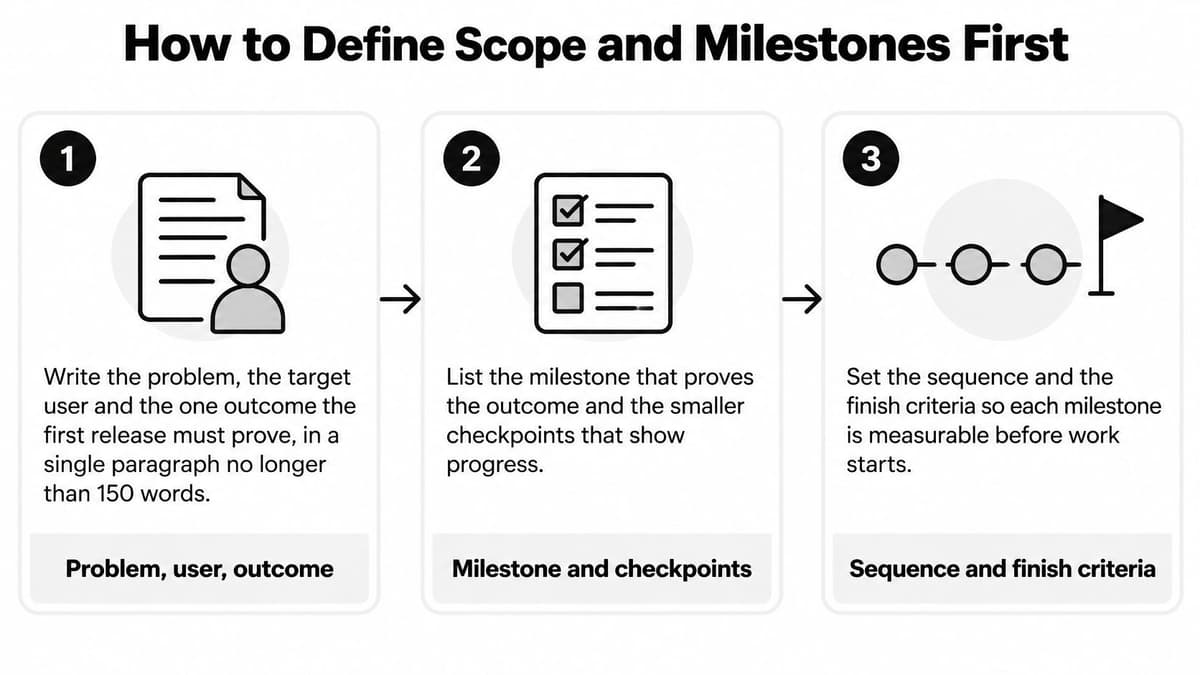
Write the problem, user and outcome. As a practical drafting constraint, keep the discovery paragraph below 150 words and identify the outcome the first release must prove. For a booking product, that might be whether patients can find an available appointment and reserve it without calling reception.
Separate inclusions from exclusions. In this hypothetical booking MVP, include sign-up, appointment selection and email confirmation, but exclude payments and management reporting. Explicit exclusions protect the release from reasonable-sounding additions that consume the same engineering capacity as essential work.
Define testable milestones. For example, set three to six milestones, each with an entry condition and an observable exit condition. Give the product owner responsibility for accepting the evidence, not merely acknowledging a demonstration.
Use the sequence below to turn the brief into measurable checkpoints.
A concrete pilot milestone could look like this:
| Milestone field | Hypothetical booking MVP |
|---|---|
| Outcome | Pilot booking journey accepted |
| Entry criterion | Appointment availability integrated and pilot accounts prepared |
| Exit criterion | Ten pilot users complete a booking without support |
| Evidence | Observed sessions, booking records and confirmation receipts |
| Acceptance owner | Client product owner |
The pilot count is an example acceptance target, not an industry benchmark. Choose a target that provides useful evidence for your product's risk and intended users.
In our Specification step, the client explains the idea in writing and we prepare a specification matched to the work. Use wireframes to clarify the proposed workflow, but document permissions, error handling, accessibility needs and integration behaviour separately.
The common slip is accepting scope that names features but contains no acceptance tests. Developers can finish the interface while stakeholders still disagree about what completion means.
Baseline the critical requirements, not every implementation detail. Record changes with their delivery impact and approval owner, then draft the brief and milestone list before opening any project tool.
How to Build the Timeline, Resources and Risk Register
A schedule slips when the team discovers that supposedly independent work depends on an unavailable supplier, incomplete data or an unmade decision. Adding developers won't fix a blocked approval.
The National Audit Office's technology suppliers review reported that five major government digital programmes experienced combined cost increases of more than £3 billion, at least 26% above original forecasts, and accumulated at least 29 years of delay. Programme resets also meant keeping legacy systems running longer than intended.
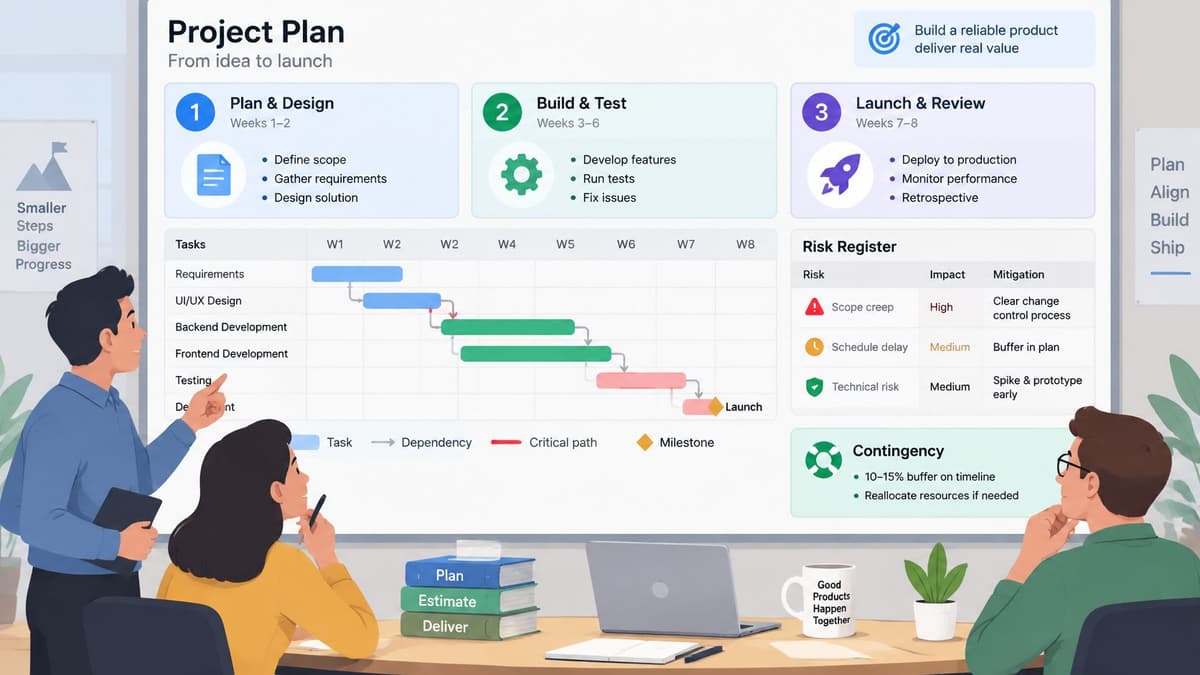
Use a visible dependency map during planning discussions, rather than reviewing isolated task lists.
Estimate the work and expose the constraints
Break milestones into tasks and dependencies. Mark the critical path, the dependent sequence that determines the earliest finish, and estimate uncertain tasks using optimistic, likely and pessimistic cases. Re-estimate after each increment using actual throughput; the usual mistake is preserving the original date after the underlying assumptions have changed.
Assign named roles and actual availability, not headcount. A designer shared across projects isn't interchangeable with a dedicated engineer, and nobody's calendar should assume uninterrupted feature work. Reserve explicit capacity for integration, technical debt, security, accessibility and operational readiness, with the allocation justified by the work rather than a universal percentage.
Baseline costs and assign contingency. Separate agreed scope from allowances for uncertain items, and record who can authorise their use. Use the app development cost guide to structure the commercial discussion, then price the actual role plan and dependencies rather than treating a headline estimate as a commitment.
If the launch date is fixed, identify which scope can move. If scope is fixed, show the corresponding schedule uncertainty instead of hiding it in overtime assumptions.
The video below offers another format for a team planning discussion.
Give every risk an action trigger
A risk register without triggers becomes a list nobody reads. The following rows are hypothetical working examples, including illustrative thresholds and review periods, not recommended defaults.
| Risk | Likelihood | Impact | Owner | Trigger | Mitigation |
|---|---|---|---|---|---|
| Legacy integration fails in staging | Medium | High | Engineering lead | Staging error rate above 2% for two days | Build adapter and test in week two |
| Client sign-off delayed | High | Medium | Product owner | No sign-off within five working days of review | Escalate to sponsor and freeze scope |
| Data migration runs past estimate | Medium | High | Delivery lead | Throughput below the likely estimate for two sprints | Re-plan milestone and draw on contingency |
Define the denominator behind any error rate and the measurement source. Otherwise, the engineering lead and product owner may interpret the same trigger differently.
Practical rule: A mitigation needs allocated work and authority to act, not just a reassuring sentence.
Pick the highest-priority risks, name an owner for each and book the next review before ending the planning session.
How to Plan QA, Deployment and Handover
A technically successful launch can still leave the client unable to maintain workflows, assess outputs or respond to incidents. Capability transfer belongs in the delivery plan, with an accountable client owner and time allocated before release.
The UK Business Data Survey 2026 reports that 41% of businesses handling digitised data used AI for at least one purpose, yet only 17% of AI-using businesses had any AI policy. Adoption and operational readiness aren't the same decision.
Define release evidence before launch
Write the QA plan against milestone outcomes. Include automated tests for core flows, exploratory testing, performance checks and accessibility checks, with a named person authorised to accept or reject the results. Don't leave sign-off to whoever happens to be available, and don't confuse a passing test suite with customer acceptance.
Prepare staging, the release checklist, monitoring coverage and rollback authority. As a hypothetical release rule, the team might monitor intensively for the first 72 hours and roll back if failed booking attempts exceed 2% within an agreed measurement window. Validate that threshold against expected traffic, specify who watches the dashboard, and rehearse recovery before production deployment.
Record whether database changes are reversible. Restoring application code isn't enough if a migration has changed records that the previous version can't read.
Our guide to the stages of software development provides useful context for assigning these checks across delivery. The operational plan should nevertheless name the people responsible for this particular system.
Make handover a workstream
- Appoint a client handover owner and a supplier counterpart. Plan role-based training, routine-operation runbooks, incident response, data and prompt ownership, accessibility responsibilities and supplier exit arrangements. The common slip is delivering documentation without checking whether the receiving team can use it.
At Launch, we help launch the project and leave it in a state a team can run. Support packages cover maintenance after launch in addition to the scoped project, so separate ongoing supplier responsibilities from those the client accepts.
Use supervised operation to test competence. Ask the receiving team to process a failed transaction, change an authorised setting, investigate an alert and locate the correct escalation contact.
- Adoption: Track sustained use by the intended user groups.
- Operational value: Compare manual effort and error rates against agreed baselines.
- Internal competency: Record which routine tasks staff can complete without supplier intervention.
Can the client's operations lead explain the rollback steps without help?
MVP and SaaS Plan Examples You Can Adapt
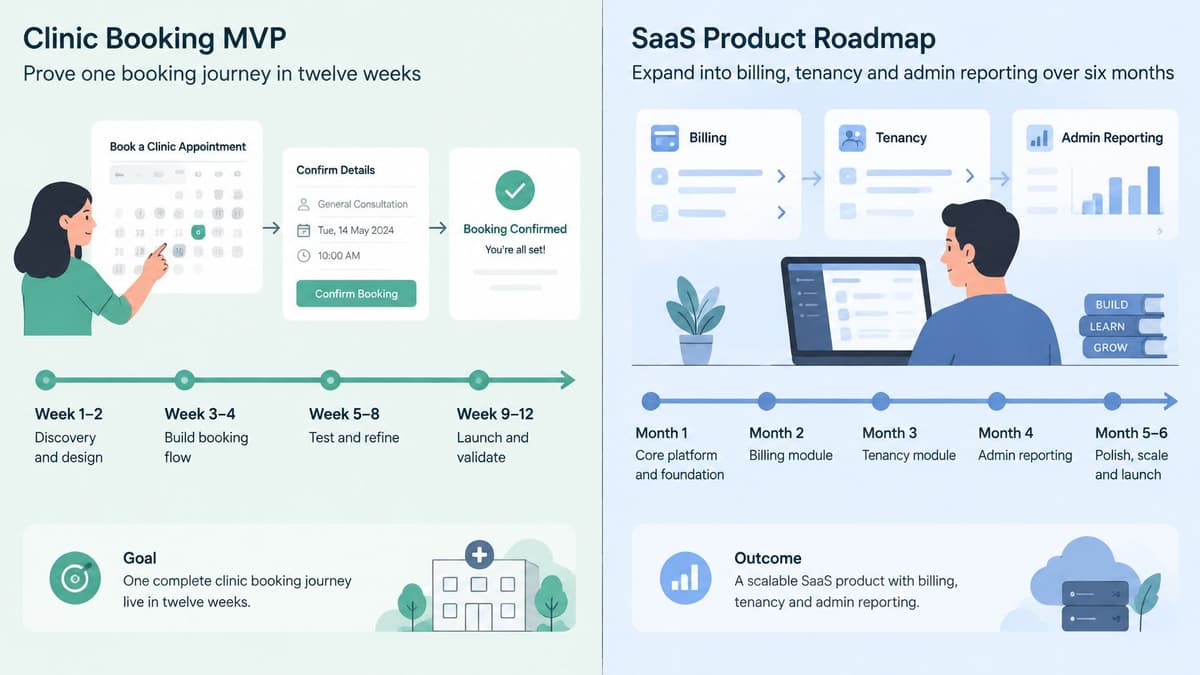
Say a clinic wants a booking MVP to prove a core workflow within twelve weeks, while a subscription business plans billing, tenancy and admin reporting over six months. These are hypothetical planning scenarios, not delivery promises.
The comparison below gives example ranges to adapt after discovery. They're not quotes, benchmarks or evidence that a particular team can deliver your scope within those periods.
| Plan element | MVP (indicative) | SaaS launch (indicative) |
|---|---|---|
| Scope and milestones | One core workflow, three milestones | Three to five modules, six to eight milestones |
| Timeline | 10–14 weeks | 4–6 months |
| Team | 3–4 people | Named product, design, engineering and QA roles, with infrastructure coverage |
| Main risk focus | Whether users want the workflow at all | Billing, tenancy, security and scaling |
| QA and release | Manual test plan, one controlled release | Automated tests, staged rollout with monitoring |
| Handover | Runbook and admin training | Support package, service levels and documented APIs |
For the clinic scenario, use milestones for workflow agreement, integrated booking and pilot acceptance. Keep payments outside that release if they aren't necessary to test the booking proposition, without postponing essential privacy or access controls.
For the SaaS scenario, add separate acceptance gates for billing behaviour, role-based access, tenant isolation, security review and staged rollout. Test failed payments and unauthorised cross-tenant access, not just successful subscription creation.
The illustration shows how those example delivery shapes differ.
Add a separate AI validation track
The UK Government's 2025 AI adoption research found that ethical concerns were a significant barrier for 80% of affected businesses, while 72% cited unclear or uncertain regulation. For a feature that generates content or influences decisions, governance belongs in the minimum viable operating model, not a later scaling project.
- Classify the use case. Identify affected users, potential harm, the named business owner and approval authority.
- Agree evidence before build. Set task-specific accuracy thresholds, representative evaluation cases, human-escalation rules and data-protection checks.
- Control operation. Require audit logging, security testing, model-change approval, a post-launch review cadence and explicit disablement criteria.
A clinic's administrative assistant shouldn't drift into clinical advice just because its underlying model can generate an answer. Define that boundary in both evaluation cases and operational controls.
Copy and adapt this hypothetical validation row:
| Use case | Required evidence | Owner and approval | Escalation and rollback |
|---|---|---|---|
| Draft appointment reminders | Approved evaluation set; accuracy threshold agreed before build; privacy and logging checks passed | Clinic operations lead approves restricted pilot | Human approves outgoing drafts; disable generation on disclosure or clinical-advice output; review flagged outputs after each pilot session |
Book a Plan Review Before Development Starts
Hold a plan review before committing the build budget. Bring the people authorised to accept scope, manage delivery, approve spending and receive the system, rather than asking a project coordinator to represent every decision.
Keep the meeting focused on whether the plan is executable. Editing wording is secondary to resolving missing authority, unavailable dependencies and unsupported estimates.
Use an approval agenda
The product owner reads the scope and milestones aloud. Confirm each exclusion and identify any stakeholder expectation that contradicts it. If a founder expects payments but the specification excludes them, resolve that disagreement before approving the schedule.
The delivery lead walks the timeline and critical path. Name the earliest dependency that could slip, its owner and the fallback. Check access to environments, supplier documentation and client reviewers rather than assuming they'll become available.
The finance lead checks the baseline and contingency. Match allowances to uncertain work and distinguish project spend from operating costs. Where ongoing support is proposed, define its scope separately; our retainer fee depends on the requirements.
The account lead confirms the handover owner and first enablement session. Verify that the receiving team has time allocated, access to the necessary systems and authority to accept operational responsibility.
Accept the plan when every milestone and risk has a named owner and the product, delivery, finance and account leads have signed. Their signatures should record actual decisions, not merely attendance.
Any unresolved item becomes a dated action with an owner before the meeting ends. If it blocks safe or credible delivery, approve only the bounded discovery work needed to resolve it, not the full build.
The outcome is a signed, usable plan, not a perfect document. Keep the approved baseline and decision log available to everyone who will deliver or operate the product.
Schedule the review this week and invite the people who will own each milestone.
Digital Souls Studios LTD offers specification, design and engineering through launch, with optional post-launch maintenance for web applications, SaaS products and AI automation. Visit Digital Souls Studios LTD to discuss your proposed scope, delivery dependencies and the capabilities your team will need at handover.