21st November 2026 · 13 min
AI Agent Development for Business Leaders

AI Agent Development is pinning down one job for the business, plugging the software into trusted information and approved actions, testing it properly, then giving it a clear owner. Done well, it can turn a messy support queue into something you can actually manage. That is a long way from just having a play with a writing tool.
Table of Contents
- What AI Agent Development Means in Practice
- How to Choose Between In-House, a Tool and a Studio
- What AI Agent Development Costs in the UK
- FAQ
What AI Agent Development Means in Practice

An AI agent is software built around a set goal. It works from approved information and takes agreed actions, rather than simply drafting text. An approved action means a task you have agreed in advance the software may carry out, such as updating a ticket or sending a standard reply.
It is a practical distinction. A draft still leaves you the work. An agent carries part of the work through, inside limits you have set.
Three Different Kinds of Software
People mix these up all the time, so it is worth separating them.
A simple chatbot answers from a script. A fixed automation runs the same steps every time, no judgement involved.
An AI agent sits in the middle of the real work. It can read a request, choose from the actions you have allowed, and hand over when it is unsure.
In support, that might mean sorting incoming enquiries and clearing the routine ones. In a shop, it might mean checking order details before replying. In finance, chasing overdue invoices.
Each of those needs defined limits and a named owner. Without that, you do not have an agent. You have a risk.
The table below makes the difference easier to spot, especially if you are not technical:
Chatbot, Automation or AI Agent
| Approach | What it does | Typical business use | What you still decide |
|---|---|---|---|
| Simple chatbot | Answers from a script | Answering FAQs | Choosing approved answers |
| Fixed automation | Runs the same steps every time | Sending a report or updating a record | The trigger and sequence |
| AI agent | Follows a goal and chooses actions | Support triage, order queries, invoice chasing | Limits, escalation and success measures |
In short: chatbots reply, automations repeat, agents act, but only inside the boundaries you give them.
Ask whether it can take agreed actions, not merely generate text.
Trying out a writing tool tells you nothing about whether live updates are safe. Agents have published harmful outputs before, as an account of an autonomous agent publishing a hit piece shows.
That is why testing and sign-off matter.
Start with one tightly scoped workflow. Then look at the buying options properly. Describe your project on Digital Souls Studios’ contact page.
Choose the owner before you choose the software. AI agent development still depends on business judgement, whether the build sits with your team, a product supplier or a studio.
How to Choose Between In-House, a Tool and a Studio
In-house works when you have people who can define the requirement, test the output and keep the agent healthy after launch. If the job is a finance checklist with unusual approval rules, you need technical capacity and a finance lead who can explain the exceptions without guesswork.
Buying a tool is worth trying for a standard job, such as answering delivery questions for an online shop. Test it against real customer enquiries, read the limits carefully, and count subscription and usage costs as part of the work.
A sensible default is an off-the-shelf product for a generic job, and a custom build once the process is part of what makes the business different.
Hiring a studio fits a founder or support lead who wants a defined agent without recruiting a technical team. A support queue with separate rules for refunds, complaints and account changes still needs clear decisions about what the agent may handle.
Check What Each Route Needs From You
Whichever route you pick, responsibility for the process stays inside the business. Protect time from the operations lead, give controlled access to existing systems, and name the person who decides when a human takes over.
Before committing, ask:
- Who checks replies and actions after launch?
- Who changes the instructions when policies change?
- Who can pause the agent if something goes wrong?
In-House, Off-the-Shelf Tool or Studio
Use the table to compare duties, capacity and exposure, rather than judging by the polish of a demo.
| Route | Best when | You provide | Ongoing effort | Main risk |
|---|---|---|---|---|
| In-house | You have skills and ownership in the team | Requirements, access, reviewers, maintenance time | Monitoring, updates, permission changes | Stretched capacity |
| Off-the-shelf tool | The job is common and easy to bound | Settings, examples, real test cases, oversight | Reviews, subscription and usage checks | Product limits |
| Studio | You need a defined agent without hiring | Scope, access, decisions, approvals | Agreed reviews and handover | Unclear handover |
The right row is the one whose ongoing effort you can actually sustain. If no one can own quality, permissions and incident response, the route is wrong even when the agent looks convincing.
Describe your project with those responsibilities in mind.
Good scoping starts with work that is already painful: the support queue that never quite clears, the same order questions every week, or the finance checklist someone runs each Friday.
Pick one outcome and write it down plainly. "Fewer routine emails handled by people" is something you can measure. "Adopt AI" is not.
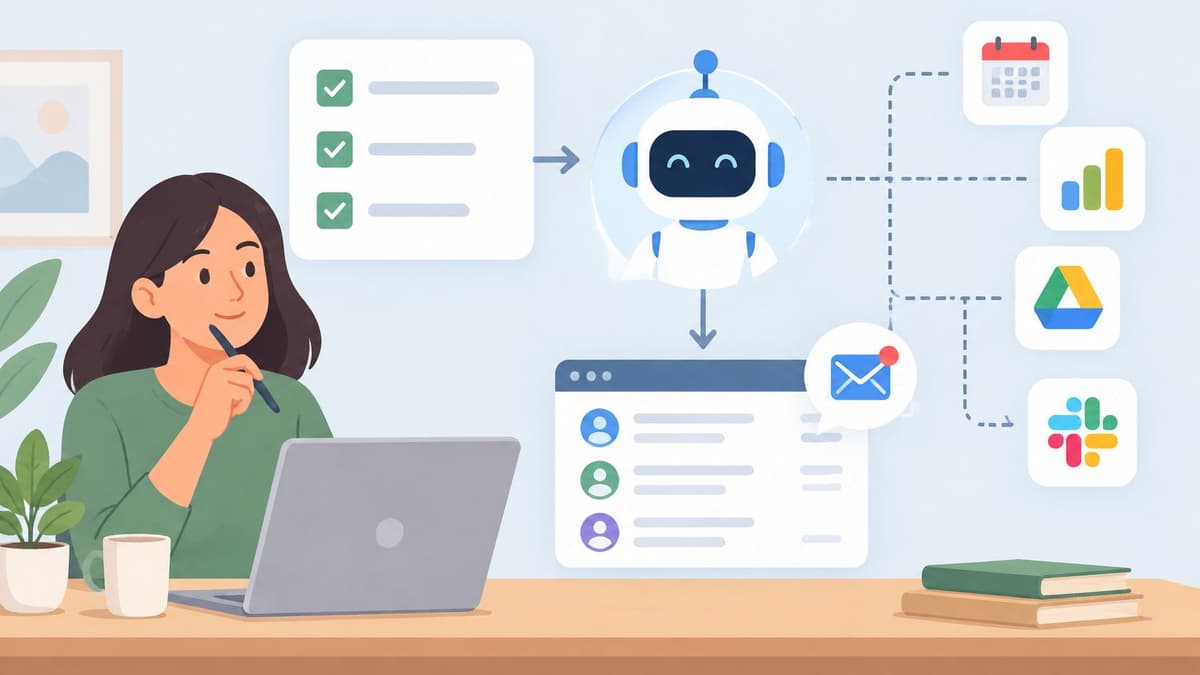
Decide What the Agent May Touch
Before you speak to any supplier, put three things in writing:
- What it may see, such as order records or the help inbox
- Which systems it may update, such as the ticketing tool or CRM
- Which actions need a person to approve, such as refunds or anything sent to a customer
Sort the process before you choose the software. An agent can send messages and change records, so its boundaries matter more than the name of the model underneath. The model is the underlying AI system that generates the words and decisions.
If nobody in the business can describe the workflow on one page, no supplier can build it safely.
A Readiness Check for Teams With No Technical Staff
If you are still unsure which workflow to automate, run three short workshops before any money goes into a build: list painful repetitive jobs, agree what the agent may and may not do, and name the owner for testing and sign-off.
It is a useful option, not a replacement for a scoped project. Once the workflow is clear, the specification above still has to exist.
Your Meeting Checklist
Take this into the next discussion:
- One workflow, described on a single page
- A success measure, such as routine emails per week
- Human approval points for sensitive actions
- Data the agent must never use
- A review after several weeks before another department is added
Keep the first scope deliberately narrow. There is more on testing an idea before committing budget in our guide to proof-of-concept testing.
That tight scope is what turns AI agent development from an experiment into something the team can genuinely run.
Once the spec is signed off, AI agent development becomes something you can follow without writing a line of code. It starts on paper: the job in plain words, a few examples of good and bad results, and clear limits on what the agent is allowed to do.
Builds work best when they are visible. Expect regular updates in normal language, so you can spot problems early and change direction while it is still cheap.
Then comes testing, and honestly, that is where it earns its keep. The team runs it against real messages and real records, including the ones it should refuse or hand to a person, and checks that every action leaves a trace.
The stages land in this order:
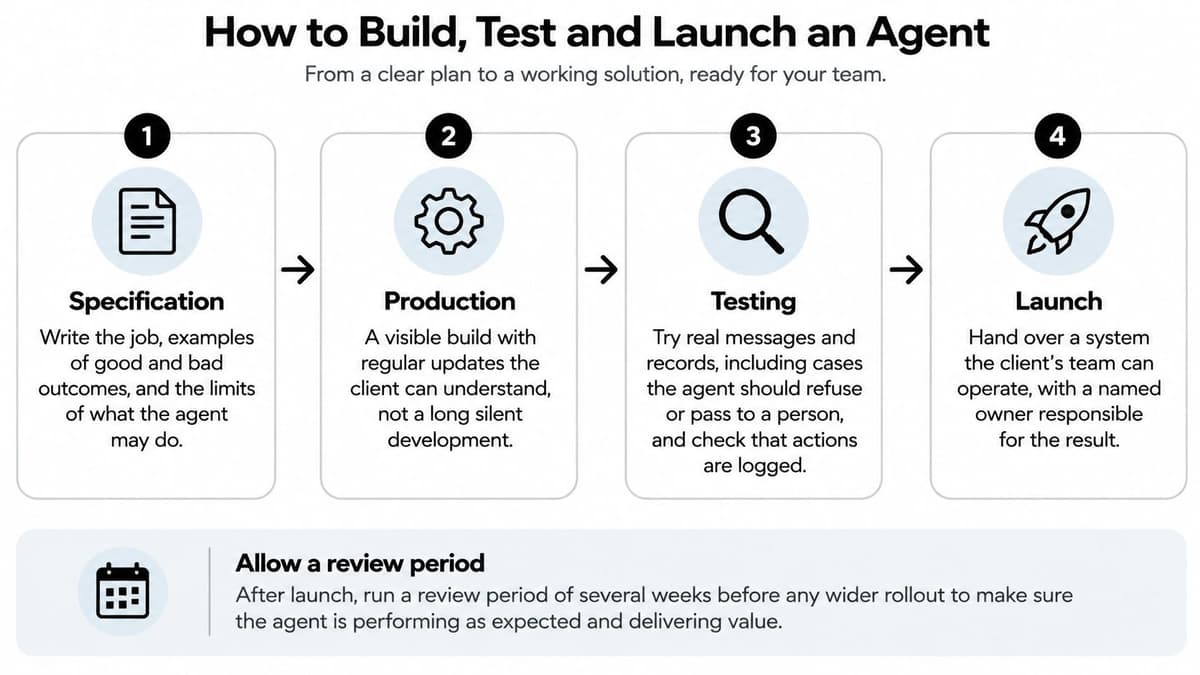
Launch is not the finish line. Allow several weeks of supervised running before you roll it out any wider.
What Each Stage Looks Like in a Support Team
A custom AI support agent lives in the queue with you. It answers emails, replies to chat, triages the awkward ones, and anything outside its permissions goes straight to a person.
A wider custom AI agent picks up the routine ops work that would otherwise mean another hire. Same principle, just a bigger remit, still inside those original boundaries.
Timing comes down to connections. A narrow support job moves quickly. An agent plugged into three or four systems takes longer, so scope by integrations, not ambition.
Keep the first release small, agree what done looks like, and do not expand autonomy until the first queue is stable.
If you are taking a prototype into live use, hosting and deployment decisions are part of the build, not an afterthought. Hosting means where the software runs and how it stays available. Beam's guide to agent hosting is a solid primer on that bit.
At handover, you should be left with something your team can actually run:
- a system configured around your process, not a demo
- logs you can audit without calling the supplier
- a named owner who answers for the result
Running more than one? Read our article on AI agent orchestration.
Budget for the whole workflow, not just the build. AI agent development costs come down to what it connects to, how much human review you need, and how much testing has to happen before you let it act.
What AI Agent Development Costs in the UK
These packages and its process from specification through launch to optional support are published starting points for scoped work, not a quote.
Published Starting Points for Agent Work
These are published prices for defined packages. Anything you pay to a third party for subscriptions or usage sits on top.
| Package | What it covers | Price | How you pay |
|---|---|---|---|
| Custom AI support agent | Answers email, replies to messages, triages issues | £3,000 | Once |
| Custom AI agent | Works as an extra team member | £3,000 to £10,000 | Once |
| Automated development team | Infrastructure to run an AI-agent development team | £5,000 | Once |
| All-in-one retainer | Maintenance, research, experiments, marketing material, documentation, servers, deployments, meetings, support, design and consultation | £1,000 to £15,000 monthly | Three-month minimum |
Management for the automated development team is available from £1,000 a month. To be clear, that one sets up the infrastructure for a development team, it is not the customer support agent.
Third-party subscriptions and usage sit outside these fees, and you pay those direct.
Compare the Full Running Cost
An online shop that only answers delivery questions from one system is a very different job from one that checks orders, updates customer records, and asks for refund approval. Ask every supplier to split out connection work, testing, and ongoing review.
Volume matters too. You can calculate token spend per request, meaning the cost of the text units an AI service processes, then get your supplier to check that against real customer conversations.
Before you compare quotes, ask for:
- Build scope, including which systems are connected and which actions are excluded.
- Monitoring responsibility, including who picks up failures.
- Usage assumptions, covering quieter and busier months.
- Management costs, including changes after launch.
Judge value on build, monitoring, usage and management together, not the headline fee alone.
And check what staff time is still needed, so you are comparing true operational effort.
Describe your project, with the workflow, the connected systems and expected volume, to talk through scope.

Give an agent the power to email a customer or update a record, and the same power lets it send the wrong message, open the wrong file, or carry on after the process has moved on. That is not a reason to avoid the technology. It is a reason to insist the controls come with the build.
UK firms point to the same blockers again and again: limited skills, weak use cases, ethical concerns, cost and uncertainty about regulation. Governance is part of what you buy, not something you bolt on later.
What A Wrong Reply Looks Like
Take a support agent that promises a refund your policy never allowed. With a human approval point on refunds, someone catches it before it reaches the customer.
Or a finance agent that marks an invoice as paid by accident. With a log of every action, the change is spotted and reversed the same day.
Permissions, human review, logs, testing and a written path for failure. If a supplier cannot explain all five, keep looking.
Questions To Ask Any Agency
- Which workflow is in scope, and what is excluded?
- What must the agent never do?
- Who approves sensitive actions?
- Where is our data stored?
- What do we pay to third parties?
- How is success measured?
- What happens after launch, and how does our team run it?
Read more on protecting your systems in our guide to AI agent security.
Three tips before you sign. Do not buy the most advanced model first. Do not automate a process nobody can describe. And watch one queue for several weeks before a second department gets involved.
Before you sign anything, nail down these four practical questions.
FAQ
How Long Does a First Agent Take?
A single support or operations workflow is far quicker to ship than one wired into three or four other systems. Agree the timing against a tight scope, then give yourself several weeks of review live before you even think about expanding it.
Do We Need Our Own Developers?
No, not if a supplier or off-the-shelf tool is doing the build. You will still need a business owner for the process itself, though: someone who owns the outcome and decides who can sign off what the agent does.
What Sits Outside the Build Fee?
You pay third-party agent subscriptions and usage separately. Get the supplier to split those running costs out from their build fee in writing before you agree a budget, so there are no surprises later.
Is a Retainer Required?
Not for a one-off package. Optional management for an automated development setup starts at £1,000 monthly, and any wider retainer is quoted separately with a three-month minimum.
Write down the workflow, which team it helps, and whether your aim is support, operations or something broader.
To discuss scope, cost and timing for your workflow, please describe your project.