4th November 2026 · 15 min
Anti-Money Laundering Software: A UK Compliance Guide

You're a compliance lead, a founder, or the person who inherited the spreadsheet. A customer has just paid in a way that doesn't match their file, your team is asking whether to let the payment through, and there's no single place that shows who checked what, when, and why. That's the moment most firms start looking at anti-money laundering software, not because they want more alerts, but because they need a defensible record.
The scale behind that decision is national, not just internal. The NCA UKFIU SARs annual report annexes for 2023 to 2024 recorded 872,048 Suspicious Activity Reports in April 2023 to March 2024, up from 859,905 the year before. Your firm only files a tiny share of that pipeline, but your software has to feed it cleanly, with structured cases and timestamps a regulator can follow.
Table of Contents
- What Anti-Money Laundering Software Does and Why Firms Need It
- Core Features and What Each One Covers
- How Transaction Monitoring Spots Suspicious Activity
- UK Rules the Software Has to Support
- How AML Software Connects to Banking and Payment Systems
- Building or Commissioning a Bespoke AML Solution
- Choose Your Scope and Confirm the Next Step
What Anti-Money Laundering Software Does and Why Firms Need It
A long-standing client who usually pays by bank transfer offers a large cash payment through a third party. A manual check may catch the change if the right person reviews it. AML software can flag the mismatch, create a case and preserve the information a reviewer needs to assess it.
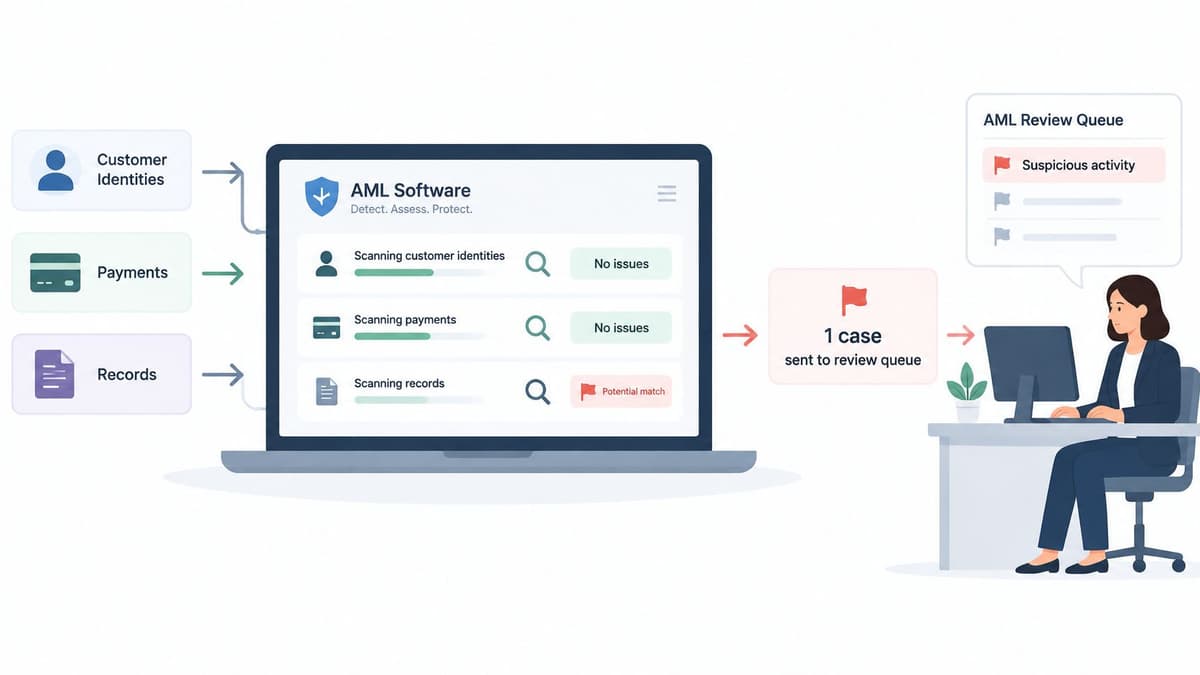
That is the practical role of anti-money laundering software: it supports decisions and records the evidence behind them. It does not determine whether a customer is guilty or replace a trained person's assessment. Its value depends on the quality of the data it receives and how well the firm sets and reviews its rules. Poorly tuned monitoring can create a queue of low-value alerts that obscures the cases requiring attention.
The UK Adoption Gap
Many firms facing money-laundering incidents still rely on manual detection rather than automated monitoring. Manual checks can suit a small operation with limited payment activity, but they depend on staff spotting relevant patterns consistently. As activity grows, software can apply checks more consistently and give reviewers a traceable record of alerts, evidence and decisions.
The right scale depends on the firm. A smaller business needs proportionate monitoring and clear case records; it does not need to reproduce the national-scale reporting pipeline run by the NCA. Banks, payment firms, fintechs, estate agents and accountants can start by identifying which customer and payment risks their processes need to cover. Firms considering wider automation can review AI applications in finance and fintech before deciding where AML-specific controls belong.
Practical rule: Choose software to reduce missed warning signs and keep a timestamped record of what the firm reviewed, what evidence it considered and why it acted.
The software supports the reporting process, but the firm remains responsible for deciding whether to report suspicious activity.
Core Features and What Each One Covers
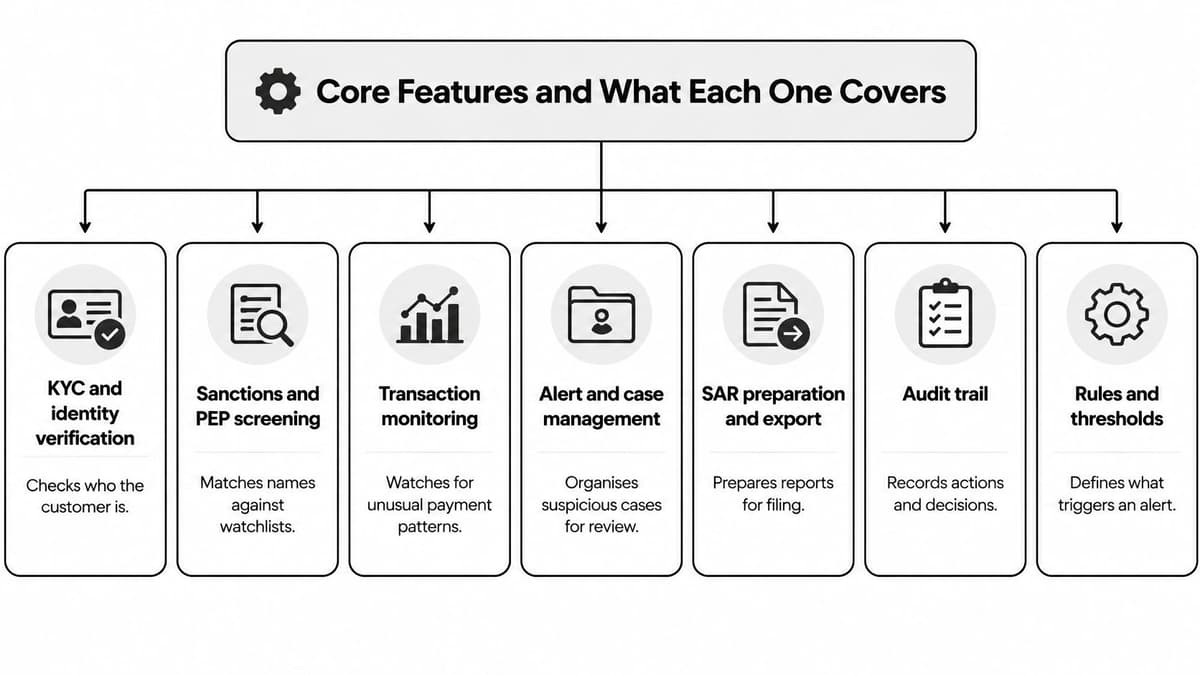
The table below shows the seven modules you'd expect in a coherent system, what each one takes in, and what a reviewer sees.
| Module | What it does | Typical data in | Output a reviewer sees |
|---|---|---|---|
| KYC and identity verification | Confirms who the customer is and rates their risk | ID documents, address, company register data | Verification record and customer risk rating |
| Sanctions and PEP screening | Checks names against watchlists at onboarding and afterwards | Customer names, dates of birth, watchlist files | Hit list with match scores and dispositions |
| Transaction monitoring | Applies rules and profiles to payment activity | Transaction feeds, counterparty and amount fields | Alert queue with rule ID and reason |
| Alert and case management | Groups, assigns and tracks alerts through investigation | Alerts, analyst notes, evidence files | Case file with status and owner |
| SAR preparation and export | Drafts suspicious activity reports for the nominated officer | Case rationale, transaction records | Report ready for submission through the NCA channel |
| Audit trail | Records every event, decision and access | System events, user actions | Immutable, timestamped log |
| Reporting dashboards | Shows alert volumes, outcomes and backlog | Aggregated case and alert data | Metrics by rule, team and customer segment |
How the Modules Hand Work to Each Other
Modules aren't a shopping list, they're a chain. An onboarding check sets a customer risk rating, that rating changes monitoring thresholds, those thresholds create alerts, and alerts become cases with an owner and a deadline.
Say a property firm receives, for example, a £40,000 cash deposit from a new client with no identity document on file. The KYC gap raises the risk rating, the monitoring rule fires on the deposit, screening runs against watchlists, and a case opens. The analyst records what's missing, requests documents, and either clears the client or escalates.
Where Gaps Show Up First
- Missing KYC link: Monitoring can't tell whether activity fits the customer.
- No case management: Alerts sit in email inboxes with no owner.
- Weak audit trail: You can't reconstruct who cleared a hit or why.
A missing module leaves a visible gap in that chain. In my judgement, that's usually what an examiner looks for first, not whether your dashboard looks polished.
How Transaction Monitoring Spots Suspicious Activity
Two mechanisms decide whether an alert fires, and they answer different questions. Fixed rules ask whether activity breached a set threshold or pattern, for example £10,000 in 24 hours to a new payee. Profiling asks whether this customer is behaving unlike themselves, or unlike similar customers.
| Approach | How it decides | Main strength | Main weakness |
|---|---|---|---|
| Fixed rules | Compares activity with set thresholds or patterns | Explainable and effective for known typologies | Excess alerts when thresholds are poorly calibrated |
| Customer profiling | Compares current activity with the customer's own history | Spots sudden behavioural change | Needs clean, long-running historical data |
| Peer-group comparison | Compares activity with similar customers | Useful where individual history is thin | Depends on a well-defined peer group |
| Hybrid (rules plus profiling) | Combines rule triggers with statistical scores | Balances explainability and detection | More complex to tune and document |
The FCA Financial Crime Thematic Review guidance describes rules-based systems as comparing activity against fixed thresholds or predefined patterns, while profiling applies statistical models to compare current behaviour with the customer's historical activity or a relevant peer group. That distinction drives your data requirements. Rules need clear definitions, profiling needs clean history, and both need version control.
A Worked Example Where Signals Disagree
Say a rule alerts on, for example, a £9,800 transfer split across three days, just under a round threshold. On its own that looks like structuring, splitting payments to avoid attention. The profile adds context, this customer pays a supplier in instalments every month, so the pattern may be routine.
Now flip it. A retailer whose transfers normally sit around, for example, £2,000 a month suddenly moves £30,000. No single payment breaches a fixed rule, but the profile flags a sharp deviation. The investigator compares both signals, checks the counterparty and supporting invoices, records why each signal fired, and escalates or closes with a written rationale.
Don't tune a system to produce fewer alerts. Tune it to produce alerts you can explain and defend.
Metrics That Keep Tuning Honest
Track performance by rule, not just in total. Useful measures include alerts per 1,000 transactions, confirmed suspicious cases per rule, average investigation time, escalation rate, and model drift across customer segments.
Test every threshold change on past data before you release it. You're looking for fewer false positives, cases that waste analyst time, without suppressing genuine risk. If a rule never produces a confirmed case, retire or rewrite it. If it floods the queue, recalibrate it with evidence, document the change, and keep the old version in the audit log.
UK Rules the Software Has to Support
A payment alert is only useful if the firm can show what triggered it, who reviewed it and why the case was closed or escalated. UK AML software should support that evidence trail while leaving reporting decisions to the firm's nominated officer.
The FCA Financial Crime Guide on money laundering controls says firms should monitor transactions against what they know about the customer. The Money Laundering Regulations 2017 set the regulatory foundation, including customer due diligence, ongoing monitoring and record keeping. A nominated officer is responsible for deciding whether to submit a Suspicious Activity Report (SAR) to the National Crime Agency.
| Obligation | Who it applies to | Evidence the software must hold |
|---|---|---|
| Customer due diligence and identity checks | Regulated firms, including fintechs and property businesses | Verification records, risk rating and dates |
| Ongoing monitoring | Regulated firms with business relationships | Rule and model versions, alert logs and outcomes |
| SAR reporting | Nominated officer in each regulated firm | Alert disposition, rationale and submission log |
| Record keeping | Regulated firms | Retained records, access logs and timestamps |
| Sanctions screening | Firms with sanctions obligations | Screening hit log and false-positive dispositions |
The software should preserve a traceable sequence from transaction event to alert, investigation and decision. Where a case is escalated, retain the rationale and any SAR submission record. Timestamps and access logs help show who handled the evidence and when.
What This Means for Design
Build the case workflow around structured triage, investigator notes, evidence preservation, role-based approvals and quality-assurance sampling. If the system uses AI or machine learning, retain information about how it reaches a result, test thresholds, record overrides and assign a compliance owner to each model. Automation can prioritise cases, but it cannot make the nominated officer's reporting decision.
Proportionality matters. The UK anti-money laundering and asset recovery strategy 2026 to 2029 warns against “blanket or excessive controls” that disrupt legitimate customers. A firm's tooling should fit its risks and transaction volumes. Map each obligation to a control, record any gaps and document why the controls are proportionate.
How AML Software Connects to Banking and Payment Systems
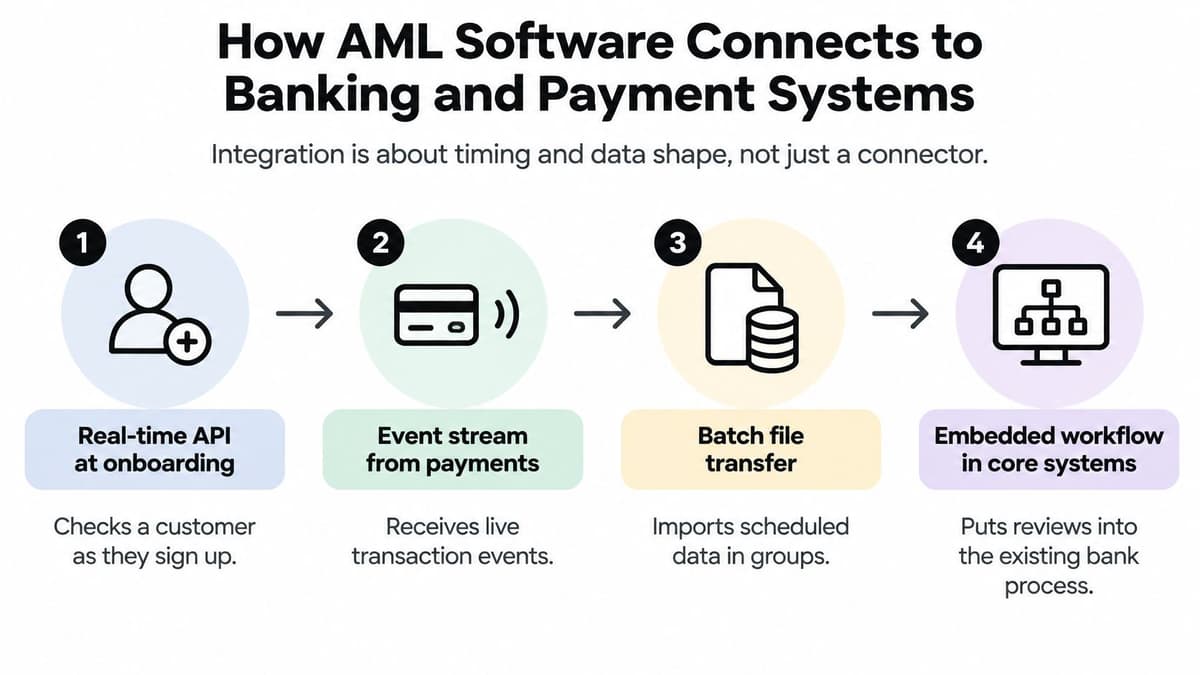
Integration is about timing and data shape, not just buying a connector. The right pattern depends on when you need a decision and how clean your source data is.
| Pattern | Best for | Typical timing | Data sent |
|---|---|---|---|
| Real-time API call at onboarding | Firms verifying new customers | Within seconds | Name, date of birth, address and ID document reference |
| Event stream from payment rails | Payment and card firms | Near real time | Transaction event with amount and counterparty |
| Nightly batch file | Banks and SMEs with bulk ledgers | Once a day | CSV or fixed-width transaction file |
| Manual upload to case tool | Micro-firms with low volumes | Ad hoc | Spreadsheet export of cases and transactions |
The Seven-Step Flow
- The source system sends a customer or payment event.
- The screening or monitoring service scores it against rules and profiles.
- An alert is generated with its rule ID and reason.
- An analyst triages the alert in the case tool.
- The decision and rationale are logged against the customer record.
- The nominated officer prepares and submits any SAR through the NCA channel.
- The audit log writes the event, access and timestamps.
If you're building these connections yourself, a primer on how to develop an API helps you specify payloads, authentication and error handling before compliance testing starts.
Common Failure Points and Fixes
- Inconsistent customer IDs: Use a single customer key across systems.
- Duplicate transactions from retries: Use idempotency keys so replays don't double-count.
- Mismatched time zones: Store UTC alongside local time.
- Late legacy batch files: Set a cut-off and alert on delay.
- Missing counterparty fields: Make them mandatory, or profiling breaks.
I would let a small firm start with a manual upload and move to event-based feeds once volumes justify the engineering cost.
Building or Commissioning a Bespoke AML Solution
Buying a licensed platform by default is a lazy assumption. Sometimes it's right. Sometimes vendor rules don't fit your products, your legacy ledger won't connect cleanly, or you need to own the logic your regulator will question.
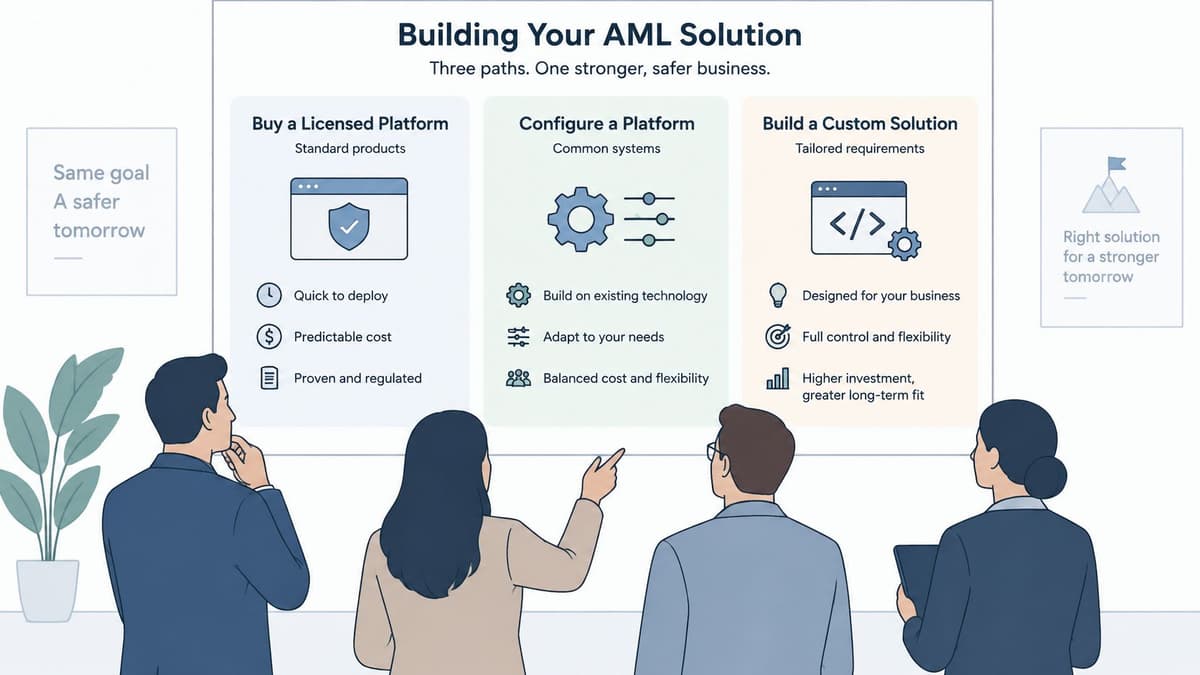
The image below shows the kind of cross-functional review, compliance, engineering and operations in one room, that a sound commissioning decision needs.
| Option | Best when | Cost pattern | Main risk |
|---|---|---|---|
| Buy a licensed platform | Standard products and common systems | Subscription plus onboarding | Vendor rules that are hard to change |
| Configure an existing platform | Firm can tune rules but needs no custom code | Licence plus configuration services | Hidden tuning work and thin documentation |
| Build a bespoke solution with a partner | Unusual products, legacy systems or owned rules | One-off build plus ongoing support | Model governance falls on the firm's own team |
Budget intent is already high. PwC's 2024 UK insights report on its EMEA AML Survey found 97% of UK respondents planned to allocate part of their budget to AI and digital tools for transaction monitoring, customer-risk assessment and screening in 2024. The question isn't whether to spend, it's whether you can evidence what the spend changed.
What a Commissioning Brief Should Contain
- The typologies your firm faces, by product and channel.
- Data sources and the quality checks you'll run on each feed.
- Rules and models, each with a named owner.
- Alert and case workflow, with service levels for triage and escalation.
- SAR preparation and export requirements.
- Audit trail and retention rules, including access logging.
- A test plan using synthetic or anonymised cases.
A general guide to custom developed software is useful background here, but an AML brief needs the governance detail above, not just features and screens.
The short video below is a useful prompt for discussing delivery approach and team roles before you sign a build contract.
Testing AI Without Exposing Customer Data
You can't freely share real suspicious-transaction data for testing. The FCA synthetic data for anti-money laundering project report stresses trade-offs among realism, privacy and data coherence, and concludes synthetic data should complement, not replace, live operational data. Build privacy-safe test cases around named typologies, embed known laundering patterns, and check whether the system finds them.
Then run assurance like an engineer, not a buyer. Benchmark precision and recall, review explainability for each score, monitor drift by segment, and link every model output to a recorded human decision. Reproduce an old alert after a model change, or you can't prove what changed.
Assurance test: If you can't replay a past alert and show the exact rule version that fired, your governance isn't finished.
Proven delivery in this space is relevant when you choose a partner. We worked with ASURISQ ApS to launch its anti-money laundering compliance platform in December 2025. Our team includes Lucas Comte, a software engineer who has built reliable systems where failure is costly at CERN, which is the right mindset for audit-grade tooling.
Choose Your Scope and Confirm the Next Step
Run this checklist this week. Each item is deliberately small, because a vague programme produces vague software.
Your Six-Item Checklist
- Count alerts and cases per month to size the workload.
- List every product and payment channel you offer.
- Map each UK obligation to a named owner.
- Decide buy, configure or build using the options compared earlier in practical terms.
- Set three starting metrics, alerts per 1,000 transactions, confirmed cases per rule, and average investigation time.
- Write a one-page brief covering typologies, data, rules, workflow, SAR export, retention and testing.
Be honest about capacity while you do it. If one person owns compliance, sales onboarding and complaint handling, a real-time event stream will create work nobody can clear. Phase the scope, identity checks and screening first, then monitoring, then richer profiling once you've got clean history.
The Go or No-Go Test
If there's no named compliance owner, don't commission a build yet. A system without an owner can't evidence its decisions, approve overrides, or answer a regulator's questions about a threshold change.
If internal capacity is thin, I would start with a scoped discovery phase with an external specialist. You get a written scope, a data-quality assessment and an assurance plan before committing to a platform or a build. End where an examiner will start, with the audit trail, and make sure every decision you'd need to defend is already in it.
If you're scoping proportionate anti-money laundering software, from screening and transaction monitoring to case workflow and audit reporting, Digital Souls Studios LTD can run a focused discovery phase and build the bespoke system your risk profile requires. Visit Digital Souls Studios LTD to discuss your obligations, data sources and assurance plan, and get a written scope before you commit to a platform.