12th October 2026 · 14 min
How to Develop an API: The Essential MVP Guide

If you're at the point where the product needs a real backend, the API can't be an afterthought. The moment a frontend needs data, a mobile app needs stable responses, or a client asks for webhook support, the weakest part of the system is usually the contract between services. That's why how to develop an API starts with clarity, not code.
The most common failure I see is teams jumping straight into routes and database tables. They ship something that works in Postman, then spend the next few weeks untangling auth gaps, inconsistent payloads, and broken assumptions between frontend and backend. A better approach is to treat the API as a product interface from day one, with documentation, security, and data shape decided before implementation begins.
Table of Contents
- Laying the Foundation with an API-First Approach
- Defining Your Contract and Data Models
- Building Endpoints and Implementing Security
- Testing Strategies and Validation Techniques
- Crafting Clear Documentation for Developers
- Deploying and Monitoring Your Live API
Laying the Foundation with an API-First Approach
Teams often start with controllers because it feels productive. A route responds, JSON comes back, the demo works, and everyone moves on. The problem shows up later, when the API has drifted away from the business process it was meant to support, and every change becomes a negotiation between code, docs, and consumers.
The UK Government's API guidance makes the foundation clear, it was built to help departments and local authorities build, authenticate, iterate, and document APIs consistently Government API design guidance. That history matters because it frames API work as an engineering discipline, not a loose collection of endpoints. For SaaS, fintech, and compliance products, that mindset avoids the common trap of building an API that technically functions but is painful to integrate, secure, or evolve.
Contract before code
API-first means you define the shape of the interface before you write the implementation. That includes the resources, the HTTP methods, the authentication model, and the error behaviour. When you do that early, frontend and backend teams can work in parallel without waiting on each other, and product decisions become visible in the contract instead of buried in source code.
Practical rule: if you can't describe the request and response clearly on paper, you're not ready to code the endpoint.
This is also where architecture decisions become easier. If the API is part of a wider web platform, your service boundaries, data ownership, and integration points should line up with the application architecture rather than being bolted on later. A useful reference point is web application architecture planning, because API design is rarely isolated from the rest of the stack.
The core trade-off is speed versus rework. Coding first feels faster for a day. Contract-first feels faster for the whole project because you catch awkward resource names, missing fields, and unclear permissions before they harden into production behaviour.
Defining Your Contract and Data Models
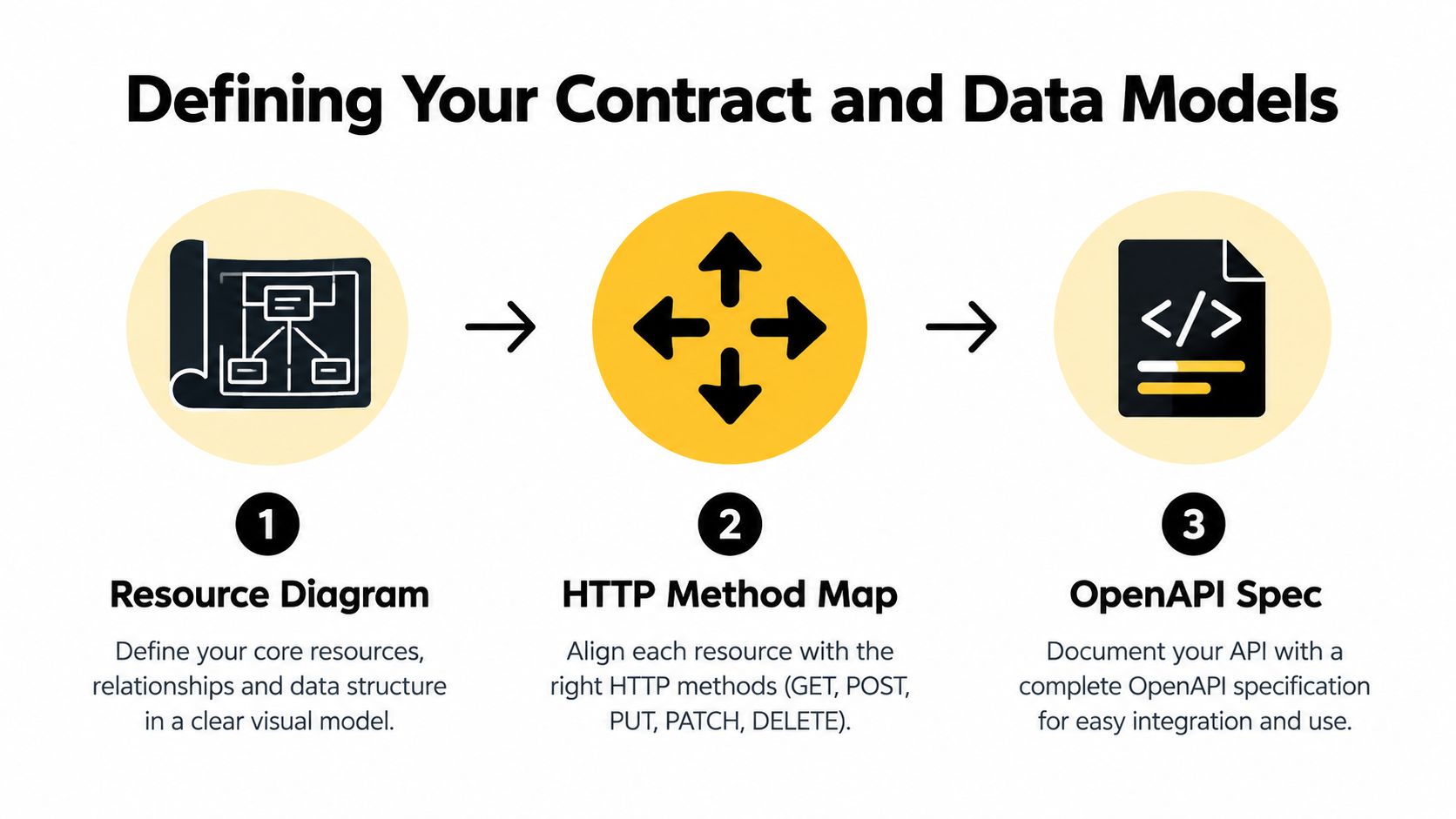
A contract-first API starts with the resource shape, not the database schema. Define the business nouns first, then map them to endpoints, methods, and validation rules. If the product exposes customers, invoices, devices, or transactions, each one needs a stable structure and a clear lifecycle.
The common failure mode is letting the database drive the interface. That usually creates awkward responses, leaky abstractions, and field names that make sense inside the service but confuse consumers. Define what the client must know, then shape the resource around that need.
Write the OpenAPI spec early
OpenAPI should be the source of truth, not a document assembled after implementation. Define the path, method, parameters, request body, response schema, and error responses before code starts. That gives the team one place to check assumptions and lets you generate or validate server and client code against the same contract. The OpenAPI Specification docs are the right reference for that work OpenAPI Specification.
For public or regulated APIs, the same discipline shows up in the GDS API technical and data standards. They call out JSON responses, UTF-8, schema validation that rejects unknown attributes, restricted HTTP verbs, and correctly configured CORS GDS API technical and data standards. Those rules reduce ambiguity, protect consumers from accidental breakage, and make contract testing meaningful.
Model edge cases inside the contract
Good contracts describe the unhappy path as clearly as the happy one. Show what happens when required fields are missing, values are malformed, a user sends unsupported attributes, or a resource no longer exists. That matters in fintech and compliance, where downstream systems often depend on exact error handling.
A useful way to keep the work grounded is to answer these questions in order:
- What is the resource? Use business language, not table language.
- Who owns the data? Decide which service is authoritative for each field.
- What changes are allowed? Mark immutable fields and version-sensitive fields early.
- What fails safely? Define validation errors, permission errors, and not-found responses explicitly.
A contract that hides edge cases creates support tickets later.
The link between data modelling and implementation matters here. If a field is optional in one workflow but mandatory in another, encode that rule up front instead of hoping the controller will enforce it consistently. For a broader build process reference, how to make a web application helps frame the API as one component inside a larger product build.
Building Endpoints and Implementing Security
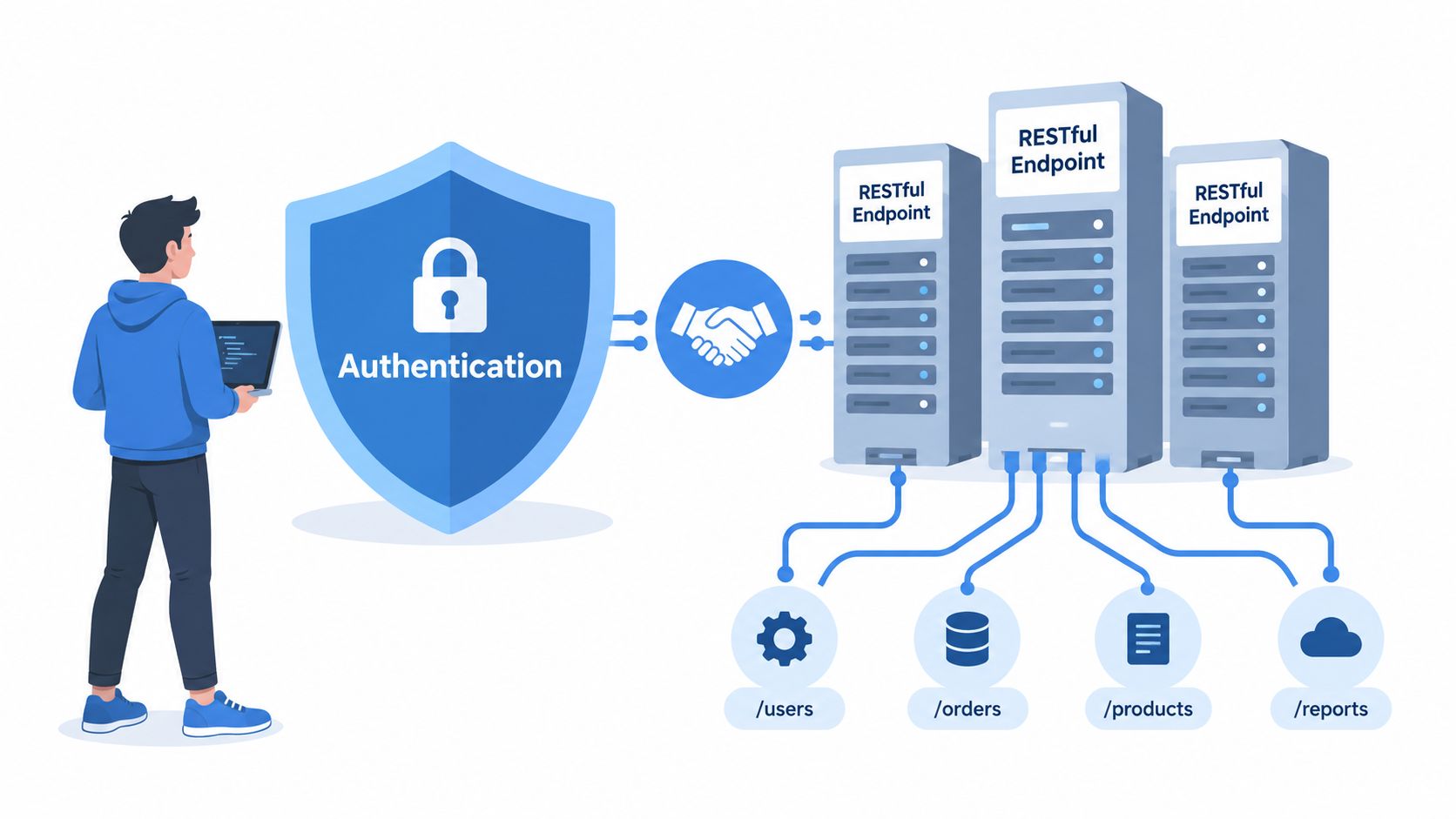
The first version of an endpoint should be boring. It should accept the documented input, enforce the documented rules, and return the documented response without guessing. That discipline matters more than fancy framework features, because every shortcut becomes a future compatibility problem.
For sensitive products, security has to be in the path before the first request reaches business logic. UKHSA guidance recommends OAuth 2.0 and OpenID Connect, extensive input testing, rate limiting, secure-by-design practice, and UK GDPR alignment UKHSA API guidelines summary. That lines up with what works in production. Authentication proves identity. Authorisation decides what that identity can touch. Those are not the same thing.
Build the endpoint in the right order
Start with input validation. Check body, path, query, and header values against the contract before anything else happens. Then apply server-side authorisation on every protected resource, using least privilege and RBAC where it makes sense. After that, add rate limits, quotas, pagination limits, payload-size limits, and timeout budgets so the API fails predictably under stress.
Practical rule: a valid token is not proof that the caller can access a particular record.
That distinction is where many APIs leak data. If the token says the user is authenticated, but the code never checks object-level permission, a user can sometimes read or change records that don't belong to them. CI should catch that class of failure with explicit tests for broken-object-level authorisation.
Choose controls that match the risk
API keys are simple, but they're a weak fit when a product needs granular user identity, delegated access, or revocation discipline. OAuth 2.0 and OpenID Connect are heavier, but they scale better when the API serves multiple client types or touches regulated data. For internal services, token format matters less than enforcement, logging, and revocation handling.
Security also needs to cover the operational layer. Centralised structured audit logs should exclude secrets and unnecessary personal data, while dependency inventories and incident response procedures should exist before launch. If the API handles UK personal, financial, learning, or workforce data, classification and lawful processing come first, not after the first build sprint.
Digital Souls Studios LTD offers backend delivery that can include APIs, data layers, and integrations as part of broader SaaS and software work, which fits teams that need a full build rather than a single endpoint implementation. That matters when the API is one piece of a larger product, not the whole product.
Add practical guardrails
- Reject unknown attributes: this keeps clients from smuggling in fields you never intended to accept.
- Set clear request limits: large payloads and unbounded queries turn into availability problems quickly.
- Log the right things: capture request context and security events, not secrets.
- Test failure paths: retry logic, expired tokens, and permission denials should all behave consistently.
After the implementation layer is in place, the security posture still isn't finished. It only becomes real when it's proven under test.
Testing Strategies and Validation Techniques
A working API is not enough. A release only earns trust when unit tests, integration tests, and contract tests each prove a different layer of behavior. Unit tests catch broken business rules in isolation. Integration tests confirm the database, middleware, and external services still work together. Contract tests protect the documented interface, which matters most once other teams or customers start building against it.
Authentication also changes what you test. API keys, OAuth, and OpenID Connect solve different problems, so the validation strategy should match the access model. A key-based setup may be acceptable for a low-risk internal integration, but it tells you very little about per-user access control, token expiry, or revocation behavior. OAuth and OIDC add more moving parts, and that creates more places for mistakes, especially in regulated or customer-facing systems.
Test the right layer with the right tool
Unit tests are the fastest way to catch broken business rules. Integration tests confirm that database calls, external services, and middleware still behave correctly together. Contract tests are the release guardrail, because they surface breaking changes before consumers feel them.
UK government API guidance sets the expectation that API teams should run unit, integration, contract, security, load, and failure-recovery tests, with deployment protected by CI/CD and production monitoring for availability, latency, error rate, saturation, and dependency failures GDS API technical and data standards. That sequence matches what works in production, especially when several consumers depend on the same interface.
Load and recovery testing aren't optional
Load tests show whether the API can meet its target response time under expected concurrency. Failure-recovery tests show how the system behaves when a dependency is slow, unavailable, or returning bad data. Those are separate checks, and both matter if the API supports billing, compliance workflows, or customer automation.
The weak pattern is testing only the happy path and one invalid input. That creates false confidence. The API may survive a single manual request, then fail when a queue backs up, a dependency times out, or retries start piling up.
Good test coverage is not about volume. It is about whether the release can survive the ways production fails.
For teams building with a product mindset, the testing layer should also support release discipline. Contract compatibility checks on every release, plus explicit backward-compatibility checks, give you a real signal that clients can keep working after a change.
Crafting Clear Documentation for Developers
Documentation is the product surface for API consumers. If it is vague, stale, or buried, engineers work around it and support costs rise. If it is clear, current, and honest about edge cases, adoption gets easier and integrations move faster.
The common mistake is treating docs as a post-launch cleanup task. By the time a team returns to write them, half the implementation details are already forgotten, and the documentation ends up describing what the code does today instead of what consumers need to know. Write the docs alongside the contract so they reflect the same source of truth.
Make the docs answer real integration questions
Start with the basics, then cover the failures people hit. A developer reading your API documentation wants to know how to authenticate, what the request body should look like, what a success response contains, and how errors are reported. They also need to know which fields are required, which are optional, and which can change in a future version.
Document the practical details that reduce back-and-forth. In the Home Office and wider government standards, teams are expected to describe requests and responses, authentication onboarding, error handling, rate limits, issue-reporting procedures, and version information. That level of detail matters because it cuts guesswork. Clear examples help, but clear failure responses matter more when a client is debugging a broken integration late in the day.
Document for humans and automation
AI-ready documentation needs more than examples. UK government work on making datasets ready for AI says that a basic API does not automatically make data AI-ready, because datasets also need metadata, ownership, quality controls, governance, and human oversight making government datasets ready for AI. That matters for API design because consumers increasingly use endpoints as inputs for dashboards, automation, and agentic workflows.
So the docs should include provenance fields, freshness timestamps, validation status, and clear ownership where those concepts matter. If a record can be incomplete, corrected later, or blocked from high-impact automation, say so plainly. Automated agents can only use what you describe, and human integrators can only trust what you explain.
A practical documentation checklist looks like this:
- Authentication guide: show exactly how a client gets access and where to send tokens.
- Error schema: publish predictable fields for validation, permission, and server failures.
- Version notes: state what changed, what is deprecated, and what remains supported.
- Data meaning: define business terms, not just field names.
Publish your error schema and version notes in the same repository as the OpenAPI spec, so docs and contract are updated in the same pull request.
Deploying and Monitoring Your Live API
Release is not the finish line. It's the point where the API becomes real, because now every bad assumption can affect actual users. A safe deployment process is less about ceremony and more about making change observable, reversible, and boring.
A CI/CD pipeline should automate the build, run the tests, validate the contract, and deploy only when the release meets the team's acceptance criteria. The point is to keep humans focused on decisions, not on repetitive steps that a machine can do consistently. If deployment still depends on someone remembering the sequence from memory, the process is too fragile.
Monitor what breaks first
Production monitoring should start with availability, latency, error rate, saturation, and dependency failures. Those are the signals that tell you whether the API is healthy enough to serve real traffic. Log volume and request counts are useful too, but only if they help you understand whether the system is under strain or a particular integration is misbehaving.
The UK government's digital review reported that more than 80% of government services were online, generating 95 million digital transactions and approximately 4 billion API hits each year, and it also noted that only about half of UK public services had a digital channel UK Government API catalogue and digital service review. Those figures show why monitoring can't be an afterthought. If public services operate at that scale, even a modest SaaS API needs clear capacity planning, observability, and failure handling from the start.
Versioning keeps the API usable
Versioning is part of trust. If you break clients without warning, they stop upgrading cleanly and begin pinning old behaviour in messy ways. Deprecation rules should be clear, and old endpoints should have a published sunset path so consumers can migrate on purpose rather than by accident.
The cleanest API release is the one consumers barely notice.
That's where operational discipline pays off. A stable API lets teams ship features without creating fear around every release. For organisations that need API work alongside product delivery, infrastructure, or ongoing support, the software development lifecycle is the right lens, because launch is only one stage of the system.
If you need an API planned, built, secured, and documented as part of a real product release, Digital Souls Studios LTD can help with that end-to-end delivery. The studio works across web applications, SaaS, AI automation, and API-backed integrations, so it fits teams that need more than a quick prototype. Visit Digital Souls Studios LTD to discuss a build, an audit, or the next version of your platform.