6th October 2026 · 20 min
10 Benefits of Chatbots for Business in 2026
A surprising chatbot lesson is that availability is easier to earn than trust. In a European and Middle Eastern consumer survey, 21% of consumers were comfortable using a chatbot for general information, while 39% preferred a customer-service agent when solving a problem. The same evidence found that 85% wanted a choice of channels, which makes the strongest chatbot model a hybrid one, not an automated wall between customers and staff. (Enterprise Times' reporting on the consumer research)
The practical benefits of chatbots appear when businesses treat them as workflow infrastructure. A well-designed bot can answer routine questions outside office hours, qualify demand, collect structured context, search an approved knowledge base, update a ticket, and route a difficult case to the right person. A poorly designed bot adds another obstacle to an already frustrated customer.
This list focuses on the operating model behind each benefit. For every use case, the important questions are the same: which bottleneck is being addressed, what system must the chatbot connect to, how will the team measure value, and when must a human take over? The ten benefits move from immediate service improvements through operational efficiency, sales, learning, integration, internal support and compliance.
Table of Contents
- 1. 24/7 Customer Support and Reduced Response Times
- 2. Operational Cost Reduction and Efficiency Gains
- 3. Lead Generation and Sales Qualification
- 4. Personalisation and Enhanced User Experience
- 5. Automated Data Collection and Business Intelligence
- 6. Scalable Training and Learning Delivery
- 7. Seamless Integration with Existing Business Systems
- 8. Improved Internal Operations and Employee Productivity
- 9. Multilingual Support and Global Market Expansion
- 10. Risk Mitigation and Compliance Automation
- 10-Point Chatbot Benefits Comparison
- Turn Chatbot Potential into a Measurable Workflow
1. 24/7 Customer Support and Reduced Response Times
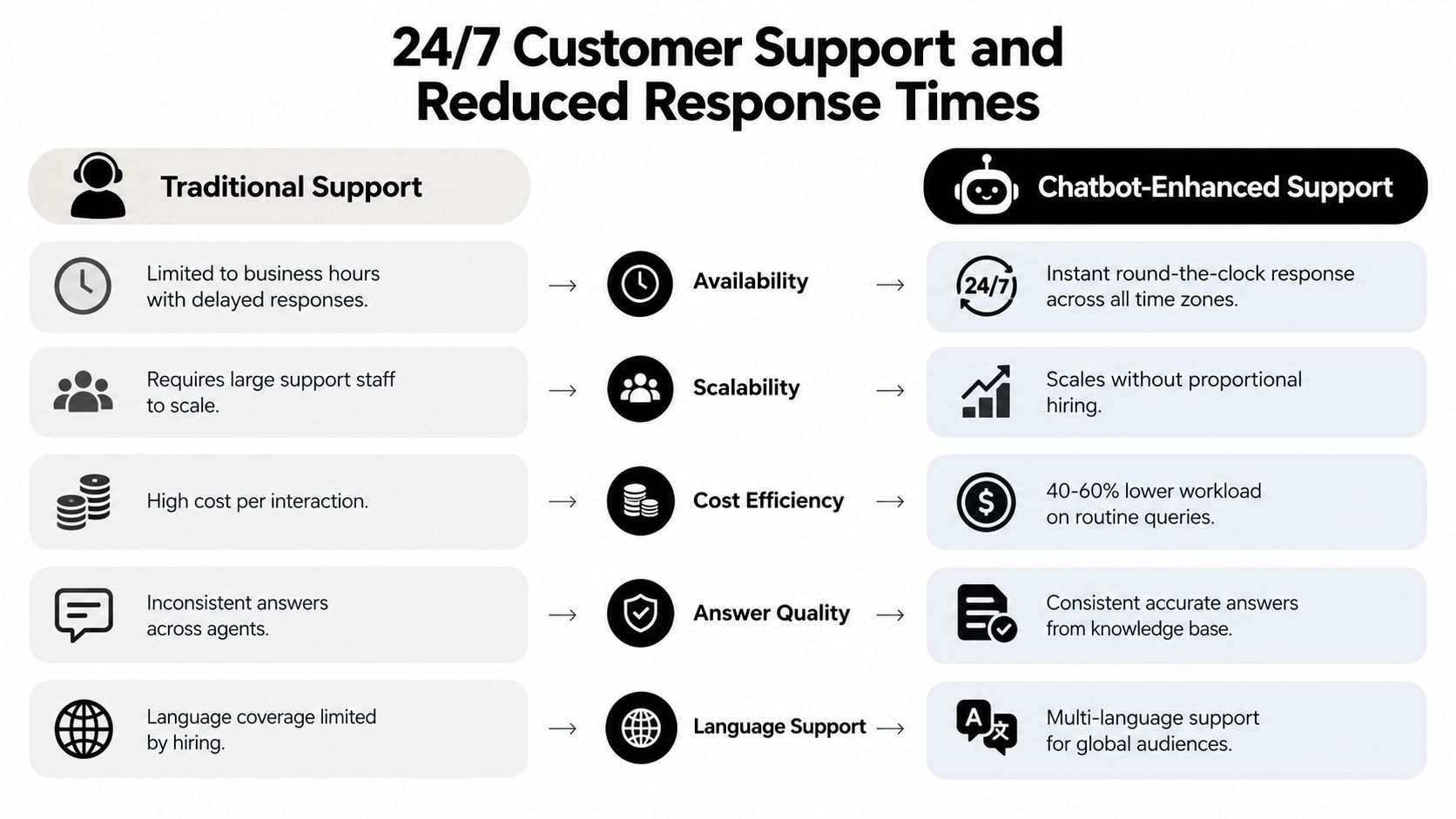
Customers don't always need a person immediately. They often need a clear answer about an account feature, delivery status, password reset, subscription plan or return process. A chatbot can provide that first response at any time, then preserve the conversation history when a support agent needs to take over.
The UK Government Digital Service identifies faster answers, support outside normal office hours and channel shift as potential benefits of AI-powered customer-service tools. Its framework also links digital resolution with lower failure demand, where users abandon a digital route and later contact a more expensive support channel. The potential annual benefit to government from automating customer-service tasks is estimated at up to £1 billion, although the framework makes clear that this isn't a guaranteed saving and depends on adoption, redesign, quality control and staffing decisions. (UK Government Digital and Data Benefits Framework)
Design the handoff before the answer
Start with a narrow set of repeatable intents, such as FAQs, order status or onboarding guidance. Connect the bot to an approved knowledge base and ticketing platform, then measure first-response time, answer accuracy, abandonment, escalation latency and resolution without repetition.
A human handoff should be visible and easy. Escalate when the bot detects repeated misunderstandings, a complaint, vulnerability, safeguarding concerns, financial disputes or a request requiring judgement. A support chatbot should reduce friction, not make customers prove that automation has failed.
For teams building a broader support workflow, AI customer service solutions from Digital Souls Studios can form part of a custom agent and escalation design.
2. Operational Cost Reduction and Efficiency Gains
Cost reduction doesn't come from installing a chatbot. It comes from removing avoidable handling work while keeping service quality under control. The business case is strongest when a team spends substantial time repeating the same answer, copying information between systems or routing requests that could have been classified automatically.
A SaaS support team might use a bot to identify a billing question, retrieve the relevant account article and create a pre-populated ticket if the customer still needs help. A fintech operation might use conversational intake to collect missing information before a specialist reviews the case. In both examples, the chatbot changes the shape of human work rather than eliminating the need for people.
The ONS provides useful UK context, but its data doesn't isolate chatbots. Technology adopters were associated with 19% higher turnover per worker after controlling for management practices and firm characteristics. Among businesses considering AI adoption, 69% planned to use AI to upgrade processes and methods, while 42% planned to automate tasks previously performed by labour. These figures shouldn't be presented as proof that a chatbot produces a 19% productivity increase. They show why process design and measurement matter. (Office for National Statistics analysis of UK firms)
Count the full cost
Include model or platform fees, hosting, integration, monitoring, content maintenance, security review, training and human quality control in the business case. Compare those costs with cost per resolved interaction, handling time, queue volume and time saved by specialists.
Practical rule: Automate the highest-volume, lowest-complexity work first. Keep exceptions, judgement and sensitive cases with trained staff.
A chatbot that creates more corrections than it saves isn't efficient. AI workflow automation for small businesses is most useful when it connects conversational intake with the actions that follow, rather than adding another isolated interface.
3. Lead Generation and Sales Qualification
A website visitor who arrives outside sales hours shouldn't have to search through a static site to understand whether a product fits. A chatbot can ask a small number of relevant questions, explain the next step, capture consented contact details and book a meeting when the visitor is ready.
The operating benefit is better allocation of sales attention. A SaaS bot might ask about team size, current workflow, technical requirements and implementation timing. A professional-services bot might distinguish an information request from a project enquiry. A fintech bot can provide general product information and route regulated or personalised advice to an appropriately qualified person.
The danger is treating every conversation as a lead. A chatbot that asks for a full sales profile before answering a simple question feels like a form with extra steps. Qualification should be progressive, with the next question based on the visitor's answer and the minimum data needed for a useful handoff.
Connect qualification to a real sales process
Define what “qualified” means in operational terms. It might require a relevant use case, an identifiable business need and permission to be contacted. Record those fields in the CRM, attach the conversation summary and show the sales team what the bot already asked.
Measure qualified conversations, booked meetings, sales-accepted leads, disqualification reasons and human follow-up time. Don't optimise for raw contact collection if it fills the CRM with people who never intended to buy.
Use ethical urgency only when it reflects a real deadline, availability constraint or implementation window. The chatbot should explain product limits clearly, avoid unsupported claims and transfer questions involving regulated financial advice or contractual commitments to a human.
4. Personalisation and Enhanced User Experience
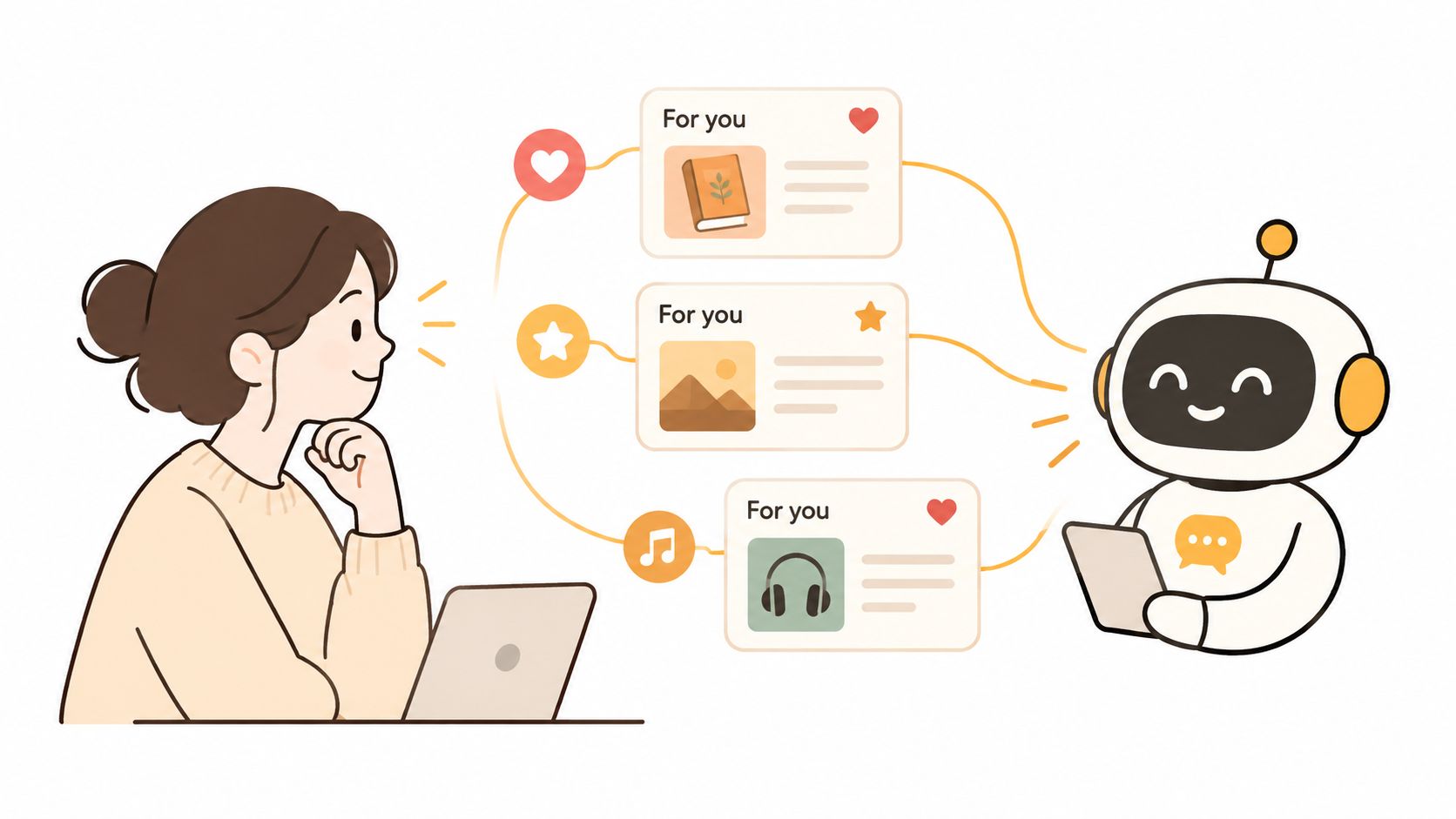
Personalisation works when it removes effort. A returning SaaS user may need guidance based on their plan and product usage. An ecommerce customer may want help finding a suitable product. An employee may need the policy that applies to their location and role. A chatbot can use authorised context to make the first response more relevant than a generic search page.
That context needs boundaries. Personalisation based on account data, previous interactions or current session behaviour should be transparent and proportionate. In fintech, a chatbot may explain general product characteristics, but it shouldn't turn incomplete information into a consequential recommendation. In compliance-sensitive environments, the bot must distinguish retrieved facts from an inference.
Build trust into the conversation
Tell users what information the chatbot can access and why it needs a particular detail. Offer a route to correct the information, disable unnecessary personalisation or speak with a person. Use first-party data and approved contextual signals, not speculative assumptions about intent.
Measure whether personalisation improves task completion, customer effort, relevant content selection, escalation quality and satisfaction by intent. A more elaborate conversation isn't automatically a better one. If the bot remembers a customer's name but still can't solve the request, the personalisation is cosmetic.
Start with straightforward context such as product area, account tier or support category. Expand only when testing shows that the additional data improves the journey without increasing privacy risk or making the interaction feel intrusive.
5. Automated Data Collection and Business Intelligence
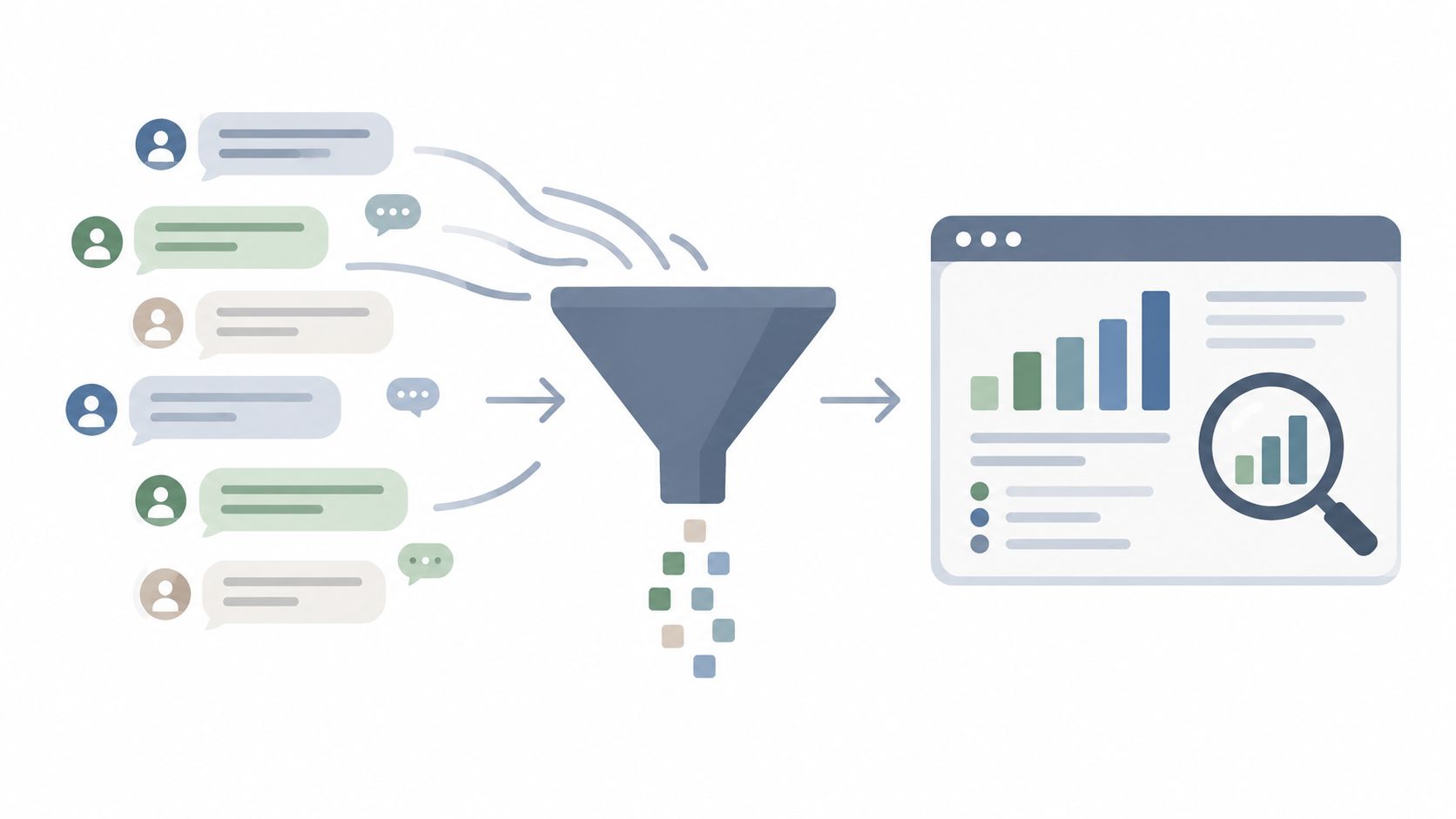
Every support conversation contains operational evidence. Customers reveal which product terms confuse them, where onboarding fails, which features they request and why they abandon a process. A chatbot can collect that evidence in a consistent format while it handles the conversation, provided the organisation has a clear purpose for collecting it.
For a SaaS product team, intent categories and transcript reviews can highlight documentation gaps or recurring feature requests. For an ecommerce operation, conversations can expose confusing delivery information or repeated questions about returns. For a regulated business, monitored interactions may help identify where a policy explanation is unclear, although this requires careful access control and compliance oversight.
The data is useful only after classification and governance. Raw transcripts aren't a strategy. Teams need defined taxonomies, retention rules, redaction, role-based access and a process for turning recurring themes into product, content or process changes.
Turn conversations into decisions
Create dashboards for top intents, unresolved questions, escalation reasons, repeated contacts, sentiment signals and knowledge-base gaps. Review a sample of conversations manually because automated labels can be wrong, especially where a customer uses indirect language.
Use chatbot data alongside product analytics, ticket data, survey feedback and sales information. AI data analytics and business intelligence becomes valuable when insights reach the team responsible for changing the underlying experience.
Don't treat customers as an unlimited source of training data. Explain data use, minimise collection and remove sensitive details that aren't needed for the workflow. A human owner should approve material changes based on conversation trends.
6. Scalable Training and Learning Delivery
Training chatbots can make learning more interactive than a page of policy text. They can present a scenario, ask the learner to choose a response, explain the consequence and provide another attempt. That format is useful for onboarding, product education, compliance practice and customer-facing troubleshooting.
The strongest use cases don't try to replace every instructor. They provide consistent practice between live sessions, answer questions from an approved curriculum and identify topics that require additional coaching. A learning team can use a chatbot to rehearse a difficult customer conversation, while a compliance team can test whether employees know when to escalate an issue.
Content quality determines whether the experience teaches anything. The bot needs a controlled source of truth, clear learning objectives and assessment criteria. It should distinguish a learner's incorrect answer from a reasonable alternative that the curriculum hasn't anticipated.
Measure learning, not conversation volume
Build retrieval practice, realistic scenarios and feedback into the flow. Track completion, answer accuracy, retry patterns, confidence, escalation to an instructor and performance on later assessments. Learner satisfaction helps, but it isn't a substitute for evidence that people can apply the knowledge.
Use spaced follow-up rather than a single information dump. Combine chatbot practice with demonstrations, human coaching and accessible reference material. In compliance training, record the relevant completion and assessment evidence, but don't allow the chatbot to make a final decision about an individual's fitness for a regulated role without human governance.
7. Seamless Integration with Existing Business Systems
A chatbot becomes operationally useful when it can do more than generate text. It should retrieve the right subscription record, check an order status, create a ticket, update a customer record or send a request into an approved workflow. Those actions require dependable connections to CRM, billing, inventory, identity, knowledge and analytics systems.
Integration also creates risk. A bot with broad permissions can expose data, trigger an incorrect transaction or make a backend failure look like a customer-service failure. The right architecture limits what the chatbot can read and do for each user, workflow and authentication state.
Start with controlled actions
Begin with read-only access, such as checking a public help article or retrieving a verified order status. Add transactional actions only after authentication, authorisation, validation and audit logging work reliably. For a fintech or SaaS platform, that may mean confirming identity before showing account information and requiring an additional approval step before changing billing or payment data.
Useful controls include:
- Scoped permissions: Give the bot access only to the records and actions required for the current intent.
- Validation rules: Check inputs and business conditions before writing to a production system.
- Failure handling: Explain when a system is unavailable and create a human-owned follow-up instead of guessing.
- Audit records: Store the request, decision path, action and result in a reviewable log.
Measure successful action completion, integration errors, unauthorised attempts, rollback events and handoff quality. The chatbot interface is only as reliable as the workflow beneath it.
8. Improved Internal Operations and Employee Productivity
Internal chatbots address a different kind of service queue. Employees ask where to find a policy, how to request equipment, which expense rule applies or whether an IT issue has a known fix. A well-scoped assistant can search approved internal content and guide the employee to the next action without forcing them to move through several disconnected systems.
The UK Government's 2026 AI skills survey found that one in three people in work had used AI at work, while 15% reported using real-time conversational AI, the most common workplace use identified in the survey. However, only 21% said AI had increased their productivity, and 51% reported neither an increase nor a decrease. (UK Government AI Skills for Life and Work survey findings)
Those results are a useful warning for internal automation. Adoption doesn't prove value. A chatbot that helps an employee find the right policy may save time, but the organisation still needs to measure search effort, correction work, employee confidence and whether the underlying policy remains current.
Give internal users a safe route out
Start with high-volume, low-risk questions about HR policies, IT access and documented procedures. Connect the assistant to maintained internal sources, show the date or owner of important information and make it easy to report an incorrect answer.
Escalate employment disputes, sensitive personal circumstances, security incidents and complex technical failures to the appropriate team. Review unresolved conversations to identify confusing policies and missing documentation. The best internal chatbot may reveal that the business needs clearer processes, not just a better interface.
9. Multilingual Support and Global Market Expansion
Language support can help a business serve customers in new markets without forcing every interaction through a single English-language queue. A chatbot can provide first-line assistance in supported languages, explain product information and collect context before routing a case to a capable agent or local partner.
The benefit depends on more than translation. Regional pricing, product availability, legal notices, payment methods, support hours and cultural expectations can change the correct answer. A technically fluent response can still be commercially wrong if it cites the wrong policy or uses a tone that feels inappropriate in the target market.
Localise the operating model
Choose languages based on actual customer demand and support capacity. Have native speakers review important intents, error messages, escalation prompts and regulated content. Keep a human review path for complaints, financial information, safety matters and any message where a mistranslation could create material harm.
Track answer accuracy, unresolved intent rate, escalation completion, language switching, customer effort and satisfaction by language. A bot that handles one language well is more useful than one that claims broad coverage but produces inconsistent answers.
Keep regional content separate where necessary. The knowledge base should identify the applicable market, currency, terms, privacy notice and service conditions before the chatbot responds. Teams should also review data residency, consent and local regulatory requirements before deploying cross-border conversation storage.
10. Risk Mitigation and Compliance Automation
Chatbots can make a compliance workflow more consistent, but they can't make an organisation compliant by themselves. Their useful role is to gather required information, present approved explanations, apply defined routing rules, record actions and flag cases that need qualified review.
In fintech, that might mean guiding an onboarding conversation, identifying missing documentation or directing a potentially high-risk case to a compliance specialist. In insurance, it could involve collecting claim details and providing status information without deciding a disputed outcome. In a SaaS business, the bot might explain data-handling procedures and route a security request into a controlled incident process.
The critical distinction is between assistance and decision authority. A chatbot can support a documented rule, but high-risk decisions involving eligibility, financial consequences, safeguarding, complaints or vulnerable users should have human ownership.
Make controls testable
Maintain versioned policies, approved response content, access controls and complete logs. Test ordinary requests, ambiguous wording, prompt manipulation, missing information, conflicting records and attempts to bypass authentication. Review changes whenever a regulation, product or internal policy changes.
A credible compliance chatbot should:
- Disclose its limits: Tell users when it provides general information rather than a final decision.
- Escalate early: Transfer sensitive or consequential cases to a trained person.
- Preserve evidence: Record relevant requests, responses, actions and handoffs for authorised review.
- Protect data: Minimise collection and restrict access to sensitive records.
- Monitor drift: Check whether answers remain aligned with current policy and source material.
Human review isn't a failure of automation. In regulated operations, it is part of the control system.
10-Point Chatbot Benefits Comparison
| Solution | 🔄 Implementation Complexity | ⚡ Resource Requirements | ⭐📊 Expected Outcomes | 💡 Ideal Use Cases | Key Advantages |
|---|---|---|---|---|---|
| 24/7 Customer Support and Reduced Response Times | Medium, design, training & routing 🔄 | Moderate, NLP, KB, monitoring ⚡ | ⭐ Fast responses; 📊 cuts routine workload ~40–60% | Global SaaS, e‑commerce, high‑volume support | Instant answers; multilingual routing; escalations to humans; 💡 automate top 20% queries |
| Operational Cost Reduction and Efficiency Gains | Medium–High, integration & optimization 🔄 | Moderate, infra, model & integration costs ⚡ | ⭐ High ROI (6–12 months); 📊 labor cost ↓30–50% | Startups, SMEs, cost‑conscious ops | Scales without proportional hiring; measurable TCO savings; 💡 calculate total cost of ownership |
| Lead Generation and Sales Qualification | Low–Medium, convo design + CRM integration 🔄 | Low–Moderate, chat + CRM + scheduler ⚡ | ⭐ Higher lead capture; 📊 increases demo bookings 30–50% | SaaS landing pages, B2B sites, product pages | 24/7 qualification and nurture; captures behavioral data; 💡 use progressive profiling |
| Personalization and Enhanced User Experience | High, data pipelines & adaptive logic 🔄 | High, user data, compute, privacy controls ⚡ | ⭐ Better engagement (25–40%); 📊 higher conversions & retention | E‑commerce, content platforms, SaaS UX | Tailored recommendations and adaptive flows; 💡 be transparent about data use |
| Automated Data Collection and Business Intelligence | Medium, NLP, tagging, dashboards 🔄 | Moderate, analytics infra & models ⚡ | ⭐ Continuous actionable insights; 📊 faster product decisions | Product teams, marketing, UX research | Ongoing feedback and trend detection; 💡 combine chatbot data with other analytics |
| Scalable Training and Learning Delivery | Medium–High, instructional design & adaption 🔄 | Moderate, content creation, tracking systems ⚡ | ⭐ Consistent scalable training; 📊 reduces time‑to‑productivity | Onboarding, compliance training, e‑learning | Interactive, adaptive learning paths; 💡 use spaced repetition and embedded assessments |
| Seamless Integration with Existing Business Systems | High, APIs, auth, error handling 🔄 | High, engineering effort, security, docs ⚡ | ⭐ End‑to‑end automation; 📊 fewer manual errors and duplicate records | Enterprise SaaS, e‑commerce, banking systems | Real‑time transactions and unified workflows; 💡 start with read‑only integrations |
| Improved Internal Operations and Employee Productivity | Low–Medium, change management & integration 🔄 | Low–Moderate, HR/IT system connectors ⚡ | ⭐ Fewer HR/IT tickets; 📊 faster onboarding and higher employee satisfaction | HR, IT helpdesk, finance, admin teams | Self‑service for routine tasks; standardized info; 💡 start with high‑volume HR queries |
| Multilingual Support and Global Market Expansion | Medium, localization & cultural tuning 🔄 | Moderate, multilingual models, review resources ⚡ | ⭐ Enables rapid market entry; 📊 supports many languages at scale | International e‑commerce, SaaS entering new regions | Lowers cost of entry; consistent cross‑region CX; 💡 begin with top 3–5 target languages |
| Risk Mitigation and Compliance Automation | High, legal rules, audit trails, domain expertise 🔄 | High, secure logging, compliance tooling ⚡ | ⭐ Reduces regulatory risk; 📊 creates immutable audit trails & flags anomalies | Fintech, healthcare, insurance, regulated platforms | Consistent policy enforcement and KYC/AML automation; 💡 involve legal/compliance from the start |
Turn Chatbot Potential into a Measurable Workflow
The best way to realise the benefits of chatbots is to resist the pressure to automate everything at once. Choose one workflow where the demand is frequent, the desired answer is well understood and the consequences of a mistake are manageable. FAQ resolution, ticket classification, order-status requests, internal knowledge retrieval and onboarding guidance are often more suitable starting points than unrestricted autonomous support.
Write the baseline down before launch. Depending on the workflow, that might include response time, average handling time, queue volume, escalation rate, repeat contacts, cost per conversation, qualified leads, action completion or customer satisfaction. For internal use, include search time, correction work and employee feedback. For learning, measure knowledge application rather than just counting completed chats.
Then connect the chatbot to the sources and systems it needs. Use retrieval from an approved knowledge base, authentication where account data is involved, scoped API permissions and a ticketing or CRM workflow for follow-up. Start with read-only actions where possible. Add transactions only after the team has tested validation, audit logging, failure recovery and human approval.
Review conversations regularly. Transcript analysis should identify incorrect answers, outdated content, repeated misunderstandings, unnecessary questions and failed handoffs. Set confidence thresholds and create clear escalation triggers for complaints, vulnerability, financial disputes, safeguarding, emotional distress and repeated failed attempts. A high containment rate can hide poor service if customers abandon the conversation or contact the business again through another channel.
UK evidence supports a measured approach. Adobe's 2025 UK Digital Trends research reported that chat and customer-support generative-AI tools were delivering measurable ROI for 19% of users in its surveyed practitioner population. That doesn't mean every chatbot produces ROI. It supports a controlled pilot with instrumentation, baseline comparison and a review of total implementation cost. (Adobe 2025 UK Digital Trends research)
Digital Souls Studios LTD is relevant when a business needs more than a plug-in chat window. The London-based software studio designs and builds web applications, SaaS products, AI automation and interactive experiences, including custom AI support agents, integrations and end-to-end delivery from specification through launch and ongoing support. Its work can suit SaaS, fintech, compliance, learning and support operations where the chatbot needs to fit a wider product or workflow.
Start small, measure accurately and keep human ownership where the risk or complexity demands it. A chatbot should earn a larger role by resolving a defined bottleneck reliably, not by promising to replace every conversation.
Digital Souls Studios LTD offers custom chatbots, AI support agents, SaaS integrations and workflow automation for businesses that want to reduce repetitive support and operational work. Visit Digital Souls Studios LTD to discuss a focused chatbot workflow, from discovery and system integration through deployment and ongoing support.