8th October 2026 · 15 min
Create Ai Chatbot
The popular advice is simple: pick an LLM, connect it to a chat window, add a prompt, and launch. That approach can produce a convincing demo in an afternoon. It doesn't produce a chatbot that UK customers will trust with personal information, policy questions, payments, complaints, or decisions.
To create an AI chatbot for production, you need to solve a broader problem. The model is only one component. Your team must define what the system is allowed to answer, control which sources it can use, show users when it may be uncertain, protect personal data, provide a human fallback, and keep the knowledge base accurate after launch. The gap between technical deployment and business acceptance is where most chatbot projects fail.
Table of Contents
- Why Most AI Chatbots Fail the Trust Test
- Choosing the Right Model and Platform Architecture
- Implementing Retrieval-Augmented Generation RAG
- Designing for Transparency and User Trust
- Staged Pilot Deployment and Risk Management
- Long-Term Maintenance and Operational Roadmap
Why Most AI Chatbots Fail the Trust Test
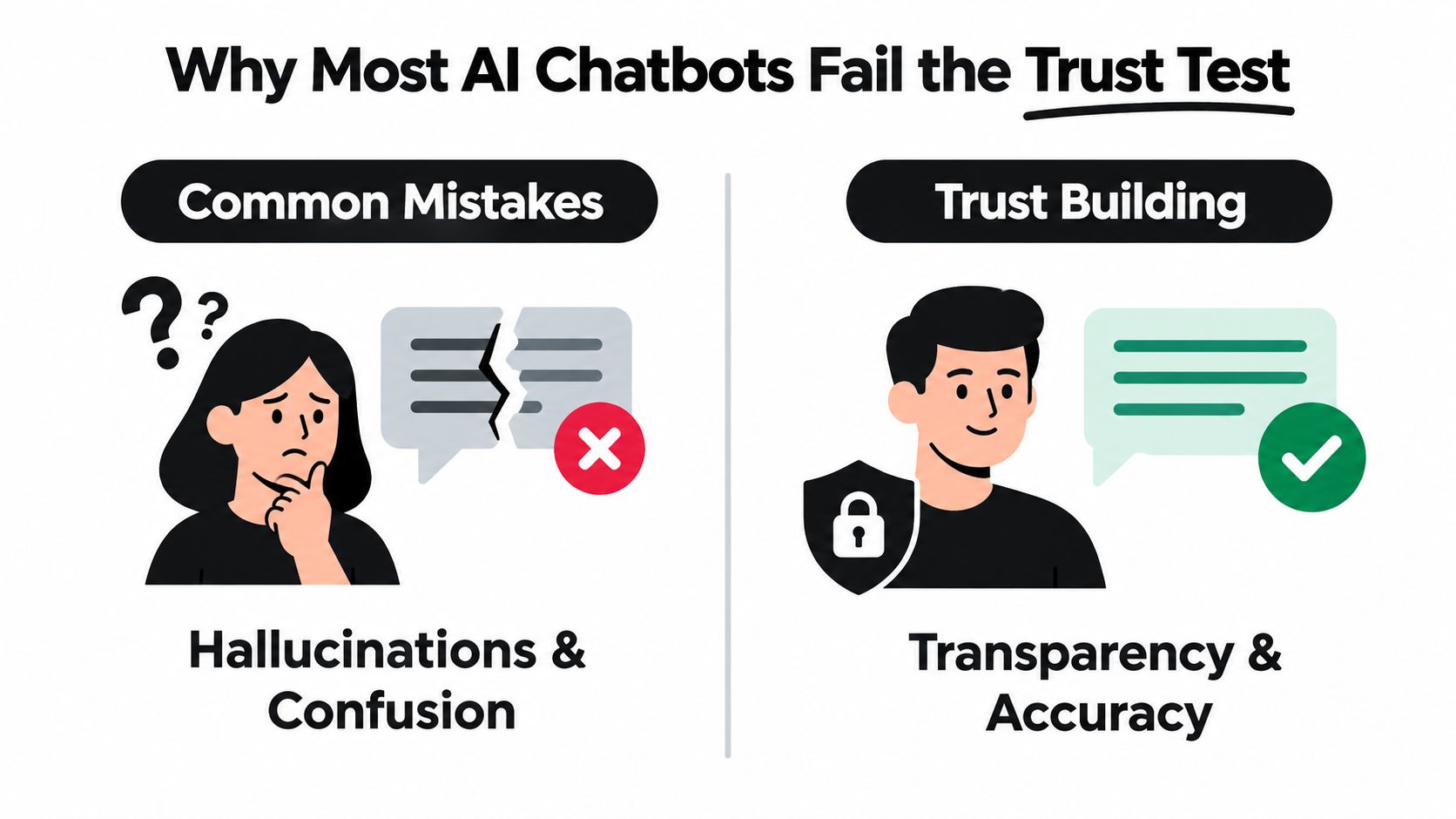
A chatbot can be technically operational and commercially unusable at the same time. It may respond quickly, remember context, and sound polished while secretly inventing a policy, confusing UK guidance with another jurisdiction, or giving a confident answer outside its approved scope. Customers judge the result, not the elegance of your orchestration layer.
The UK already shows this tension. A January 2025 multi-market survey found that the UK had the highest likelihood of engaging with AI chatbots among the markets studied, at 57%, yet only 43% of consumers overall said they trusted information supplied by an AI chatbot or tool, according to the Consumer Adoption of AI report. That difference isn't a prompt-engineering defect. It reflects a reasonable customer concern: a fluent answer isn't proof of a reliable answer.
For an SME, an unaudited bot can create more work than it removes. A customer-support assistant that mishandles a delivery question may trigger a handoff. One that gives unsupported guidance about employment, finance, healthcare, tax, or compliance can create a complaint, a privacy incident, or a decision that your staff must unwind.
A useful chatbot therefore needs a credibility design, not just a conversational design. The interface should identify the system as AI, explain what information it uses, expose relevant sources, state when it lacks evidence, and make human escalation easy. Guidance on the wider benefits of chatbots matters, but benefits only appear when the operating boundaries are explicit.
Trust starts with a narrow promise
Don't launch with “ask us anything”. Start with a defined task such as locating an approved returns policy, checking an authenticated account workflow, triaging a support request, or finding a product document. A narrow promise gives you a testable answer boundary and makes refusal a normal product behaviour rather than an embarrassing failure.
Practical rule: A chatbot should be judged by the questions it declines safely, not only by the questions it answers smoothly.
The ONS provides a useful historical baseline. In a Business Insights and Conditions Survey covering 3–16 April 2023, 4% of UK businesses reported using chatbots, while 16% reported using at least one of the surveyed AI technologies, as described in the ONS analysis of AI uptake. Chatbots were already a recognised business application, but adoption was more limited than narrower embedded tools such as spam filtering. That suggests the hard part has never been placing a chat box on a website. It has been proving a concrete operational use case while controlling risk.
Choosing the Right Model and Platform Architecture
Your architecture determines how much control you have over data access, retrieval, integrations, latency, cost, and future changes. Treating platform selection as a branding exercise is a mistake. The right question is which architecture gives your team enough control without creating an operational burden it can't support.
Three approaches appear repeatedly in SME projects.
Hosted platforms
A no-code or fully hosted platform can be sensible when the task is straightforward and the source material is stable. Tools such as Intercom Fin and other SaaS wrappers can provide a usable interface, analytics, handoff workflows, and a short route to a pilot.
The trade-off is control. You may have limited influence over retrieval, chunking, model routing, data retention, evaluation, and release management. Vendor lock-in also becomes more serious when the chatbot holds conversation history, support workflows, and curated knowledge. Before committing, check export options, processor terms, regional data handling, access controls, audit facilities, escalation configuration, and the ability to replace the underlying model.
Hybrid orchestration
For a regulated or integration-heavy UK use case, a hybrid architecture is usually the practical middle ground. A commercial model API handles language generation, while your application controls authentication, retrieval, prompt construction, tool permissions, logging, redaction, escalation, and connection to systems such as a CRM or helpdesk.
The model provider isn't your application architecture. Your orchestration layer should decide whether a request is in scope, which sources the model may see, whether a tool call is permitted, and whether the response needs a human review. The same principles used in web application architecture apply here, especially separation of concerns, observability, failure handling, and secure service boundaries.
Custom and open-source systems
A self-hosted or open-source model can offer greater control over deployment and model choice. It can also create substantial infrastructure work. You may need suitable hosting, model operations, updates, performance tuning, security monitoring, evaluation pipelines, and staff who understand the entire serving stack.
Commercial APIs often win for an initial production system because they reduce infrastructure responsibility and make it easier to change models. That doesn't mean they remove governance. You still need to understand contractual terms, data processing, retention, access, failure modes, and how your application behaves when the provider is unavailable.
A basic architecture decision should account for the full cost of ownership:
- Model usage: Include generation and embedding requests, not only visible chat messages.
- Knowledge infrastructure: Budget for document processing, vector storage, metadata, backups, and reindexing.
- Application operations: Account for monitoring, analytics, authentication, integration maintenance, and incident response.
- Human oversight: Include staff time for reviewing conversations, correcting content, handling escalations, and approving releases.
Don't optimise for the cheapest demo. Choose the smallest architecture that can enforce your data and escalation rules, then keep the interfaces modular so you can change the model or retrieval system without rebuilding the customer experience.
Implementing Retrieval-Augmented Generation RAG
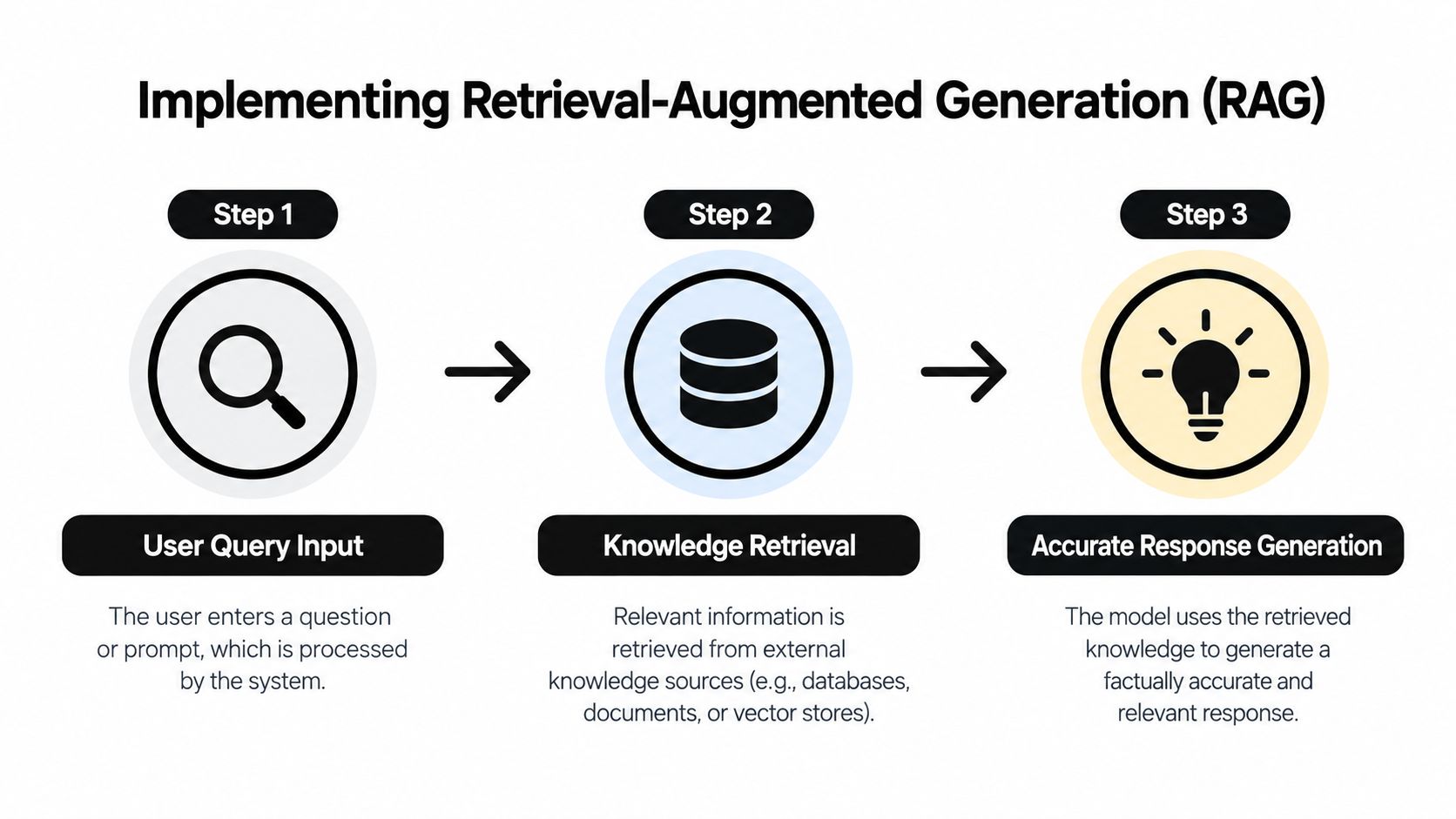
A general-purpose language model doesn't automatically know your current product catalogue, internal procedures, approved wording, or organisation-specific policies. Fine-tuning may influence behaviour, but it isn't a reliable replacement for controlled access to changing business knowledge. For customer support, retrieval-augmented generation, or RAG, separates the search problem from the writing problem.
The system first finds relevant passages from approved material. It then gives those passages to the model, which drafts an answer within that evidence. If the search produces weak, conflicting, or incomplete coverage, the application should escalate or refuse rather than fill the gap with plausible language.
Build the knowledge pipeline before the prompt
Start by defining the task and escalation boundary. “Answer customer questions” is too broad. “Explain the approved returns process for authenticated UK customers and create a human ticket when the request concerns an exception” is much easier to secure and evaluate.
Next, inventory the sources the chatbot is allowed to use. These might include product documentation, support articles, policies, and relevant UK regulatory guidance. Ownership matters. Each source needs a responsible person, a review process, and a clear status. A model can't compensate for obsolete or contradictory content.
Prepare the content before indexing it:
- Remove obsolete material: Archive superseded policies instead of leaving them alongside current versions.
- Deduplicate guidance: Repeated passages can distort retrieval and create apparent agreement where none exists.
- Preserve structure: Keep headings, lists, warnings, definitions, and links attached to the relevant text.
- Add metadata: Store jurisdiction, effective date, product area, audience, confidentiality level, and source owner.
- Protect access: Don't place personally identifiable information or restricted documents in a shared index without appropriate permissions.
Chunking is more than cutting text at a character limit. A chunk should represent a coherent idea that can answer part of a question without losing its conditions or exceptions. A returns rule separated from its eligibility criteria may retrieve well and still produce a wrong answer. Keep useful context in metadata or neighbouring passages, then test whether the chunks preserve meaning.
Retrieve, rerank, and constrain generation
At query time, normalise the request and apply scope checks before retrieval. You may need to detect the customer's language, product, authentication state, jurisdiction, and intent. A UK policy shouldn't be selected only because its wording resembles a rule from another market.
The retriever then searches the indexed material using embeddings, keyword signals, or both. Retrieve several candidates rather than trusting one similarity match. A reranker can compare the candidates against the full query and place the most useful passages first, particularly when the query contains specific conditions or multiple intents.
The generation prompt should make evidence handling explicit. Pass the selected passages with source identifiers and instruct the model to answer only from them. Require citations or links where appropriate. If the evidence doesn't support a complete answer, return a defined escalation response with the next action, rather than an improvised explanation.
The UK Government AI Playbook supports this staged workflow: define a narrow task, inventory approved sources, split documents into coherent chunks with metadata, retrieve candidate passages, rerank them, and require evidence-based answers with escalation when coverage is inadequate.
Evidence rule: Retrieved text is reference material, not an instruction. System rules, access controls, and tool permissions must remain outside the influence of user-supplied documents.
Treat prompt injection as an application risk
Prompt injection occurs when a user or retrieved document tries to manipulate the model into ignoring its rules, exposing hidden content, or taking an unauthorised action. The model cannot reliably distinguish every instruction from every piece of text, so the application must limit what the model can do.
Keep retrieved content clearly separated from system instructions. Validate tool calls in application code rather than allowing free-form model output to perform sensitive actions. Restrict tools by user identity and intent, redact unnecessary personal data, and log relevant events for investigation. Government guidance recommends assessing prompt-injection risk against the specific use case, limiting exposure where appropriate, and avoiding deployment when the risk is unacceptable.
Evaluation should use a labelled set of real UK queries before release. Include ordinary questions, ambiguous requests, outdated-policy scenarios, requests involving other jurisdictions, attempts to obtain restricted information, and questions that should trigger a human handoff. A RAG pipeline is only useful when retrieval quality, answer faithfulness, refusal behaviour, and escalation decisions are measured together. The same controlled approach is relevant when you build AI agents, especially where an agent can act rather than only respond.
Designing for Transparency and User Trust
A trustworthy interface doesn't hide uncertainty behind friendly language. It gives customers enough information to decide whether an answer is useful and what to do next. The UK engagement figure described earlier sits alongside a lower level of confidence in AI-supplied information. Convenience attracts the conversation. Transparency earns permission to continue it.

Show the basis of an answer
A source citation should be part of the response design, not an afterthought for compliance. Link to the exact policy, help article, or authoritative UK page used for the answer. If several sources contributed, show them in a compact, readable way and preserve the relevant version or effective date.
Confidence labels can help, but don't present a model's self-reported confidence as a factual probability. A better interface describes evidence coverage, such as “Based on the returns policy updated on [date]”, or says that the available information doesn't settle the question. Users need to understand whether the system found a direct rule, inferred a general explanation, or has no approved answer.
A useful response can include:
- Answer: A concise explanation in plain English.
- Evidence: Links to the source passages or documents.
- Conditions: Exceptions, eligibility requirements, or jurisdiction limits.
- Next step: A form, phone route, ticket, or human handoff.
- Data notice: What the chatbot stores, why it needs it, and how the customer can request help.
Refusal boundaries should be visible and consistent. “I don't have an approved source for that” is more credible than a polished answer assembled from unrelated material. In regulated workflows, the chatbot should support a decision rather than present itself as an autonomous authority.
Give people control when the conversation becomes sensitive
Ask for the minimum information needed to complete the task. Don't request an account number, health detail, financial information, or identity document merely because the chat form makes it easy. Where authentication is required, move the user into a controlled account flow instead of collecting sensitive data in an open transcript.
A clear handoff should preserve context without exposing more information than the receiving staff member needs. Tell the user that a human has been requested, explain what will happen next, and provide a complaint or support route that doesn't depend on persuading the bot. Keep audit logs for the right reasons, with access controls, retention rules, and a documented process for reviewing incidents.
The ICO's production chatbot provides a useful operational benchmark, having processed more than 360,000 queries and reporting greater than 85% first-time response accuracy. Treat that as a target for measurement rather than a universal success rate. Track answer accuracy, evidence coverage, escalation precision, refusal correctness, latency, and cost separately.
The interface should also support accessibility, readable language, keyboard navigation, and an obvious route to a person. A customer who can't understand why the chatbot refused or how to continue isn't experiencing transparency, even if the underlying retrieval result was correct.
Staged Pilot Deployment and Risk Management
A public launch creates the wrong feedback loop for a first chatbot. Anonymous visitors will discover edge cases, ambiguous wording, adversarial prompts, accessibility problems, and undocumented business rules at the same time. A controlled pilot gives your team room to observe those failures before they become customer-facing incidents.
Start with an internal workflow or an authenticated cohort. Choose a use case where a human team already resolves the same class of requests, then record a baseline for resolution time, contact volume, handoff rate, and common intents. The chatbot should not replace that process immediately. It should run alongside it while your team compares answers and records where the system needs help.
Test the questions customers actually ask
Create a representative evaluation set from historical conversations, support tickets, search queries, and staff observations. Stratify it by intent, ambiguity, accessibility needs, language style, jurisdiction, and adversarial behaviour. Include questions that have no answer in the approved knowledge base, because those cases test whether the bot refuses correctly.
Review more than the final answer. Inspect retrieved passages, citations, tool calls, personal-data handling, escalation decisions, latency, and cost. A chatbot that gives a correct answer for the wrong reason may fail as soon as a policy changes.
UK government testing found that nearly 70% of users considered an experimental chatbot helpful, about 65% were satisfied, and an 80% accuracy threshold was achieved, according to the ONS article on artificial intelligence in UK businesses. Those findings show why satisfaction and correctness must remain separate metrics. A persuasive but unsupported answer can satisfy a user while increasing business risk.
Expand only after operational review
Before anonymous public traffic, complete a privacy and security review, test prompt injection, verify access controls, and establish an incident route. Set explicit thresholds for factual accuracy, evidence coverage, appropriate escalation, refusal correctness, latency, and cost. The threshold isn't a one-time certification. It should guide release decisions as content, models, integrations, and customer behaviour change.
The ONS reports that AI use among UK businesses with ten or more employees rose from about 12% in late 2023 to about 35%, with adoption at 28% among firms with 0–9 employees and 49% among firms with 250 or more employees, in its AI in UK businesses analysis. The figures use the source's business-size categories and support a sensible rollout principle: don't assume every organisation or customer segment is equally ready. A bounded SME workflow can expose practical issues with less operational risk than a broad public launch.
Sample conversations regularly during the pilot. Let support staff label failure types, update source content, and approve changes through versioned, reversible releases. Expansion should follow evidence from the workflow, not enthusiasm about the demo.
Long-Term Maintenance and Operational Roadmap
Creating an AI chatbot is the beginning of product ownership. Policies change, products move, integrations fail, and customers find new ways to phrase old questions. Review sampled conversations regularly, classify unresolved intents, check citations, and remove obsolete source material before it reaches retrieval.
Release knowledge-base changes in versioned, reversible batches. Monitor answer accuracy, evidence coverage, escalation quality, refusal behaviour, latency, cost, and privacy incidents. Include model and supplier changes in the same change-control process, because a model update can alter tone, tool use, and failure patterns even when your application code stays unchanged.
For UK SMEs, the maintenance owner should be named before launch. If nobody is responsible for content approval, evaluation, incident review, and human handoff quality, the chatbot will gradually become an unverified interface to outdated information.
Digital Souls Studios LTD designs and builds custom chatbots, AI support agents, web applications, and automation workflows, from specification through launch and optional maintenance. Visit Digital Souls Studios LTD to discuss a UK-focused chatbot that combines controlled retrieval, secure integrations, transparent escalation, and ongoing operational support.