22nd November 2026 · 18 min
MVP Project Management: A Plain-English Guide for Owners

71% of UK businesses cite a lack of an identified need as a barrier to AI adoption, while 60% cite limited skills and expertise, according to the UK Government's AI adoption research. For an owner considering software or automation, that makes the first question commercial, not technical: what problem is worth paying to solve?
Table of Contents
- Why an MVP Is a Decision System, Not a Smaller App
- The Four Stages From Discovery to Launch
- Who Owns Each Decision on an MVP
- Choosing What Goes Into the First Release
- Measures That Show Whether the MVP Is Working
- When to Change Direction or Stop
- What an MVP Costs and What Drives the Price
- Risks to Check Before the Build Starts
- Write a One-Page MVP Brief Before You Hire
Why an MVP Is a Decision System, Not a Smaller App
Only 38.4% of UK businesses born in 2019 were still active five years later, meaning approximately 61.6% hadn't survived to 2024, according to the Office for National Statistics. Those figures don't measure MVP success. They establish why founders need evidence before committing substantial money.
A minimum viable product, or MVP, is the smallest product able to test a commercially important assumption, such as whether customers sign up, pay, return or recommend a service. It's closer to a test drive than a discounted car: the point is to learn before making the larger commitment.
The distinction is between staying small and staying afloat.

A full-build conversation often starts with a feature list. MVP project management starts with a question and a decision date. For a support team, the question might be whether suggested replies reduce routine work without creating unacceptable checking work.
Practical rule: A useful MVP changes a funding decision. A smaller app without a clear test merely costs less to build.
Some uncertainty can be resolved before a working product exists. Proof-of-concept testing checks whether an approach is feasible; an MVP must also reveal whether it creates value in use.
The cheapest sensible experiment isn't always the one with the fewest features. It's the one that produces credible evidence without unnecessary investment.
The Four Stages From Discovery to Launch
The UK Government's agile assurance guidance describes delivery through Discovery, Alpha, Beta and Live, followed eventually by Retirement. For a business buying an MVP, those stages separate investigating a problem from funding an operating service.
The sequence gives each commitment a clear boundary.
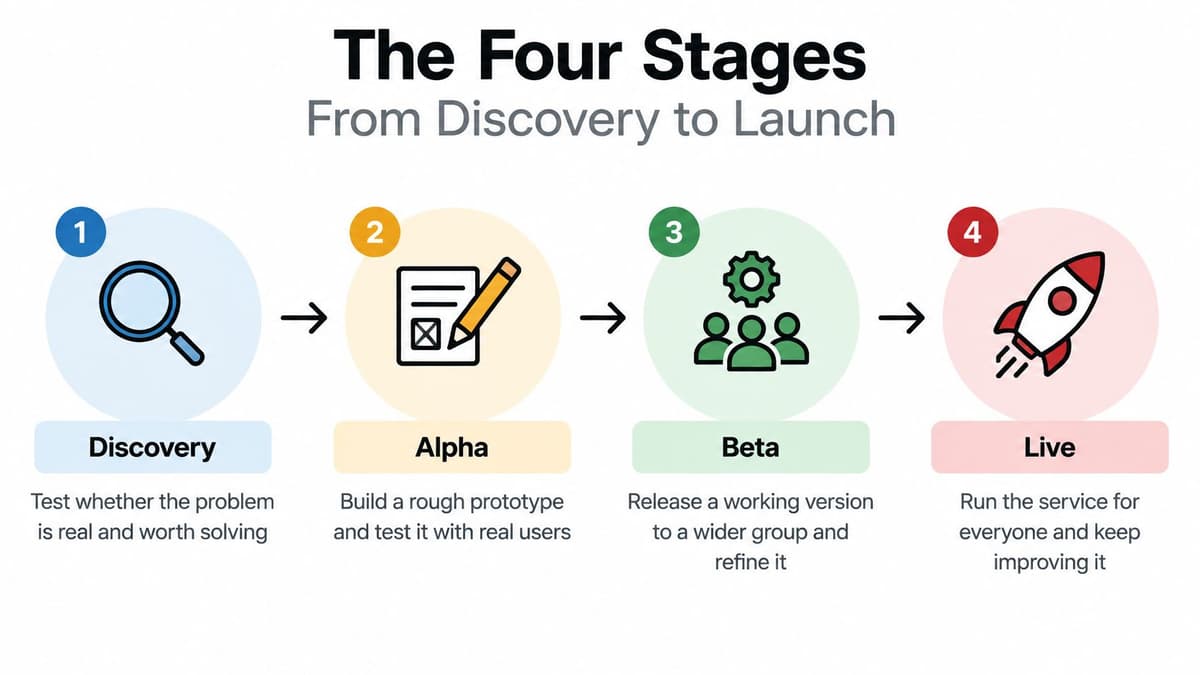
Discovery tests the problem and customer. Alpha tests a proposed solution. Beta puts a limited working version in front of real users. Live means operating the product. Passing a stage means earning the next investment, not completing the scheduled tasks.
The evidence required at each gate
A gate is a scheduled review at which a named owner approves, changes or ends the next commitment.
MVP stages, the question each answers and the gate decision
| Stage | Question it answers | Evidence to collect | Decision at the gate |
|---|---|---|---|
| Discovery | Is the problem real, and who has it? | Customer interviews and the current cost of the problem | Continue, change the target customer or stop |
| Alpha | Will the proposed solution work for users? | Tested prototype with representative users | Continue to build, redesign or stop |
| Beta | Will real users return to the product? | Limited release data, support load and repeat use | Fund a wider launch or hold |
| Live | Does the product keep creating value? | Retention, running cost and support volume | Improve, expand or retire |
Consider an online shop with abandoned purchases. During Discovery, the owner interviews customers and checks where purchases break down. An unattractive checkout might not be the main problem; unexpected delivery charges could be.
During Alpha, shoppers try a rough model of a simpler checkout. A prototype is a representation of the proposed product that lets people test the experience before the full service is built. If shoppers still misunderstand delivery charges, the team changes the proposal rather than polishing the wrong screens.
Beta exposes the working checkout to a limited customer group. The owner examines completed purchases, errors and support requests before authorising wider use. Live then requires an operating owner, running budget and improvement priorities.
Dates and commitments
Each stage needs an agreed end date before it starts. Discovery shouldn't drift into informal design work, and Alpha shouldn't become an open-ended production build.
The supplier's proposal should identify:
- The decision supported: What uncertainty will this stage resolve?
- The stage price: What spending is authorised before the next gate?
- Acceptance criteria: What observable evidence makes the work acceptable?
- Research ownership: Who receives interview notes, findings and prototypes?
A stage-based software project plan makes these boundaries easier to compare across proposals. A single fixed MVP price is less useful when the buyer can't tell where investigation ends and production begins.
The accompanying video offers another explanation of the MVP approach.
The practical check is simple: the business should be able to name its current stage, its next gate date and the person authorised to decide. Without those details, a stage name is just a label.
Who Owns Each Decision on an MVP
A support automation project needs more than a supplier and an enthusiastic head of support. Someone must settle disagreements about scope, approve spending and decide whether the results justify continued investment.
Every decision needs a named owner. Shared consultation is useful; shared final accountability leaves suppliers waiting and allows small requests to accumulate without approval.
Jobs that need an owner
The business sponsor makes the final go, change or stop decision. In a support project, that might be the operations director, who can judge whether reduced handling work justifies the running cost and organisational change.
The MVP lead maintains the priority list and prepares the weekly report. This person gathers feedback, distinguishes defects from new requests and brings decisions to the sponsor rather than expanding the work.
| Responsibility | Decision owned | Support-team example |
|---|---|---|
| Business sponsor | Further investment and major scope changes | Operations director approves the next stage |
| MVP lead | Daily priorities and unresolved questions | Support manager maintains the agreed list |
| Delivery lead | Delivery commitments and practical options | Supplier explains the cost of a requested change |
| Frontline tester | Whether the workflow works in practice | Senior agent checks suggested replies |
| Finance or data contact | Spending controls and information access | Finance approves payment gates; data owner approves access |
The supplier shouldn't decide what commercial success means. Equally, the sponsor shouldn't promise a launch date without the delivery lead's assessment of the work and dependencies.
The brief becomes a working agreement
The business must describe its problem before asking a studio to price a solution. At Digital Souls Studios LTD, the client explains the idea in writing during Specification, and the studio puts together a specification suited to the work.
That document needs an internal owner. If the head of support wants reduced handling time but marketing wants personalised selling messages, the sponsor must resolve the competing aims before production starts.
A weekly review should compare working results with the agreed success measures. It should finish with recorded decisions, outstanding questions and owners, rather than another presentation of activity.
A supplier can manage delivery. The business must still own the reason for spending the money.
A founder without time for day-to-day coordination can hire a delivery lead. The sponsor role should remain inside the business because an external coordinator can't take responsibility for its commercial priorities.
Before work begins, the ownership check is:
- Scope: A named person approves additions and removals.
- Budget: A named person authorises further spending.
- Testing: A named frontline user accepts the working process.
- Data access: A named owner approves what information can be used.
Choosing What Goes Into the First Release
A feature earns its place only if it tests the core assumption or is necessary for the product to work safely. Everything else needs a stronger argument than someone might want it.
Four levels for sorting features in the first release
| Priority | Test to apply | Example for a support team |
|---|---|---|
| Must have | Without it the MVP cannot test its core assumption | Log each enquiry and suggest a reply |
| Should have | Makes the test more useful but the test still works without it | Tag enquiries by topic for weekly reporting |
| Could have | Improves the experience but adds risk or time | Branded reply templates with the customer name |
| Later | Not needed to learn anything in the first release | Automatic refunds and replies in several languages |
This approach is commonly called MoSCoW, which sorts requests into Must, Should, Could and Won't have. Using Later instead of Won't keeps possible future work visible without promising it for the first release.
The same feature can have different priorities
For an online shop testing willingness to pay, taking payment is essential. A wishlist can wait, and product recommendations are unlikely to strengthen the first test enough to justify their cost.
But payment isn't automatically essential to every experiment. If Discovery is testing whether shoppers understand delivery options, a prototype may answer the question without taking money. The business question determines the requirement.
For a support team testing suggested replies, logging enquiries and presenting a draft answer belong in Must have. Topic tags belong in Should have when a manager can still review enquiries manually. Branded templates are Could have, while automatic refunds introduce financial authority that the initial test doesn't need.
A practical sorting method
The MVP lead can prepare the priority list through a short working session:
- List requests plainly. Describe what a person needs to do, not the supplier's preferred technology.
- Attach an outcome. Record whether each request should improve completion, save handling work or reduce errors.
- Assess value, risk and cost. Use simple relative scores, with written reasons rather than false precision.
- Assign a level. Challenge every Must have by asking whether the experiment could still produce a reliable answer without it.
- Secure sponsor agreement. Freeze the initial commitment before production begins.
Must have isn't a label for the loudest stakeholder's preference. Accessibility, appropriate security and essential error handling may qualify because users can't safely complete the core task without them. Decorative polish usually doesn't.
Scope test: If removing a feature wouldn't change the decision made from the experiment, it probably belongs in Later.
New information can justify a change during the build. The change should replace another item, use an explicitly approved allowance or move the date and price through a recorded decision.
Quiet additions are the expensive option. They make the original promise look intact while the actual commitment grows.
Measures That Show Whether the MVP Is Working
The UK Government project-delivery guidance provides an eight-week Alpha benchmark. It calls for a business case before Beta and progress shown through working software and delivery evidence. For a private business, use this as a planning reference, not a promised supplier timeline.
A Beta funding decision may come after Discovery and Alpha. Set a date for that decision before the build, and require a report on what the test has learned, not just how long the team has worked.
Dashboard measures for an MVP and what each one shows
| Measure | What it shows | Example for an online shop |
|---|---|---|
| Burn-up or burn-down against the priority list | Whether planned scope is being delivered at the agreed pace | Checkout fixes completed against the agreed list |
| Cycle time for completed work | How long a change takes from request to live release | Days from a request to a live change |
| Defect escape rate | How many problems reach customers after release | Failed payments reported after each release |
| User task completion | Whether people can finish the main job | Share of shoppers completing a purchase on the test checkout |
| One commercial outcome | Whether the MVP creates business value | Repeat orders from the test group within an agreed period |
A burn chart tracks completed or remaining work against the agreed list. Cycle time measures elapsed delivery time. Defect escape rate records problems that reach customers after release.
Choose thresholds before production starts. For example, agree how many qualified participants the test needs, how many manual-support hours the team can accept, and what commercial signal counts, such as paid pilots or repeat orders. Record each threshold beside the actual result. That makes the go decision meaningful: a checkout redesign is an output; a higher share of completed purchases is evidence of an outcome.
When to Change Direction or Stop
A completed feature list isn't a reason to keep funding a weak proposition. The sponsor needs written conditions for continuing and a separate rule for changing direction or closing the project.
Continue when the agreed customer outcome is met, running costs remain acceptable and the business can operate the service safely. Change direction when the evidence identifies a more promising customer or narrower workflow.
A stop rule that can be applied
A sensible default is to stop when the target outcome is missed at consecutive decision gates despite a fair, bounded attempt to fix the cause. A dangerous data exposure or unacceptable operating risk can justify stopping immediately.
- Weak demand: Close the experiment when suitable participants understand the offer but still won't use or pay for it.
- Narrower demand: Test a smaller problem when support enquiries repeatedly concern a particular product.
- Poor economics: Hold expansion when customers value the service but manual checking consumes the expected savings.
- Inconclusive evidence: Authorise a limited retest only when the missing evidence and spending limit are explicit.
For an online shop, a checkout experiment that doesn't improve completed purchases shouldn't automatically trigger another redesign. The sponsor should first decide whether the proposed remedy addresses an observed cause.
Stopping needn't discard the work. Interview notes, usage records, a tested prototype and the priority list can support a later attempt.
Supplier exit terms should allow closure at a gate and state the notice required, outstanding fees and return of project files. Those terms belong in the agreement before enthusiasm makes stopping difficult.
What an MVP Costs and What Drives the Price
Total ownership cost matters more than the build quotation. The OECD's findings on UK SME technology adoption identify financial constraints spanning investment, implementation, maintenance and subscriptions.
A working budget separates discovery and specification, design and testing, production, hosting or subscriptions, launch help, maintenance, security and later changes. A narrow enquiry-triage tool may cost less than a shop handling payments, stock, refunds and delivery updates.
Three routes to an MVP and their cost pattern
| Route | Main upfront cost | Recurring cost | Best when |
|---|---|---|---|
| In-house team | Recruitment and salaries | Salaries, tools and management time | The business already employs product and technical staff |
| Off-the-shelf tool | Setup and configuration | Monthly subscription and possible lock-in | The workflow is narrow and common |
| Specialist studio | Discovery and first-stage fee | Support or retainer after launch | The business has no technical team and needs controlled scope |
Digital Souls Studios LTD publishes a custom AI support agent at £3,000, a custom AI agent at £3,000 to £10,000, an automated development team at £5,000, and an all-in-one retainer at £1,000 to £15,000 a month, with a three-month minimum. These are commercial options, not universal UK MVP benchmarks; the service options address different needs.
Its process follows Specification, Production, Launch and Support. During Production, the studio designs and builds with regular updates.
Questions that make quotations comparable
- Included work: Does the price cover research, accessibility, testing, launch assistance, documentation, hosting and defect fixes?
- Recurring charges: Which subscriptions, support fees and usage costs continue?
- Price changes: What triggers additional charges, and who approves them?
Connected business systems, moving existing data, design expectations and security requirements drive scope. An app development cost assessment should separate these drivers rather than rely on a headline price.
Risks to Check Before the Build Starts
The biggest problem may not be whether the software works. It may be whether employees trust its answers, whether records are accurate or whether anyone has authority to act on its output.
UK SME findings published by the OECD record concerns about data security at 22%, data accuracy at 21% and perceived lack of relevance at 21%. These concerns belong in the buying decision, not in a hurried review before launch.
The right response is to check the route before committing the whole business.
Check the operating rules
A finance tool can produce incorrect outputs because the records are wrong or approval rules are unclear. Automating that process doesn't resolve the ambiguity; it can make incorrect work easier to repeat.
Before approval, the buyer should complete a practical checklist:
- Information used: List the records, messages and files the MVP can access.
- People with access: Identify who can view, change and download that information.
- Human authority: Specify which decisions require a person, including payments, refunds and sensitive complaints.
- Error reporting: Name the person receiving reports and the process for pausing unsafe use.
- Data export: Confirm how business information can be retrieved in a usable form when the relationship ends.
For a support team, an automated reply might mishandle a complaint or expose another customer's details. A pilot should therefore begin with non-sensitive information and restricted tasks, with a person checking outputs before wider use.
Ask for evidence, not reassurance
The supplier should provide a risk register, a plain-English list of what could go wrong, its likely impact and the person responsible for controlling it. A statement that a service is secure isn't a substitute for this work.
The remaining documents should be proportionate but concrete:
- Test plan: Show how ordinary tasks, mistakes and unusual cases will be checked.
- Permissions model: Explain who can do what.
- Incident process: State how a problem is reported, contained and investigated.
- Subcontractor list: Identify other businesses handling information or operating part of the service.
- Exit plan: Describe the return of records, files and access.
Contracts should address ownership, retention, deletion and permitted reuse of business data. A buyer shouldn't assume that paying for a service settles those questions.
At Launch, Digital Souls Studios LTD helps launch the project and leaves it in a state a team can run. The buyer still needs to allocate the internal owner who holds the instructions and access afterwards.
That handover should leave the business able to identify a problem, contact the right person and continue essential work if the service is paused. A small scope isn't permission to leave operating responsibility undefined.
Write a One-Page MVP Brief Before You Hire
A founder should write a page before comparing suppliers. The purpose isn't to specify every screen; it's to make the buying decision clear enough that proposals can be judged against the same problem.
What belongs on the page
- Target customer: Name the people experiencing the problem and when it occurs.
- Risk being tested: State the assumption that could make the investment worthwhile or wasteful.
- Success thresholds: Define acceptable user outcomes, operating effort and commercial evidence.
- Time limit: Set the experiment's boundary and the date of the decision.
- Budget range: Separate the authorised first commitment from possible later funding.
- Decision owners: Name who controls scope, spending, testing and information access.
- Stop condition: Record the evidence that would make further investment unjustified.
For a support team, the brief might propose sorting routine enquiries to reduce handling work. The head of support owns the result, a senior agent tests releases, and the team compares weekly handling effort with its agreed threshold over a fixed period.
That's more useful than asking an agency to build an AI assistant. It gives the supplier a problem to price and gives the sponsor a result to judge.
The immediate decision is whether the idea deserves a first test this quarter, and which evidence would make the business stop. A clear brief makes either answer legitimate.
Digital Souls Studios LTD builds and maintains software, websites and AI systems for businesses without an in-house technical team. For an MVP with a defined question and spending boundary, visit Digital Souls Studios LTD and describe the project with its one-page brief.