25th October 2026 · 17 min
How to Choose a Web Application Development Agency

You've got six proposals open, all promising a fast, scalable build, and no reliable way to tell which team will still be reachable six months after launch. Choosing a web application development agency gets easier when you judge discovery, ownership and risk before you judge portfolio polish or price.
Table of Contents
- Agency Evaluation Criteria at a Glance
- How a Good Agency Runs Discovery to Deployment
- Project Deliverables and Accessibility Evidence to Request
- AI Safeguards to Check Before You Sign
- Contract and Payment Terms to Negotiate
- Judging Whether Your MVP Is Ready to Scale
- Shortlist and Brief Your Agency This Week
Agency Evaluation Criteria at a Glance
Portfolios are the easiest thing an agency can polish. A founder weighing up a shortlist of near-identical proposals needs something harder to fake: testable criteria that reveal how the team handles discovery, ownership and risk before any code is written.
That scrutiny matters because most buyers are renting a team they cannot inspect. The proposal describes the agency; the build is done by whoever is available that quarter. Subcontracting, bench rotations and mid-project departures are routine, and the salesperson who impressed you may never touch your product. The only reliable protection is evidence: named people, named roles, and contract terms that hold even if the team changes.
Use this scorecard on one short call per agency. You're listening for evidence you can verify, not adjectives.
| Criterion | Strong answer | Red flag | How to test it |
|---|---|---|---|
| Relevant shipped products | Live apps in your sector with referenceable clients | Only mock-ups or unnamed portfolio images | Ask for two live references and speak to one of them |
| Discovery before quoting | Written scope, risks and an explicit MVP boundary before a fixed price | Firm fixed quote within a day with no questions | Ask what they would leave out of version one and why |
| Named team roles | Named product lead, engineers, UX, QA and security owner | One generalist with unnamed subcontractors | Ask who writes the code and who reviews it |
| Technical standards | Documented architecture, automated tests in CI, staged deployment with rollback | Speed claims with no test or rollback process described | Request a redacted architecture decision record from a past project |
| Accessibility and security | WCAG 2.2 AA acceptance criteria written per feature | Accessibility treated as a final audit or a statement on the website | Ask for an accessibility defect log from a previous build |
| Communication rhythm | Named project lead, demos at the end of each iteration, replies within one working day | One contact who is hard to reach until the invoice arrives | Send a test question and time the reply |
| Ownership and exit | Client owns code, repositories, credentials and documentation from day one | Agency keeps repositories or production accounts until a dispute is settled | Check the IP and handover clauses before the proposal stage |
How to Score the Shortlist
Don't average away a serious weakness. An agency can score well on design and still leave you unable to move your own product.
Scoring method: Rate each criterion from 1 to 3, weight discovery and ownership double because they predict overruns and lock-in, and drop any agency that scores 1 on ownership whatever its total.
If two agencies tie, favour the one that surfaces a risk you hadn't considered. That's usually the team that has shipped before and knows where projects break.
How a Good Agency Runs Discovery to Deployment
A founder I advised signed with an agency whose entire discovery output was a feature list. Six months later the build stalled on an integration nobody had flagged as a risk, and most of the budget was already spent. That is what a weak discovery phase costs.
Reporting on UK digital transformation failures found that one in five surveyed UK businesses had failed to deliver such a project. Among the reasons those businesses gave for the failures, insufficient understanding of available technologies and inappropriate platform selection were the most common, cited by 51% and 39% respectively. A further 23% each pointed to skills and budget limitations.
Understanding and platform choice are exactly what a gated discovery-to-deployment process exists to catch. Skills and budget are separate constraints, and no discovery phase manufactures either, so weigh them on their own when you compare agencies.
The diagram below summarises the flow you should expect, from discovery through to deployment.
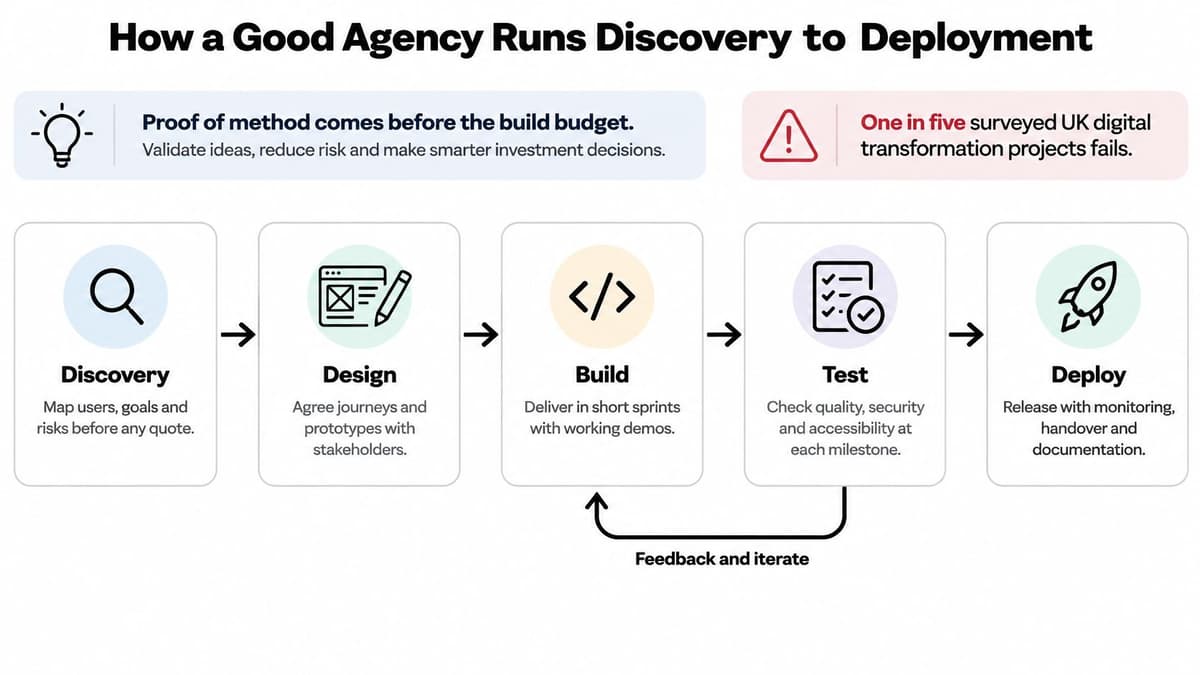
The Seven Steps to Expect
- Scope outcomes first: Define measurable outcomes, user journeys, data protection constraints, integrations and an explicit MVP boundary. Warning sign: undefined scope dressed up as flexibility.
- Run a technical spike: Test the riskiest architecture assumption for a short, fixed period before committing. Warning sign: a framework chosen before workload and compliance are understood.
- Prototype with acceptance criteria: Produce a clickable prototype and agree what passes for each feature. Warning sign: sign-off based on screenshots with no testable criteria.
- Build in flagged increments: Deliver behind feature flags with a stakeholder demo at the end of every iteration. Warning sign: weeks of silence between updates.
- Test on every merge: Run unit, integration, accessibility and security tests automatically. Warning sign: integration testing pushed to the final week.
- Roll out in stages: Deploy gradually with a rehearsed rollback. Warning sign: a rollback plan that exists only in a document.
- Measure after launch: Track release frequency, escaped defects, lead time, uptime and adoption. Warning sign: success defined as launch day alone.
Discovery exists to remove unknowns. If the phase ends with a long PDF and the same list of risks you started with, you paid for paperwork.
The table pairs each stage with what you should receive and the question that tests it. For broader context on sequencing, compare the agency's plan against the stages of software development and note any stage they have skipped.
| Stage | What you should receive | Question to ask |
|---|---|---|
| Discovery | Outcomes, user journeys, data constraints and MVP boundary | Which assumptions will you test first, and what would change the scope? |
| Architecture spike | Short technical spike with hosting, identity and API choices | What evidence would make you change the framework or hosting plan? |
| Prototype and acceptance criteria | Clickable prototype with acceptance criteria per feature | Who signs off each screen, and what happens if a criterion fails? |
| Build iterations | Feature-flagged increments and a demo each iteration | How will I see working software before the final release? |
| Testing | Unit, integration, accessibility and security test results | Which tests run on every merge, and who reads the failures? |
| Launch | Staged rollout with a rehearsed rollback | How long does a rollback take, and when was it last tested? |
| Post-launch | Monitoring, uptime and adoption reporting, support terms | What is the response time for a critical fault, in hours? |
Ask these questions before you discuss price, and write the answers into the statement of work. An agency willing to commit its demo cadence, rollback times and test coverage to the contract has defaults it trusts. One that improvises in the meeting will improvise in the build.
Project Deliverables and Accessibility Evidence to Request
The proposal stage is the last moment you hold real influence over an agency's paperwork. Ask for a redacted sample of each document below from a past project, before you sign anything. A promise costs an agency nothing; a document shows how it really works when nobody is pitching.
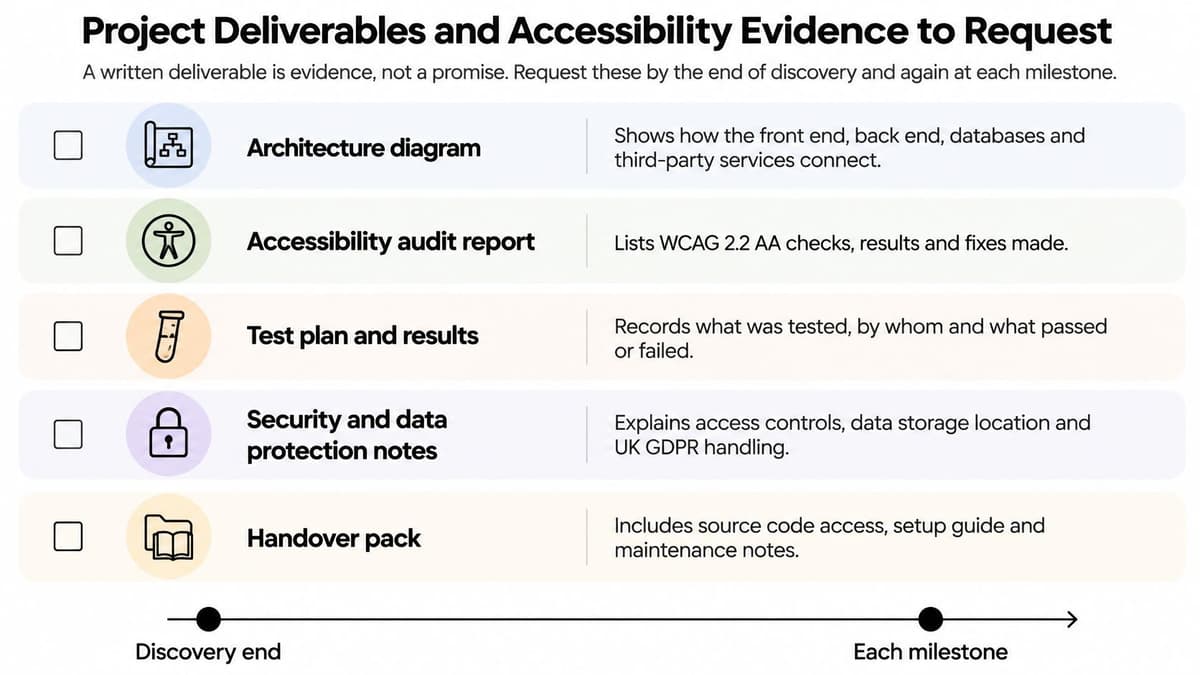
These seven items separate agencies with delivery discipline from those running on goodwill. Request each at the point shown, and chase anything that arrives late.
| Deliverable | What it proves | When to request |
|---|---|---|
| Architecture decision record | Hosting, identity, API boundaries, observability, backups and recovery objectives were chosen deliberately | End of discovery |
| Data flow diagram | Processors, retention periods and data locations are known before build | Before implementation |
| API documentation | Endpoints and versioning are documented for later integrations | Each milestone |
| CI test reports | Unit, integration, accessibility and security tests run on every merge | Each milestone |
| Incident runbook | Named responders and the order of response are set | Before launch |
| Handover pack | Repositories, environments, credentials and third-party accounts are listed for transfer | Before launch and on termination |
| Accessibility defect log | Each defect shows journey, WCAG criterion, severity, reproduction steps and retest evidence | Before the proposal stage, as a redacted sample |
The video below walks through the deliverables a development team produces across a real engagement and how to use them to hold an agency accountable. Watch it before you finalise your own list.
Accessibility evidence deserves the same scrutiny. UK Government accessibility monitoring of public sector websites tested 612 sites and found roughly half had fewer than five detected issues. Where problems did appear, they clustered in a small set of categories: visible keyboard focus at 12%, accessible names, roles and values at 11%, colour contrast at 11% and keyboard operation at 8%. These are testable, fixable defects, which is exactly why the defect log matters.
A published accessibility statement proves almost nothing on its own. In the same monitoring, 90% of sites had published an accessibility statement, yet only 7% of those statements initially contained all the required information. Ask for the defect log and retest evidence instead.
A document you never see is a risk you carry. Make the samples a condition of signing, not a favour granted after it.
AI Safeguards to Check Before You Sign
A demo can make an AI feature look inevitable. In the agency selections I have run, the stronger test comes earlier: ask who owns the risk when the model is wrong, what data it may touch, and which action it is never allowed to take. A web application development agency that answers before the sales deck finishes is easier to trust than one that reaches for another case study.
Skip the demo until you have seen an AI readiness pack for each application. Judge it like a deliverable, because it shows whether discovery, ownership and risk were handled before code.

What the Readiness Pack Should Contain
- Risk register: One entry per AI feature, naming the harm, the likelihood and the control.
- Approved-use policy: What staff may and may not do with the tool.
- Prompt and data boundaries: Which personal data may enter a model, and which must never do so.
- Logging and retention rules: What is recorded, who can read it and how long it is kept.
- Evaluation tests: Sample inputs with pass thresholds, run before each release.
- Fallback workflow: What happens when the model fails, times out or is unavailable.
- Named accountable owner: One person responsible for incidents, rather than a shared inbox.
- Exit plan: How you would move if the provider changes pricing, terms or model behaviour.
Take a support team of eight that wants an AI triage agent. A sensible first release classifies tickets only, logs every suggestion and keeps human sign-off for refunds and account changes. It cannot reply to customers unsupervised or close a ticket by itself.
That limit is deliberate. You learn whether classification is accurate before refunds, account access or customer messages depend on it. If accuracy is weak, the blast radius stays small.
A good agency may add less automation than you expected. Its value is often in narrowing permissions, naming the owner and writing the exit route while change is still cheap. If you are weighing agent designs, guidance on AI agent security sets a useful baseline for the controls to expect.
Which safeguard stops the agent from acting, and who is paged when it does?
If that cannot be answered in one sentence, keep the feature out of production, however polished the demo looked.
Contract and Payment Terms to Negotiate
Disputes often begin in the contract, and ownership is decided there, not in the kickoff meeting. Treat the contract as part of the evaluation, because a web application development agency that resists clear terms is telling you something.
Consider a SaaS founder whose agency held the production cloud account in its own name. When the relationship broke down, recovering access took three weeks, during which the founder couldn't deploy fixes or answer a customer's data question. Nothing technical caused that delay. The paperwork did.
Eight Clauses to Check
| Clause | What to ask for | Red flag |
|---|---|---|
| IP ownership | Transfer of code and designs to you on payment of each milestone | IP transfers only at final payment, or never |
| Payment schedule | Modest deposit, then milestones tied to accepted deliverables | Large upfront payment or fees invoiced by time with no cap |
| Change control | Written change requests priced against an agreed rate card before work starts | Scope changes absorbed into the quote with no process |
| Defect window | Free fixes for defects for 30 to 90 days after launch | No warranty period, or defects billed as new work |
| Support levels | Response and fix times for critical incidents, stated in hours | Support described as best effort |
| Data processing | UK GDPR data processing agreement naming sub-processors and hosting regions | No DPA, or processors not disclosed |
| Handover and exit | Code, repositories and credentials handed over on any termination | Agency keeps repositories, cloud accounts or domains |
| Subcontractors | Named subcontractors and their locations disclosed in the contract | Right to subcontract without notice |
A few notes are worth spelling out, because they're where money slips away unnoticed.
- IP on each milestone: Transfer on payment of each milestone means a dispute can't hold your code hostage.
- Payment follows acceptance: Pay against deliverables you've reviewed, not against elapsed time.
- Change control protects both sides: Pricing a change before work starts prevents the end-of-project argument about what was included.
- Separate the defect window from support: Fixing faults in work you've paid for isn't a support subscription.
- Name response times in hours: Best effort means whatever the agency can manage that week.
- Insist on a DPA: It should name sub-processors and hosting regions, particularly where payments or regulated information are involved.
Choose the engagement model to fit the certainty you have. A fixed price suits a bounded MVP backed by an accepted discovery document. Time and materials can work for evolving products, but only with a cap, a regular burn-down report and a right to stop at each milestone.
For anything beyond a small fixed-price job, have a lawyer review the IP and liability clauses. That review costs far less than recovering a codebase you thought you owned.
Judging Whether Your MVP Is Ready to Scale
Launch and scale readiness are different tests. Launch proves people will try the product. Readiness proves you won't need an expensive rebuild when more of them arrive.
This gap is also a useful interview question. Ask a candidate agency how it would stage the build across the first year. An agency that wants to fund everything at once is either overselling or has never sequenced a product under budget pressure. An agency that defers everything until "later" hasn't thought about which shortcuts are reversible.
The staging below shows what to fund now and what can wait.
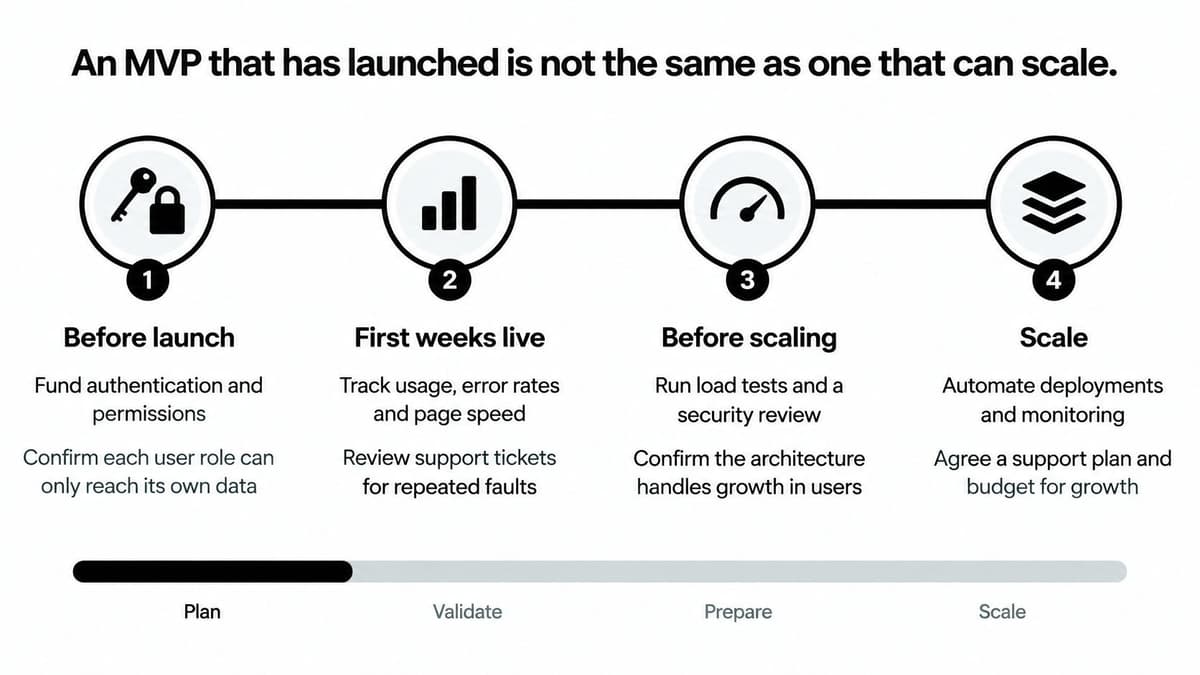
A Staged Readiness Timeline
Before launch, fund authentication and permissions, automated tests, billing failure handling, backups and recovery, documented APIs and security updates. These are the items that cause data loss, revenue leakage or a breach if they're missing, and they're painful to retrofit under live traffic.
In the first few months, add observability, data export and a full accessibility audit. You'll have real usage by then, so you'll know which journeys need instrumentation and which reports customers request.
Once traction is proven, revisit tenancy isolation, scaling and cost controls. That's the point where load testing and infrastructure changes earn their cost, because you're optimising for demand you've measured.
If you want to sanity-check those staging decisions, an overview of web application architecture helps you separate structural choices from cosmetic ones.
Reversible Versus Dangerous Shortcuts
Reversible shortcuts include a narrow first feature set, limited automation with manual work behind the scenes, or a no-code front end. You can replace any of these without losing your data or your customers.
Dangerous shortcuts include weak tenancy isolation, unmonitored production deployments and no data export. Each one can turn a routine change into an incident, and weak tenancy isolation can expose one customer's data to another.
Take a founder choosing between a no-code launch and a custom build. The no-code route is sound if data can be exported cleanly and the workflow could be rebuilt elsewhere. It becomes a trap if customer records live only inside the platform with no export path.
Scalable doesn't mean building an enterprise platform early. It means preserving the options most likely to matter while validating demand cheaply. A good agency will tell you which shortcuts it took and how to unwind them. A weak one will describe its shortcuts as permanent, or won't be able to name them at all.
Which shortcut do you propose, and how would we reverse it?
Shortlist and Brief Your Agency This Week
You don't need a longer shortlist. You need a consistent test applied to a short one.
Five Actions to Run This Week
- Shortlist three to five agencies: Score them with the criteria above and discard any that can't show a live product in a similar sector.
- Send the same one-page brief: Cover outcomes, users, integrations, data constraints, a budget range and the MVP boundary you have in mind.
- Request evidence, not assurances: Ask for answers to the discovery questions plus two sample documents, such as a redacted architecture decision record and an accessibility defect log.
- Run a small paid test: Commission a tightly scoped discovery or spike with the top two and judge how they handle the risks they surface.
- Compare contracts before prices: Check ownership, payment and exit clauses first, then look at the totals.
Digital Souls Studios LTD is a London studio whose website describes a discovery-to-deployment workflow and post-launch support, so you can hold it against this scorecard by requesting its process documents and timing its reply, exactly as you would any other candidate.
Apply the same standard to every agency, including the one you already like. Favouring a familiar name is how weak ownership terms slip through unchallenged.
The best agency is the one that makes risk visible early, while it's still cheap to fix.
If you're planning an MVP, a SaaS platform or an internal tool and want the risks surfaced before the build budget is committed, talk to Digital Souls Studios LTD about a scoped discovery covering specification, architecture and post-launch support. Bring your scorecard, ask for the sample documents described above, and use the answers to decide whether the fit is right.