8th November 2026 · 16 min
API Integration Services: A Practical UK Guide for 2026

Your finance team starts the morning copying invoices from the order system into the accounting package. Someone checks a spreadsheet, fixes a customer name and asks whether yesterday's payment has arrived. You want the systems connected, but you don't want an automation that creates duplicate invoices or stops working without anyone noticing.
That's the useful starting point for API integration services: not which connector to buy, but which business process should change, what could go wrong and who will own it after launch.
Table of Contents
- What API Integration Services Actually Cover
- Six Delivery Phases and What Each Produces
- Architectures and Stacks for Each Situation
- Security Controls for Payments and Sensitive Data
- Lock-in, Silent Errors and Pre-Signature Checks
- Engagement Models and What Each Costs
- Client Examples From Launched Platforms
What API Integration Services Actually Cover
An API, short for application programming interface, is like a hotel reception desk. It accepts a defined menu of requests, such as retrieving a booking or updating a guest's details. Integration is the translator making sure the systems on either side send and understand the right forms.
For the invoice workflow, a provider must do more than transfer fields. They need to establish which system owns the customer record, how tax codes correspond and what happens when the accounting package rejects an invoice. A technically successful request isn't enough if it posts the wrong amount.
The work behind the connection
A complete service typically includes:
- System mapping: Identify the applications, data owners and business rules.
- Connector development: Build requests and translate records between formats.
- Access controls: Limit what the integration can read or change.
- Failure handling: Test rejected records, unavailable services and safe retries.
- Operational handover: Document the workflow and monitor its live behaviour.
Early-stage SaaS teams buy this work to connect payments and login. SMEs use it to replace spreadsheet handoffs, while operations teams use it to automate support and internal administration.
The scale is already substantial: Open Banking Limited reported more than 22 billion API calls across the UK ecosystem in the twelve months to July 2025, representing 36% year-on-year growth. At that scale, reliability, consent, security and user trust matter as much as connectivity.
A one-off connection delivers working software at an agreed handover point. An ongoing integration service adds responsibility for keeping that workflow usable as providers, credentials and business requirements change. Decide which responsibility you're buying before comparing quotes.
Six Delivery Phases and What Each Produces
Commission integration work through discovery, design, implementation, testing, documentation and monitoring. Each phase should produce something you can inspect, not just a statement that development is progressing.
Discovery produces an integration brief defining the business outcome and boundaries. Design turns that brief into an agreed technical contract. Implementation produces working components in staging, where mistakes won't affect live customers.
From requirements to an operable service
For REST APIs, the Government Digital Service technical and data standards recommend OpenAPI, OAuth 2.0 and ISO 8601 date and time formats. These give teams a shared description of requests, delegated access and unambiguous timestamps.
An OpenAPI contract should describe schemas, permitted operations, error responses, pagination and versioning. Include idempotency, meaning how repeated requests avoid creating repeated business actions. If an invoice submission times out, the integration needs a safe way to discover whether the invoice already exists before resending it.
Testing then checks both the contract and business behaviour. Documentation records how to operate the finished workflow. Monitoring gives someone responsibility for detecting and resolving live problems.
The delivery flow below also shows deployment, which should have its own approval and rollback checkpoint.
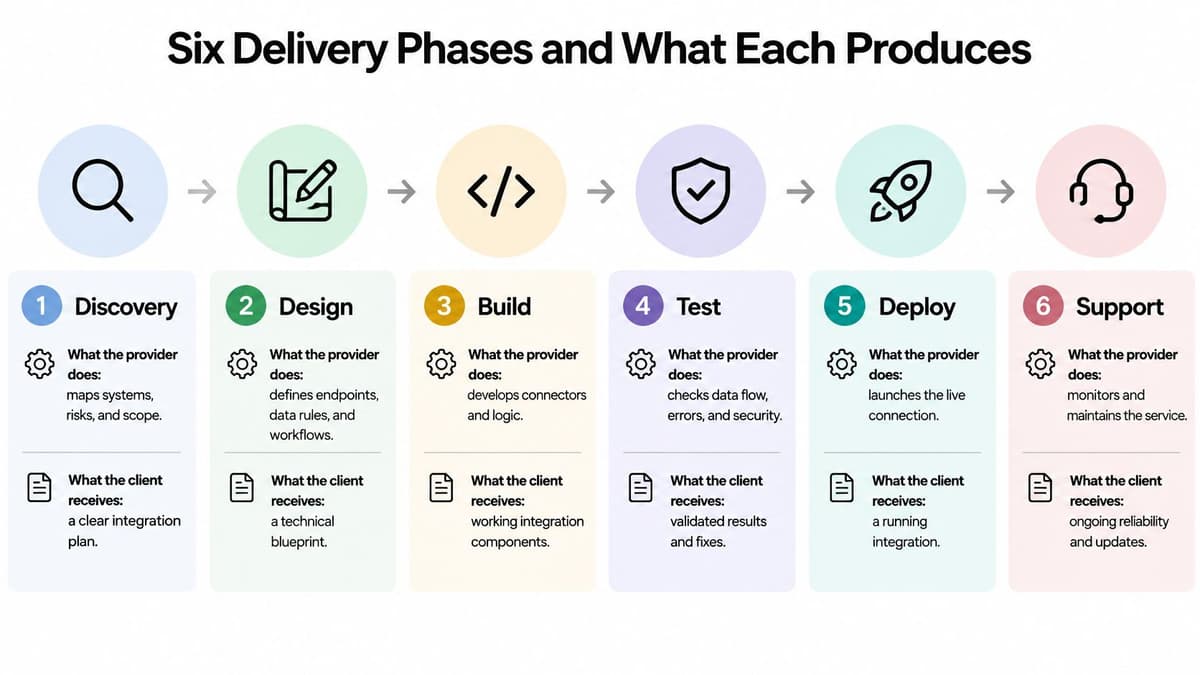
Delivery phases, outputs and scheduling rules
| Phase | What the provider does | What you receive | Typical duration |
|---|---|---|---|
| Discovery | Maps systems, data flows, owners and business rules | Integration brief and system inventory | Time-boxed until access and scope are confirmed |
| Design | Drafts API contracts, data mapping and authentication model | OpenAPI document and data-mapping specification | Scheduled around contract approval |
| Implementation | Builds connectors, transformations and error handling in staging | Working integration in a staging environment | Estimated from approved mappings and connector complexity |
| Testing | Runs contract, load and failure-path tests | Test report and resolved defect list | Continues until agreed acceptance criteria pass |
| Documentation | Writes runbooks, schema notes and handover material | Operational runbook and documentation repository | Runs alongside the build |
| Monitoring | Sets alerts, dashboards and a support rota | Live dashboards and named monitoring owner | Ongoing after launch |
Set dates against evidence
There isn't a defensible universal timetable for a mid-sized integration. Missing sandbox access, inconsistent records or an undocumented upstream API can change the work substantially. Ask for estimates tied to assumptions, dependencies and approval dates rather than treating a generic range as a commitment.
Use a software project plan to record those dependencies alongside delivery milestones. Documentation should develop with the code, and monitoring should be configured before production traffic starts.
Procurement test: A complete proposal names the deliverables, their owners and the evidence required to accept them.
Credentials for each environment, automated contract tests and a runbook belong in that acceptance checklist. Without them, you may receive a working demonstration rather than an operable service.
Architectures and Stacks for Each Situation
Architecture is a decision about where complexity lives. You can put workflow logic inside an application, an integration platform, a messaging system or a dedicated service. Each choice changes what your team must maintain.
Direct calls suit a small, clearly bounded connection. An integration platform centralises shared workflows but introduces licence costs and platform dependence. Event-driven messaging separates the sender from the receiver, which helps when work can be queued rather than completed immediately.
Integration architectures compared
| Pattern | Best for | Main trade-off | Typical tools |
|---|---|---|---|
| Point-to-point API calls | Two systems with low volume | Links become harder to trace as connections multiply | Direct SDKs and webhooks |
| Integration platform (iPaaS) | Several SaaS tools sharing workflows | Licence cost and platform dependence | Make, Zapier, Boomi, MuleSoft |
| Event-driven messaging | High volume, near-real-time updates | More moving parts to monitor | Kafka, Azure Service Bus, AWS EventBridge |
| Scheduled batch sync | Legacy systems with no modern API | Data is only as fresh as the last run | File exports, SFTP, ETL jobs |
| Adapter layer over legacy | Old systems that need a modern front door | Adapter maintenance stays with you | Custom middleware and API gateways |
When older systems set the constraints
The UK Technology Adoption Review identifies integration challenges with legacy technologies as a barrier to adoption. Don't assume every source application offers webhooks, reliable identifiers or a supported modern API.
A scheduled export can be the sensible option when staff need to approve records before release. An adapter is useful when newer applications need a stable interface while the underlying legacy system remains unchanged. Avoid writing directly into an old application's database unless the vendor explicitly supports that method.
Choose the simplest pattern that keeps information fresh enough for the business process, not the pattern with the most fashionable infrastructure.
A support automation example
Our custom AI support agent answers email, replies to user messages and triages issues. In a proposed helpdesk-to-CRM architecture, an integration layer could retrieve approved customer context, record the response and route cases requiring human attention.
Keep that workflow separate from the agent's wording decisions. Deterministic rules should control which records it can change and which actions require approval. The broader web application architecture should make those boundaries explicit.
A controlled batch is safer than immediate synchronisation when uncertain records need reconciliation before staff act on them. Faster delivery of incorrect information isn't an improvement.
Security Controls for Payments and Sensitive Data
An integration touching payments, balances or sensitive customer records needs more than a shared credential passed between applications. It needs a clear answer to who is acting, what they're allowed to do and whether the customer approved it.
The diagram shows those separate checks around a banking connection.
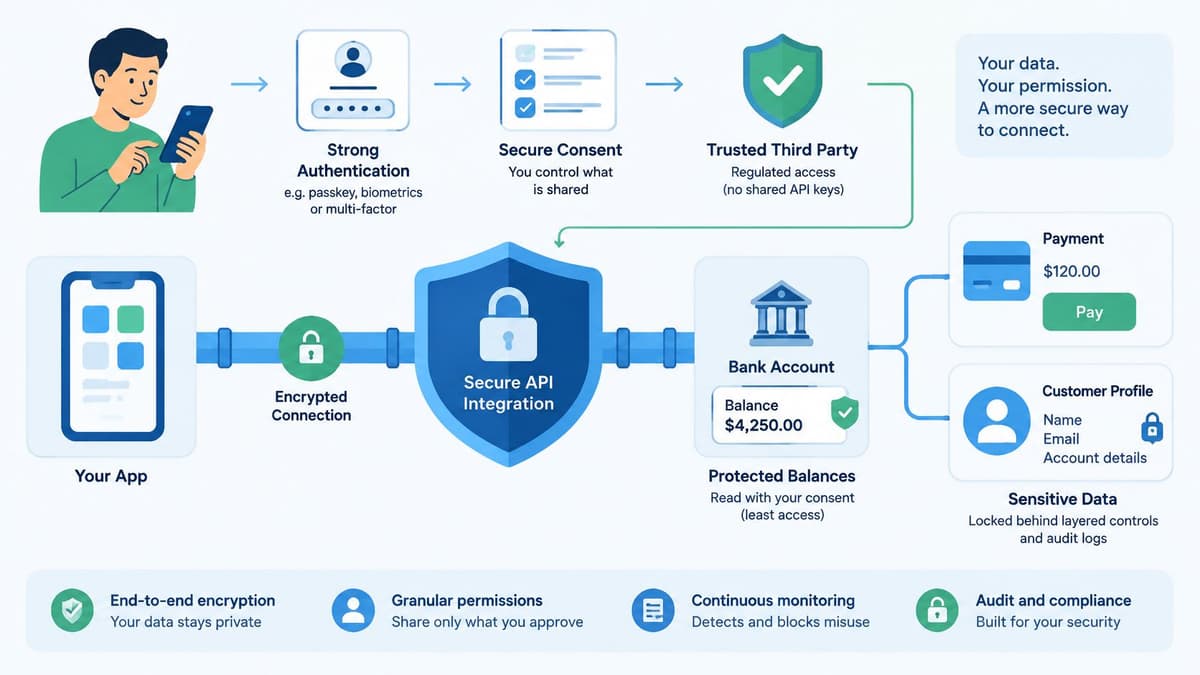
The Open Banking Read/Write participant guidelines describe customer-consented access using OAuth 2.0 and OpenID Connect over mutually authenticated TLS, within a wider Financial-grade API security model. In plain language, these controls separate delegated permission, identity checks, protected transport and stronger financial-service safeguards.
A static API key alone doesn't demonstrate that a particular customer approved a particular action. Scoped permissions and strong client authentication reduce what an attacker can do with a compromised component. Don't assume that adopting OAuth automatically gives a general business integration the complete Open Banking security model.
Put operational controls into the scope
Specify concrete protections rather than asking for a secure API:
- Rate limiting: Apply per-client limits so excessive traffic doesn't exhaust shared capacity.
- Schema validation: Reject malformed inbound payloads before business logic processes them.
- Replay protection: Check signatures, timestamps and nonces where the protocol requires them.
- Credential rotation: Assign an owner and schedule for secrets and certificates.
- Structured audit logs: Record consent events and calls without storing tokens or unnecessary sensitive payloads.
- Anomaly alerts: Investigate unexpected traffic patterns, failed authentication and unusual access.
- Tested fallback behaviour: Define what users and staff see when an upstream provider is unavailable.
For workflows involving anti-money laundering software, preserve the connection between the initiating action, the information used and the resulting decision. A generic success log won't explain why a sensitive record changed.
The accompanying video provides another visual explanation of API connections.
Before approving a payment integration, establish whether regulated-participant onboarding is required, who manages certificates and how consent revocation is recorded and enforced. Those answers should identify operational owners, not just technologies.
Lock-in, Silent Errors and Pre-Signature Checks
The cheapest build can be the most expensive arrangement to leave. If a supplier holds the only readable copy of your mappings, changing supplier becomes a reconstruction project rather than a handover.
The UK government evidence review on technology adoption identifies adoption costs as a significant barrier for 33% of businesses and workforce skill gaps for 25%. Procurement needs to address both: what you'll spend and whether your team can operate what you receive.
Recognise the less visible dependencies
Vendor lock-in isn't limited to proprietary software. It can come from undocumented transformations, supplier-controlled cloud accounts or business rules buried inside a visual workflow that nobody in your organisation can access.
Say an old finance system uses a blank customer category to mean standard terms. A new CRM interprets the same blank as unknown. If the integration converts both to a default value, staff may stop seeing errors while the underlying records drift apart.
A successful HTTP response only confirms that the receiving service accepted the request. It doesn't establish that the customer, amount, category or business outcome was correct.
Operational safeguard: Reconcile business records, not just request counts.
Build checks around source totals, destination totals, unmatched identifiers and rejected records. Give exceptions a visible queue with a named person responsible for resolving them. Staff also need a way to distinguish a temporary delay from a record that requires correction.
Make the contract support an orderly exit
Use the following pre-signature checklist to turn broad assurances into inspectable commitments:
- Written scope: List discovery, design, implementation, testing, documentation and monitoring outputs with owners and acceptance dates.
- Accessible schemas and mappings: Specify ownership and access rights for contracts, transformation rules and configuration.
- An executable exit plan: Name the repositories, exports, deployment instructions and credentials needed to transfer operation.
- Monitoring and rollback ownership: Identify who receives alerts, who can pause processing and how changes are reversed safely.
- A multi-year cost model: Include platform licences, hosting, usage charges, support, upgrades and eventual migration work.
An exit plan should distinguish your business logic from third-party licensed components. You may be entitled to your mappings and custom code without being entitled to copy a platform vendor's software. Record those boundaries before delivery starts.
Rollback needs similar precision. Reverting an application deployment doesn't automatically undo invoices already posted or messages already sent. The plan should describe how staff identify affected transactions and perform authorised corrective actions.
Separate maintenance from wider retained work
Our support packages cover maintenance after launch in addition to a scoped project. That model suits a defined build followed by an explicit maintenance arrangement.
Our all-in-one retainer has a wider remit: maintenance, research, A/B experiments, marketing material, documentation, servers, deployments, meetings, customer support, design and consultation. It shouldn't be compared with a narrow maintenance quote as though both purchase the same work.
For agent-based workflows, the client pays third-party agent subscriptions and usage. Include those costs separately so a build fee doesn't become an accidental proxy for the full operating budget.
Start procurement with a discovery session and request a scoped brief. Compare competing proposals against delivery evidence, operating responsibilities and exit terms, not just the headline amount.
Engagement Models and What Each Costs
There's no single price for API integration services. A bounded connector, an AI support agent and ongoing development oversight purchase different outcomes.
The package figures below are Digital Souls Studios LTD's own published prices, not market averages. Bespoke integration work needs a quote based on the agreed scope.
Engagement models and cost signals
| Model | How it is billed | Best for | Cost signal |
|---|---|---|---|
| Fixed-scope project | Milestone payments against a written scope | One integration with clear requirements | Quote after discovery |
| Automated development team setup | One-off package | Teams setting up an AI-agent development team | £5,000, paid once |
| Custom AI support agent | One-off build | Support teams triaging email and routine queries | £3,000, paid once |
| Managed development team | Monthly management fee | Clients wanting ongoing oversight of an AI-agent team | From £1,000 a month, optional |
| Support retainer | Monthly fee scaled to requirements | Maintenance, changes and support after launch | Quoted against requirements |
Match the commercial model to the outcome
A fixed-scope project works best when the intended workflow and acceptance criteria are clear. Milestones should correspond to accepted deliverables rather than vague proportions of development completed. Changes need an agreed process so neither side has to guess whether additional work is included.
Our automated development team setup establishes the infrastructure so the client can run an AI-agent development team. It's a setup package, not a promise that every subsequent integration or product feature is included.
The custom AI support agent is a distinct package for a support use case. Define its intended channels, permitted actions and escalation boundaries when agreeing the implementation scope. Don't assume that a package label includes an unrestricted number of downstream systems.
Distinguish setup from ongoing responsibility
Managed development team oversight is optional after setup. That distinction matters if your team wants to operate the infrastructure itself rather than commission ongoing management.
A retainer suits continuing work where priorities change. Our retainer fee is based on requirements, so the agreement should state the expected remit and how work is prioritised.
Several practical factors change a bespoke integration quote:
- System access: Supported APIs are different work from undocumented legacy exports.
- Data condition: Conflicting identifiers require reconciliation rules and cleanup.
- Security requirements: Sensitive operations need additional controls and testing.
- Environment coverage: Development, staging and production each require configuration and operational attention.
Compare quotes against the same deliverables and acceptance criteria. A cheaper proposal that excludes failure testing or deployment isn't necessarily a cheaper way to obtain the same service.
Client Examples From Launched Platforms
A named launch establishes that a team helped deliver a real platform. It doesn't, by itself, establish which APIs were connected, what architecture was used or who operated the service afterwards.
Our work with ASURISQ ApS helped launch its anti-money laundering compliance platform in December 2025. That's a useful example of platform delivery in a compliance setting, but it shouldn't be treated as evidence of undisclosed integrations or performance results.
Read a compliance example carefully
For a prospective compliance project, explore how the proposed scope would preserve reporting accuracy and traceable changes. Ask which delivery responsibilities a comparable engagement included and what evidence can be shared without exposing confidential information.
The relevant handover questions are concrete:
- Scope boundaries: Which components were delivered and which remained with other teams?
- Documentation: Who received the operating instructions and technical contracts?
- Live ownership: Who investigated incidents after deployment?
- Continuation: Was post-launch maintenance included or separately commissioned?
These questions distinguish delivery evidence from assumptions about a client's sector. A compliance platform needs careful controls, but its name alone doesn't prove which controls a supplier implemented.
Read a portal launch differently
We also partnered with Minday.ai to launch its platform on IT Jobbank, a job portal for IT professionals in Denmark, in July 2024. The stated outcome is the launch partnership, not an undisclosed claim about traffic, conversion or integration throughput.
For a comparable portal-facing project, your discovery questions might focus on account journeys, availability during upstream outages and how releases are coordinated across organisational boundaries. Those are proposed evaluation criteria, not claims about the Minday.ai implementation.
A useful case study separates what was delivered, what can be demonstrated and what remains outside the published scope.
Request a named launch, the agreed scope and an appropriate handover example when evaluating delivery evidence. Where confidentiality prevents sharing client materials, request a redacted or demonstration version rather than assuming the material exists.
Compliance and portal projects have different operational priorities. In a compliance workflow, an incorrect record may undermine a decision; in a portal workflow, unavailable customer journeys may prevent people using the service. Your own failure scenarios, internal capacity and operating responsibilities should determine the engagement model.
Digital Souls Studios LTD offers API development, SaaS integrations and workflow automation, with delivery from specification through launch and optional ongoing support. Visit Digital Souls Studios LTD to discuss your systems, the manual handoffs you want to remove and the operational risks a scoped integration brief needs to address.