22nd October 2026 · 17 min
8 Bespoke Software Examples Worth Studying

Bespoke software isn't automatically better than a product you can configure tomorrow. That's the most popular misconception in this market, and it's expensive. A custom build earns its cost only when it solves a distinct workflow, connects systems that can't talk to each other, or creates a feedback loop that changes behaviour. If an off-the-shelf tool already does those things well, building your own version usually just transfers maintenance, security and training costs to you.
That caution matters because specialised software is already mainstream in the UK, not a niche experiment. The Office for National Statistics found that 61% of UK firms had adopted specialised software in 2023, compared with 69% using cloud-based computing systems and applications, in its analysis of management practices and technology adoption in UK firms. The important nuance is that officials define this category by business function, not by whether every line of code was written from scratch.
These eight bespoke software examples are worth studying for the decisions behind them. Each one shows a problem, a narrow implementation choice, and a tactic you can reuse without copying the product. You'll see internal tools that became products, AI that only works because it's connected to live systems, and dashboards whose value lies in shared definitions rather than visual polish.
Table of Contents
- 1. Slack Internal Tool Turned Product
- 2. Klarna AI Customer Service Assistant
- 3. GOV.UK Platform Rebuild Focused on Performance and Reusable Components
- 4. STRIVR VR Training Platform
- 5. Zapier Programmatic SEO Integration Pages
- 6. Duolingo Max AI-Driven Practice and Feedback Tools
- 7. Virtual Battlespace Military-Grade Interactive Simulation
- 8. Custom Internal Operations and Compliance Dashboards
- The Eight Examples Compared
- Build Around the Problem, Not the Technology
1. Slack Internal Tool Turned Product
Slack started as an internal messaging tool at Tiny Speck while the team was developing Glitch, an online game that didn't succeed commercially. The game failed, but the tool the team used every day to coordinate its work had clear, repeated value. Tiny Speck launched Slack publicly in 2014, and the product later reached an exit through its acquisition by Salesforce, announced in 2020 and completed in 2021.

The pattern is useful because validation happened before commercialisation. The first users weren't a focus group giving opinions, they were colleagues relying on the tool under real deadlines. That daily use exposed which features mattered, which notifications annoyed people, and where integrations would reduce context switching. It's a stronger test than a landing page survey.
What to Copy and What to Avoid
Don't copy the pivot story as a strategy. Most internal tools shouldn't become products, because they solve one company's habits rather than a market problem. Copy the discipline of building around one core workflow and measuring actual use from day one.
- Start with daily friction: Build the first version around a task your team repeats constantly, not a broad vision.
- Instrument early: Track activation, feature use and retention so you can cut what people ignore.
- Document APIs early: Integrations often drive retention, so treat them as product features, not afterthoughts.
That discipline is central to custom developed software built as a validated product, where the MVP proves demand before you fund a wider platform.
2. Klarna AI Customer Service Assistant
Klarna launched its AI customer service assistant in February 2024, built on OpenAI models and integrated into its help system. The company reported that it handled a large share of customer chats in its first month, focusing on refunds, payments and account questions. The meaningful detail isn't the headline volume. It's that the assistant could act inside live systems, rather than only produce plausible answers.

A support agent that can't check an order, verify identity or trigger a process will frustrate customers quickly. Klarna's pattern works only if routine queries are predictable, source data is reliable, and human escalation is fast when confidence drops or emotion rises. Without those boundaries, automation shifts workload into complaints and rework.
Practical rule: Automate the queries you can resolve from trusted data, and make the route to a person obvious before you scale the bot.
Governance is where many teams fall short. Only 17% of businesses using AI reported having any AI policy or guidance, and just 5% had a formal written policy, according to the UK Business Data Survey 2026. That gap makes transcript reviews, escalation rules and prompt change control essential operating work.
Build the first release from your most frequent queries, measure handover rates, and review failures weekly. A well-designed AI chatbot for customer service that escalates cleanly protects trust while it reduces repetitive work.
3. GOV.UK Platform Rebuild Focused on Performance and Reusable Components
When the Government Digital Service launched GOV.UK on 17 October 2012, it consolidated fragmented government websites into one service. The project is often praised for design, but its lasting lesson is operational. Teams reduced duplication, audited content, enforced accessibility, and built reusable patterns that other services could adopt without starting again.
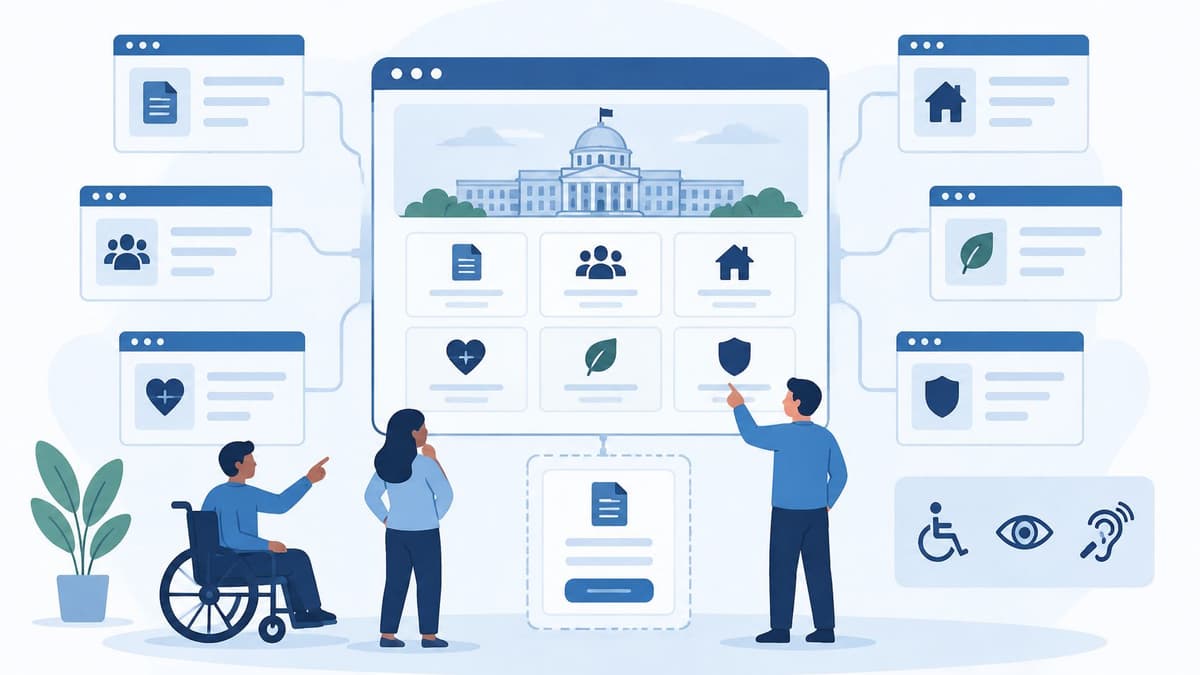
The GOV.UK Design System turned individual design decisions into a shared asset. That matters for any multi-team platform, because consistency isn't achieved by issuing brand guidelines and hoping. It's achieved when the easiest route for a team is to use a tested component with known behaviour, accessibility characteristics and content guidance.
Reusable Doesn't Mean Generic
A component library fails when it becomes a catalogue of buttons nobody maintains. GOV.UK's stronger practice was joining components to user research, performance budgets and service standards. Teams had to think about the complete task, including error states and assisted digital support, not just the happy path.
- Audit before migration: Delete or archive outdated content instead of moving it into the new platform.
- Set performance budgets: Test page weight and load time at every release, not after launch.
- Own the library: Assign maintainers, version changes and deprecate patterns publicly.
The trade-off is upfront coordination. Shared components slow the first service slightly, then speed up every service after it. For a single small website, that investment may be excessive. For a platform with many teams and audiences, reuse becomes the product.
4. STRIVR VR Training Platform
Walmart's use of STRIVR from 2017 onward is one of the most cited examples of VR in frontline training. Associates practised customer interactions and in-store situations in immersive modules instead of relying only on manuals or classroom sessions. Sports teams have used similar simulation approaches for decision-making practice, where repetition outside live competition is valuable.

VR earns its place when the scenario is costly, rare, disruptive or unsafe to rehearse. It also suits spatial tasks and situations where emotional pressure changes performance. It doesn't automatically improve learning for information that a short video, quiz or supervised practice session would teach more cheaply.
Where Immersive Training Breaks Down
Headset logistics are the hidden work. Devices need charging, cleaning, storage, updates and support, and some learners can't use them comfortably. Content also becomes dated when store layouts, scripts or procedures change. If updating a scene requires a long production cycle, the training asset can become accurate-looking but operationally wrong.
Start with one high-stakes, repeatable scenario, measure behaviour after training, and provide structured scoring rather than immersion alone. Offer a web or mobile fallback where headsets aren't practical, using WebXR when it fits the scenario. Those constraints also apply to augmented reality products used for training and operations, where hardware access and content maintenance decide whether the pilot survives.
5. Zapier Programmatic SEO Integration Pages
Zapier turned its product data into a customer acquisition system. It created large numbers of pages for specific app-to-app automations, generated from structured information about integrations and refined around what people search for. Each page answers a narrow question, such as how two tools connect and what workflow that enables.
This is one of the more instructive bespoke software examples because the custom work isn't a visible feature. It's the template, data model and quality controls behind thousands of useful pages. If the underlying integration data were inaccurate, scale would create inaccurate pages faster. If every page repeated the same copy, the system would generate volume without distinct search value.
A programmatic page should exist only when a specific query deserves a specific answer grounded in real product data.
E-commerce teams use a similar pattern for category, compatibility and comparison pages built from catalogue data. The risk is index bloat. Pages with thin differentiation can consume crawl resources, dilute internal linking and produce traffic that doesn't convert.
- Map one query to one job: Generate a page only where search intent is distinct.
- Add unique evidence: Use real examples, data fields, screenshots or setup steps in each instance.
- Measure by template: Track indexation, impressions and conversions per template, not only total visits.
- Protect speed: Monitor Core Web Vitals as page volume grows.
The transferable lesson is that bespoke software can turn proprietary structured data into distribution. It works when your data is accurate and useful. When it isn't, programmatic generation merely automates weak content.
6. Duolingo Max AI-Driven Practice and Feedback Tools
Duolingo introduced Duolingo Max in March 2023 as a premium tier built on GPT-4. Its Explain My Answer feature gives personalised feedback on mistakes, while Roleplay lets learners practise conversations with an AI character. Although it's a consumer product, the pattern is directly relevant to corporate language, sales and service training.
The strength is immediacy combined with specificity. A learner doesn't wait for a tutor to explain why an answer failed, and practice can adapt to the response they just gave. That feedback loop is more valuable than generating unlimited exercises. It helps learners correct an error while the context is still fresh.
The Control Layer Matters More Than the Prompt
AI practice becomes unreliable when the model improvises the curriculum. A bespoke training tool needs learning objectives, a rubric and escalation rules that constrain feedback. It also needs logs, so instructional designers can inspect recurring misunderstandings and correct poor explanations before they spread across cohorts.
Cost control is another product decision. Open-ended conversations consume model tokens quickly, especially when learners are encouraged to practise frequently. Set usage limits per learner, cache common explanations where safe, and assess skill gain separately from activity. Time in the app isn't proof of competence.
Use AI where varied practice and instant feedback improve outcomes. Keep assessments, safeguarding and final judgement under accountable human ownership, particularly in regulated or safety-critical training.
7. Virtual Battlespace Military-Grade Interactive Simulation
Virtual Battlespace, developed by Bohemia Interactive Simulations, is used by military forces and defence training centres to build custom environments, scenarios and exercises. Its value sits in controlled repetition. Teams can rehearse decisions, vary conditions, and examine what happened without exposing people or equipment to the full risk and cost of live training.
Realism is only part of the design. A technically impressive environment can still train the wrong behaviour if instructors haven't defined learning objectives and assessment criteria first. The scenario must make relevant cues visible, record meaningful actions, and support an after-action review where participants understand why an outcome occurred.
Those principles transfer to emergency services, industrial safety and compliance training. A fire evacuation simulation, hazardous equipment drill or control-room incident exercise doesn't need military scale. It needs credible decision points, consequences that follow from choices, and a debrief that connects behaviour to procedure.
- Define competence first: State what the learner must notice, decide and communicate before building the scene.
- Record decision data: Capture timing, choices and communications, not only completion.
- Make debrief core: Replay key moments and agree corrective actions in every session.
Budget is the main limitation. Heavy simulation engines and specialised content can lock a programme into expensive updates. For smaller teams, prototype in WebGL or WebXR, test whether the scenario changes behaviour, then invest in richer fidelity only where realism affects the decision being trained.
8. Custom Internal Operations and Compliance Dashboards
Compliance dashboards look mundane, which is partly why they're so valuable. Fintech and regulated businesses build internal consoles to monitor transactions, manage approvals, flag exceptions and produce reports from systems that were never designed to work together. Platforms such as Retool, publicly referenced by customers including Brex for internal tools, let teams build these interfaces quickly on top of databases and APIs.
The NHS offers two instructive versions of the pattern. One foundation trust combined predictive scheduling with behavioural nudging, reducing missed appointments by 23% beyond standard SMS reminders over six months, generating 1,910 additional patient attendances and releasing an estimated £1.3 million in clinical capacity, as reported in a UK government NHS case study. The system connected risk scoring, messaging and scheduling into a closed loop.
One Trusted View Before Automation
NHS Midlands and Lancashire took a different route for frailty care across Lancashire and South Cumbria. Its dashboard integrated data sources and standardised measures across primary, community and secondary care, supporting a shared frailty score, care-plan template, trends and regional variation, according to the NHS Midlands and Lancashire frailty dashboard case study.
That sequence matters. Define data ownership, validation rules, refresh frequency and metric lineage before automating actions. Enforce least-privilege access, log every action, and document definitions so teams don't produce competing reports. Low-code is suitable when workflows are internal and change quickly. Choose a fuller custom build when scale, audit requirements or complex integrations exceed the platform's controls.
The Eight Examples Compared
Treat the table as a screening tool. The useful comparison is the operating burden behind each pattern: who maintains it, what data it depends on, and which outcome proves the build earned its cost. Complexity and resource columns expose the commitment; outcome and advantage test the fit.
| Example | 🔄 Implementation Complexity | ⚡ Resource Requirements | 📊 Expected Outcome | ⭐ Ideal Use Case | 💡 Key Advantage |
|---|---|---|---|---|---|
| Slack: Internal Tool Turned Product | Medium: evolve an internal tool into a secure, scalable SaaS product | Product engineering, hosting, security, and integration support | Validates demand; can grow into a subscription product | Startups testing a focused workflow before a public launch | Real internal usage provides early product feedback |
| Klarna AI Customer Service Assistant | High: integrate AI with support systems and escalation workflows | AI models, structured knowledge, monitoring, and human support fallback | Automates routine queries and can shorten response times | High-volume customer support operations | 24/7 handling of common questions at scale |
| GOV.UK Platform Rebuild | High: migrate content and coordinate a large-scale redesign | Significant engineering, content, accessibility, and change-management effort | Consolidated services with reusable components and improved accessibility | Organisations replacing fragmented websites or platforms | Shared design patterns reduce future development effort |
| STRIVR VR Training Platform | High: develop immersive scenarios and deploy VR hardware | Headsets, device management, simulation content, and analytics | Enables repeatable practice with measurable learner performance | Frontline or high-stakes workforce training | Realistic practice without disrupting live operations |
| Zapier Programmatic SEO Pages | Medium to High: build templates, structured data, and quality controls | Initial content-system development, SEO expertise, and ongoing review | Creates many targeted landing pages with low marginal production cost | Products with substantial integration or catalogue data | Captures long-tail search demand at scale |
| Duolingo Max AI Practice Tools | High: develop AI interactions, learning feedback, and cost controls | Language models, learning design, evaluation, and usage monitoring | Offers personalised practice and immediate feedback | Language learning and other guided practice tools | Scales individualised conversational practice |
| Virtual Battlespace (VBS) | Very High: design complex environments, scenarios, and reviews | Specialist simulation software, trained designers, and substantial licensing or development budget | Supports repeatable, data-rich training for complex scenarios | Military, emergency-response, or industrial safety training | Safe rehearsal of high-stakes situations |
| Custom Internal Operations and Compliance Dashboards | Low to High: varies by low-code platform, integrations, and scale | Database/API access, permission setup, audit logging, and licensing | Centralises operations and reporting with traceable actions | Regulated teams managing approvals, exceptions, and reports | Unifies fragmented data and supports audit trails |
A row is a pattern to adapt, not a spec to copy. Start by ruling out options whose resource load your team cannot sustain, then test the remaining rows against one costly workflow and the evidence that would prove improvement.
Build Around the Problem, Not the Technology
The shared decision across these examples isn't bravery about technology. It's restraint. Slack began with an internal coordination problem. GOV.UK started by removing duplication and defining reusable service patterns. Klarna and Duolingo made AI useful by connecting it to a specific task and feedback loop. STRIVR and Virtual Battlespace targeted scenarios that were difficult to rehearse well through conventional methods. Zapier converted structured product data into pages people were already searching for, while the strongest dashboards established trusted data before adding automation.
That sequence gives you a practical way to decide whether bespoke software is justified. The UK context argues against assuming every organisation needs a custom AI platform. Around 1 in 6 UK businesses currently use at least one AI technology, while 80% neither use AI nor plan to adopt it, according to UK government AI adoption research. Readiness, process quality and integration capacity vary widely, so the right scope may be configuration, an API connection or a thin custom layer, not a complete build.
A Short Decision Checklist
Use these tests before you approve discovery.
- Name the costly workflow: Who performs it, how often, and where does delay, error or manual reconciliation occur?
- Prove the configuration gap: Which existing products have you tested, and which exact requirement can't they meet?
- Define the minimum useful product: What can a small group use safely to prove value before wider rollout?
- Choose the delivery route: Can low-code handle access, audit and scale, or does the workflow justify custom engineering?
- Plan the operating model: Who owns data, reviews automated decisions, fixes errors and funds support after launch?
Adoption constraints should shape that plan from the start. London recorded a 65% overall adoption rate in a UK survey of 4,595 businesses, while 17% identified data privacy and security concerns as a barrier and 16% cited technology integration, according to the UK innovation diffusion and adoption survey summary. A technically elegant system that can't integrate or reassure users won't solve the operational problem.
Digital Souls Studios LTD follows the practical side of this approach through discovery, specification, UX, engineering, AI, infrastructure and post-launch support. That structure matters because launch isn't the end of ownership. You still need monitoring, documentation, accessibility, security testing and a route for changing the product when the workflow evolves.
Start with the problem you can observe, not the platform you imagine. If the requirement survives comparison with existing tools, build the smallest system that improves the workflow and measure the result. Scale only after that evidence exists.
If you're weighing a custom MVP, AI support agent, compliance dashboard or training simulation, Digital Souls Studios LTD can help you define the smallest useful scope and build it through discovery, design, engineering and post-launch support. Visit Digital Souls Studios LTD to discuss your workflow, integration constraints and whether bespoke software is the right route.