27th November 2026 · 18 min
Fixed Price vs Time and Materials: Which to Choose

A quote arrives for a new website. It's one page, one number, and a line at the bottom saying the automation work can be priced once the site is live. A second supplier sends a day rate, a range of days and a request for a deposit before anything starts.
Neither document is dishonest. They're answering different questions, and the gap between them decides whether your project finishes on budget or turns into a monthly argument about invoices.
Choosing between fixed price vs time and materials comes down to three things: who carries the risk of the work taking longer than expected, how changes get priced, and when money leaves your account. The headline number is the least useful part of the comparison.
Table of Contents
- Fixed Price and Time and Materials at a Glance
- How Each Model Splits Financial Risk
- Where Budgets Drift Under Each Model
- Flexibility and Change Control Compared
- Cash Flow and Payment Timing Risk
- Which Model Fits Which Project
- Confirm Your Pricing Model Before You Sign
Fixed Price and Time and Materials at a Glance
Say you run a business with no technical team. You're asked to approve a quote for a website now and a second phase of automation work later. The website quote is a single figure for a defined build. The automation quote is a day rate with an estimate of somewhere between 15 and 25 days. Comparing them feels like comparing a train ticket with a taxi meter, and that's roughly what they are.
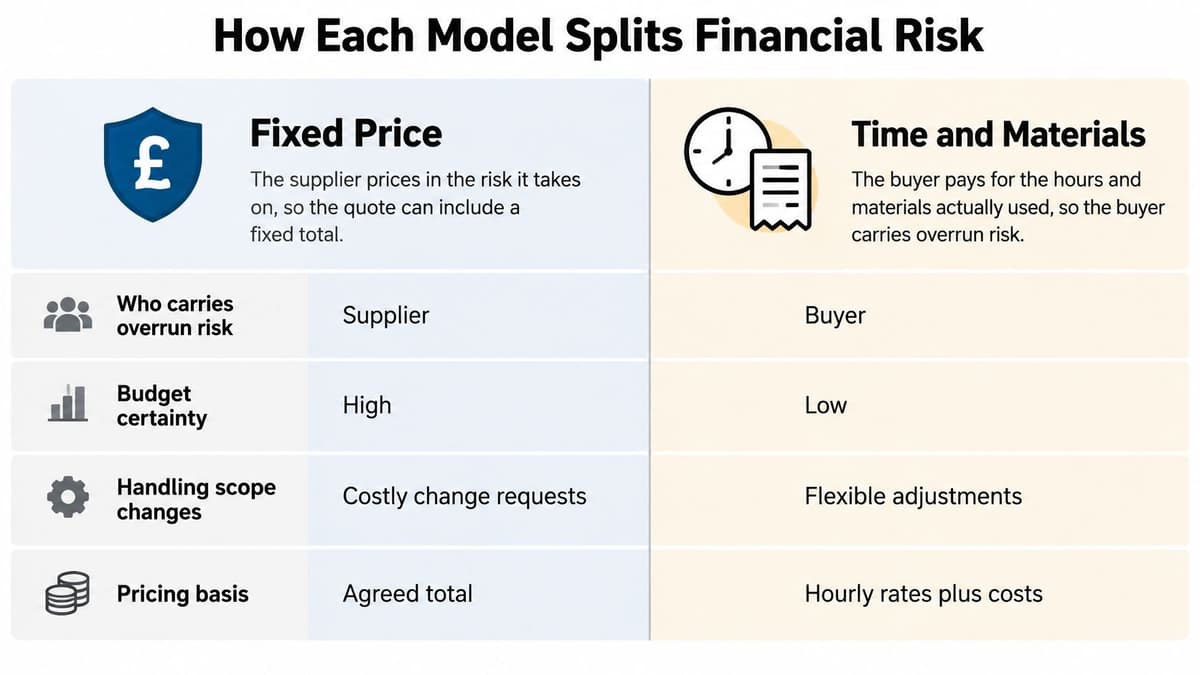
Fixed price means one agreed sum for a defined deliverable. The supplier carries most of the cost risk inside the agreed scope, because if the work takes longer than they estimated, absorbing that is their problem. Time and materials means you pay for the hours worked at agreed day rates, plus any materials, so the uncertainty about the final bill sits with you.
| Criterion | Fixed price | Time and materials |
|---|---|---|
| Who carries the cost risk | Supplier, within the agreed scope | Buyer |
| Budget predictability | High when the scope is clear | Lower, improved by a spending cap |
| Price basis | One agreed price for a defined deliverable | Actual hours at agreed day rates, plus materials |
| Change handling | Formal change requests with a separate price | Added to the next invoice, approved per change |
| Flexibility when priorities shift | Low, change needs re-pricing | High, priorities can move without renegotiating everything |
| Supplier incentive | Protect margin and limit extras | Can favour time over outcomes unless outputs are defined |
| Best fit | Stable scope with testable outputs | Discovery, learning and uncertain requirements |
| Main buyer risk | Disputes over what was included | Final cost and completion date are less certain |
The test worth running today is simple. Can you describe the finished product on a single page, with clear acceptance criteria for each part? Not a wish list, but an actual description of what "done" looks like, screen by screen or workflow by workflow. If you can, fixed price is a serious option and worth pushing for. If you can't, expect time and materials, a phased structure, or a supplier who builds a large risk premium into a fixed quote to cover what they can't see.
The distinction that matters most: a fixed price limits what you spend on the agreed scope. It does not limit what you lose to delays, slow approvals or a launch that lands a quarter late.
How Each Model Splits Financial Risk
The two models split financial risk differently, and that split, not the day rate, is what you are really buying.
Under time and materials, the supplier charges for the hours worked at agreed hourly or daily rates, plus materials purchased. UK government contract guidance frames the whole comparison this way, as a question of how financial risk is allocated between buyer and supplier (UK government buyer guidance on contract pricing). Under fixed price, a single price is agreed for a defined project or deliverable regardless of the supplier's actual time or cost. Budget predictability improves, but only as far as the specification and the change control hold.
That same guidance separates "fixed" pricing from inflation protection. On long contracts, agreed prices can be adjusted through indexation using independently compiled Office for National Statistics indices, which matters if your build runs across a year or more.
What a fixed price does not cover
A fixed price is a fixed price for a scope. It is not a guaranteed total project cost. New features, integrations, content changes, compliance requirements and delays caused by your own team can all sit outside the agreed figure and arrive as change requests.
A support team example. A support team commissions an automation workflow that drafts replies to common tickets and routes the rest to a human. The first two weeks reveal that the ticket data is messier than anyone assumed: duplicate records, missing categories, three inboxes nobody documented. Under fixed price, the supplier either absorbs that work or prices the possibility into the original quote as a premium. Under time and materials, it shows up as extra hours on the next invoice, visible and arguable.
Many buyers now use a hybrid: paid discovery first, then either a fixed price for a bounded first release or a capped time-and-materials arrangement for the parts still being learned. It costs a little more upfront and prevents the more expensive mistake of forcing unknown work into an unrealistic estimate.
The central question isn't which model is cheaper. It's which risk you would rather hold.
Where Budgets Drift Under Each Model
An online shop is nearly ready to launch when someone asks who is handling the payment provider integration. It was missing from the estimate. The budget problem now includes the work itself, the pressure to approve it quickly and when the extra payment falls due.
A fixed price is only as firm as its assumptions. Construction offers a reminder that contractual protection does not remove delivery risk: the NAO evidence on construction and PFI contracts examines the rescue of Carillion's PFI hospital contracts. For a software buyer, the practical question is what happens to the budget when delivery stops matching the agreement.
Where fixed price drifts
Look at the boundaries first. Extra feedback rounds, an unnamed integration or late content can create work outside the allowance. Each item may look small on its own. Together, they turn an apparently settled budget into a series of additional approvals.
Quote validity matters too. Gleeds forecast typical UK tender-price inflation of 3.75% for 2026 in its Gleeds UK market report. That is construction context, not a software inflation forecast, but it illustrates why a supplier may limit how long an offer stands. Check whether your quote will still apply when you are ready to start.
For the online shop, the omitted payment integration returns as a change request close to launch. The buyer must find extra budget while the original project payments remain due. The headline quote has not changed, but the cash needed to finish has.
Where time and materials drifts
Here, drift sits inside the hours: meetings, repeated work after unclear feedback and time spent waiting for decisions where the contract allows it to be billed.
The same shop can pay for the integration through ongoing development hours without seeing a separate change quotation. Without a spending cap or regular report, the cost becomes clear only when the invoice arrives.
Track spending against remaining work. A running total alone cannot show whether the unspent budget is enough to finish.
Early-warning signs to look for
- Vague exclusions: “third-party integrations excluded” leaves you unable to tell whether the payment provider is covered.
- No named approver: extra work proceeds without a clear spending decision.
- No burn report: invoices arrive without a running total against the estimate or an explanation of remaining work.
- Assumptions you haven't read: content, feedback and approval obligations can affect both the schedule and the bill.
Before signing, ask what is excluded, who can approve extra spending, how it is priced and when it becomes payable. Require written reporting against the estimate. To understand the underlying work before comparing quotes, use this guide to app development costs.
Flexibility and Change Control Compared
Flexibility means different things under each model, and the difference shows up on the invoice.
Under fixed price, flexibility arrives through a formal change process. Each change gets priced, agreed in writing and recorded, which protects your budget and slows everything down. Under time and materials, flexibility comes from reordering work each week without reopening the contract, but someone on your side still has to approve the extra spend.
UK public-sector agile contracting guidance names the trade-off plainly. Time and materials supports flexibility under uncertainty, but it can leave the buyer exposed to poor quality and can reward a supplier for selling time rather than reaching an outcome (Risk allocation and pricing approaches, UK Sourcing Playbook). The same guidance warns against fixing an entire requirement at the outset and recommends fixed-price sprints or phased commitments instead.
| Situation | Fixed price | Time and materials |
|---|---|---|
| New feature requested mid-build | Priced as a change request before work starts | Added to hours and approved against the cap |
| Client feedback arrives late | Milestone may slip; check who pays for waiting time | Billed only for time worked, but the plan slips |
| Discovery reveals more work | Usually a change request or a dispute over scope | Absorbed into hours and visible in weekly reports |
| Third-party integration fails | Depends on whether it was in the assumptions | Extra hours billed until resolved |
| Content or data not ready | Excluded unless listed in the assumptions | Time billed while waiting unless the work can be paused |
| Approved change in a later stage | Re-quote needed for the new scope | New priority agreed, cap unchanged |
The control that makes either model flexible is a measurable output per stage. A tested checkout flow. Deployed analytics events. A working support-agent workflow that answers real tickets. Release the next tranche of budget only after acceptance testing, and the model stops being a philosophical argument and becomes a series of decisions you can make.
The mechanics nobody reads until there's a problem
UK government contract-management guidance treats milestones, invoicing and change control as connected mechanics rather than paperwork. Milestones should link to the payment schedule so delivery is worth chasing. A change-control process should record changes to deliverables, dates or terms, agreed by both sides and signed off by named people (UK contract management playbook). Ask to see the change-request form before you sign, not after.
Three conditions make either model work in practice:
- A named approver on your side with authority to say yes to extra spend up to a set limit.
- A written definition of a usable release, so "nearly finished" has a test attached to it.
- A cap that can be paused, so work stops rather than continues while you decide.
Practical rule: if a supplier can't describe what a finished stage looks like in one sentence, they can't price it as fixed and they can't bill it honestly by the hour.
Cash Flow and Payment Timing Risk
The question most comparisons skip is whether the business can afford the payment pattern, not just the headline figure.
A fixed price is a price for a scope. A payment schedule is a separate mechanism that controls your working capital, and quotes bundle the two together until you pull them apart. Fixed-price work can look safer while requiring milestone payments before you've received anything you can use. Time and materials can reduce the risk premium in the quote, then hand you a bill on a regular cycle whether or not progress is visible.
UK payment data makes this a live issue rather than a theoretical one. 89% of UK companies reported at least one late payment in the previous year, and late invoices were 34 days overdue on average, with micro and small businesses averaging 35 days (2026 UK Payment Survey). If your own customers pay you late, your supplier's invoice date matters more than the rate printed next to it.
A founder's brand launch, held at the milestone
A founder commissions a brand launch with a milestone tied to approved design. The design goes to three stakeholders, then to a partner who's on holiday for two weeks, then back with comments that reopen the direction. Six weeks pass. The supplier's team is held, half-committed, waiting.
Under a well-drafted contract, that pause has a price and a rule. Under a badly drafted one, either the supplier eats the cost and rushes later stages, or the founder gets an invoice for standby time nobody warned them about.
Five things to compare across both models
- Deposits: how much leaves your account before any work is visible, and whether it's refundable if the project stalls.
- Milestone triggers: whether payment follows a date or a piece of evidence you can verify.
- Invoice due dates: 14 days, 30 days or on receipt, and whether early payment is discounted.
- Suspension rights: whether the supplier can pause work, how much notice they give, and what restarting costs.
- Idle time: whether a team held while you decide is billed, and at what rate.
Before signing, ask for named rates by role, an estimate of effort, a spending limit, weekly reporting, the rules for approving extra work, and a definition of a usable release (Contracting for agile, Digital, Data and Technology Playbook). Then ask three questions about the money specifically: who pays when a milestone is paused, whether the supplier can stop work, and how waiting time is charged.
The commercial point: a fixed project price limits scope uncertainty. A fixed payment schedule limits working-capital risk. Most buyers need the second one and only negotiate the first.
Which Model Fits Which Project
Fixed price suits work where outputs can be tested against a written specification. Time and materials suits work where learning changes what gets built. Most real projects sit in between, which is why phased structures are so common for first product releases and automation.
UK government guidance for digital buying is direct about this: fixed-price contracts transfer most delivery and cost risk to the supplier, and can cost more because suppliers price in the risk they assume, while time and materials charges the agreed day rate for any additional days required (How to pay for digital outcomes and specialists). A website with a signed-off specification can carry a fixed price with confidence. An AI automation or SaaS MVP where user feedback reshapes priorities usually needs time and materials or capped time and materials, plus a spending cap, weekly burn reporting and approval thresholds.
The trap is agreeing a fixed price before costs and delivery conditions are understood. A detailed-looking brief is not the same as a stable, testable scope. For websites, apps and AI automation, the unknowns tend to surface through user testing, integrations, data quality, security review or a change in how your team works.
Where a scoped project fits
Most of the work Digital Souls Studios LTD does is a scoped project running from specification through launch, with packages covering a standing engagement or a fixed AI setup. That structure suits a fixed first stage followed by a separate support arrangement, and a first version of a product can be built limited to the core features, which keeps the initial release bounded and priceable.
| Project | Better fit | Why | Watch for |
|---|---|---|---|
| Website with signed-off design | Fixed price | Scope is testable against the design | Content and assumptions locked before signing |
| Online store launch | Fixed price for the core build, capped time and materials for add-ons | Core features are known; add-ons emerge in testing | Payment and delivery integrations listed as assumptions |
| SaaS MVP | Paid discovery, then a fixed first release or capped time and materials | Feedback from early users changes priorities | Spending cap, weekly spend report, acceptance criteria per release |
| AI support automation | Paid discovery, then capped time and materials | Workflow depends on ticket data and process rules | Named approver and a defined usable release |
| Brand launch with uncertain scope | Time and materials or capped time and materials | Creative direction often changes after first reviews | Approval turnaround times and a cap on revisions |
| Internal tool that must fit existing systems | Fixed price if integration specifications are known | Integration unknowns can change the price | Access to existing systems confirmed before quoting |
For a fuller view of how to sequence scope, budget and delivery before anyone writes code, this piece on software project planning covers the decisions that make pricing predictable. Buyers weighing the commercial arguments in more depth will find a useful second opinion in Rite NRG on fixed price tradeoffs, particularly on where a fixed quote stops protecting the client.
Confirm Your Pricing Model Before You Sign
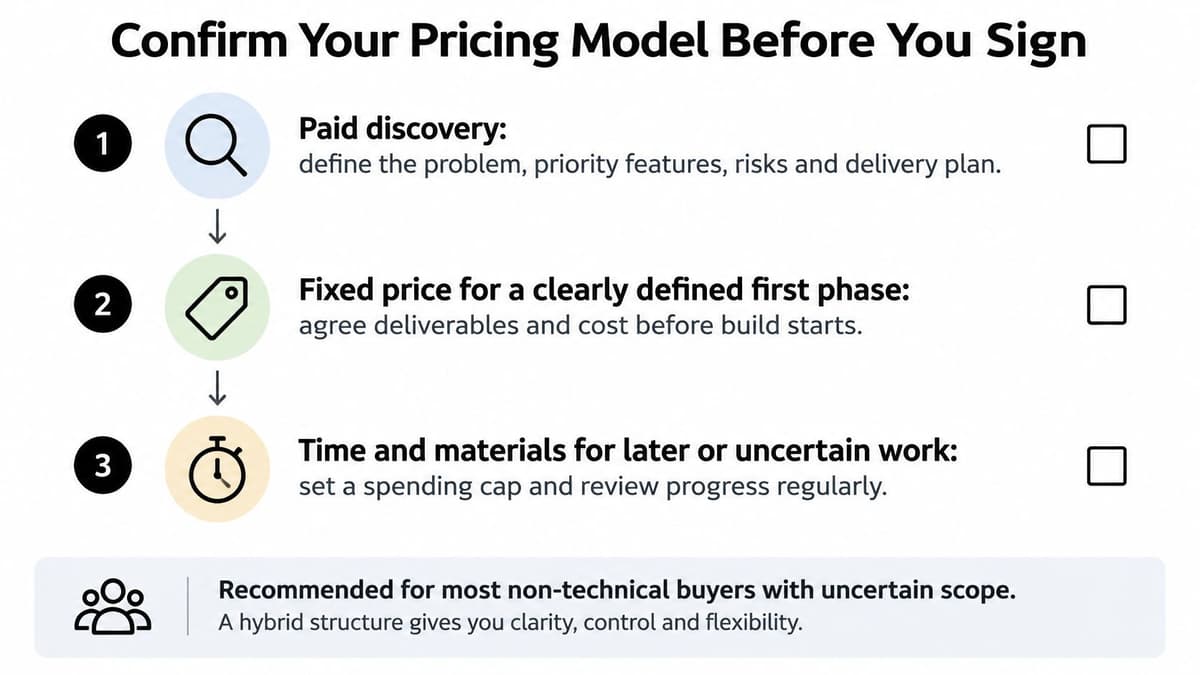
A signed pricing model should make the next decision easy: what changes, who approves it, and what it costs before the work begins. For most non-technical buyers with any uncertainty in the scope, a hybrid structure beats picking a side.
- Paid discovery. Define the customer problem, the priority features, the risks and the delivery plan. A 2026 UK software-development pricing guide from Magora Systems puts a typical discovery sprint at two weeks with a starting price of £3,000 when scope is defined before a fixed-price quote (Magora Systems guide to UK software development costs).
- Fixed price for a clearly bounded first release. Agree the deliverables, the acceptance criteria and the cost before the build starts.
- Capped time and materials for approved changes. Set the cap, the approval threshold and the reporting rhythm.
- Separate lines for launch and optional support. Launch work and post-launch maintenance are different jobs with different risk.
The UK Government's Digital, Data and Technology Playbook advises against using a traditional fixed-price or time-and-materials arrangement for an entire agile project when the detailed solution is uncertain. It suggests fixed pricing where scope is certain and a variable approach where uncertainty is higher, and it recommends separating cloud or software subscription costs from the supplier's build fee (Digital, Data and Technology Playbook). That last point matters commercially. If a supplier bills third-party agent subscriptions and their usage, keep those on their own line so you can see what the build costs and what the tools cost.
Six questions to put to any supplier
- What evidence shows discovery is complete? A document you can read and sign, not a verbal briefing.
- What is excluded? Named integrations, content, training, hosting and ongoing support.
- Who approves changes, and what does one cost? Get the change-request form and a rate card.
- What is the cap, and how is spend reported? Weekly, in writing, against the estimate.
- Which acceptance criteria trigger each payment? Evidence per milestone, not calendar dates.
- What happens when an assumption fails? Who absorbs the cost, and who decides whether to continue.
If the build has to connect to a system you already run, such as a store linking to an order system, read about koppling mellan kundportal och affärssystem before you scope the integration. Those connections are where fixed prices most often break, because access, data fields and business rules can change the work after signing.
Digital Souls Studios LTD works in a way that suits this structure. In the Specification step, the client explains the idea in writing and the studio puts together a specification fitted to the work before production begins. In Production, the studio designs and builds the project with regular updates. Most of the studio's work is a scoped project running from specification through launch, while packages cover a standing engagement or a fixed AI setup. That gives you a document to compare against other quotes, and a clearer view of what a change costs. If you're still deciding how to brief an agency, this guide to choosing a web application development agency sets out the questions that separate a solid partner from a cheap quote.
Digital Souls Studios LTD builds websites, online stores, SaaS products, mobile apps and AI automation on a written specification, so the scope, deliverables and price are agreed before production starts. If you're holding two quotes in different formats and can't tell which is better value, bring both and describe the project at Digital Souls Studios LTD. The studio replies to messages within 24 hours and will tell you which pricing model fits the work in front of you, not the one that's easiest to sell.