3rd November 2026 · 18 min
MVP Product Development: A UK Roadmap from Idea to Launch

Ship fast and be embarrassed by version one. That's the advice most founders repeat, and it's the advice that wastes the most money. Speed doesn't validate anything if you haven't decided what evidence would make you stop, change segment, or spend more.
Good MVP product development isn't a race to launch a thin product. It's a fixed time budget spent on a set of tests, each with an owner, a threshold, and a consequence. I would rather see a team spend eight weeks proving that nobody will pay than sixteen weeks building a polished answer to the wrong question.
Treat every phase below as a gate. If the gate doesn't open, you don't buy the next phase.
Table of Contents
- MVP Roadmap From Discovery to Private Beta
- Validate the Problem Before You Build
- Cut Scope to a Release Users Can Finish
- Hire, Freelance or Retain a Build Team
- Pick a Build Approach and Tech Stack
- Launch a Private Beta and Read the Signals
- Decide Whether to Scale, Pivot or Stop
MVP Roadmap From Discovery to Private Beta
Start with the calendar, not the feature list. This is the shape I'd plan around for a single-workflow SaaS or web application.
| Phase | Typical duration | Output | Go signal |
|---|---|---|---|
| Discovery | 2-4 weeks | Problem statement, 10-20 interview notes, list of current workarounds | Users describe the problem without prompting |
| Specification | 1-2 weeks | Prioritised feature list, user flows, acceptance criteria | Every must-have traces back to a validation finding |
| Prototype and testing | 6-8 weeks | Clickable prototype, task test results, go or stop decision | Users complete the core task without help |
| Build | 8-16 weeks | Working product, analytics events, security baseline | Core task works end to end in staging |
| Private beta | 4-8 weeks | Invited user group, feedback log, activation data | Activation and repeat use hit thresholds set in advance |
Why the Prototype Window Gets 6-8 Weeks
That window isn't padded. The UK Government Service Manual agile delivery guidance states that alpha phases typically last between 6 and 8 weeks, during which teams investigate different solutions, build prototypes, and test assumptions with users before committing to a full production build.
The same guidance treats alpha as complete only when a prototype is substantial enough to support a decision about whether to proceed to beta, including evidence that the proposed service can meet user needs cost-effectively and that the necessary budget and people are available. Borrow that discipline even if you're a five-person startup. Your prototype phase ends with a decision, not a demo.
An MVP is a deliberately limited, testable version of a product that produces evidence about demand, feasibility, cost, and delivery risk. It is not a small feature list or an early technical release.
Discovery and specification look short because they're narrow by design. You're naming one segment, one problem, and one workflow. If discovery drifts past four weeks, you usually don't have a research problem. You have a segment you can't reach, which is itself a finding worth acting on.
The build range is wide for an honest reason. An eight-week build assumes one core workflow, standard authentication, and no unusual integrations. Add payments, complex permissions, or a regulated data flow and you're planning toward sixteen weeks, or you're cutting scope.
Add the rows together and a realistic first release runs roughly five to nine months from first interview to the end of private beta. Hold your own plan against the table. If a phase has no named output, or no go signal that could fail, that phase is where your budget will leak.
Validate the Problem Before You Build
The most common mistake in MVP product development is treating interview enthusiasm as proof. People are polite. They will tell you your idea sounds useful, then go back to the spreadsheet they have used for three years.
Turn the idea into a claim that can fail. Late cancellations costing a physiotherapy clinic several appointments a week gives you something to test. "Clinics want better scheduling" gives you nothing to measure.
Look for Workarounds, Not Opinions
Run 10-20 structured interviews with people who have that problem now. Ask what they did last time it happened, what it cost, and what they have already tried. List every workaround, from shared inboxes to a receptionist phoning patients the night before.
A paid or time-consuming workaround is the strongest early signal you have. It means the pain already survives a budget decision. If nobody does anything about the problem today, ask why they would pay you to fix it tomorrow.
Then demand observed behaviour:
- Real data handed over: A prospect gives you anonymised appointment records to test against.
- Effort accepted: A clinic agrees to change its confirmation process for a pilot.
- Commitment signed: A letter of intent, a design-partner agreement, or a paid constrained pilot.
Cap the interview round. If those conversations produce no costly workaround and no behavioural commitment, stop interviewing and change the claim. A validation phase with no time budget becomes the whole runway.
The base rate is unforgiving. The UK Government backing your business evidence annex reports that among 325,811 UK start-ups registered in 2020, only 47% survived to 2023. You cannot control that environment. You can control whether you spend your runway on evidence or optimism.
Keep a Hypothesis Register
Give every assumption four fields: an owner, a test method, a decision threshold, and a kill-or-pivot rule. Write the rule before you see results, while you are still capable of being stern with yourself.
A worked example: if fewer than three of fifteen clinics agree to a pilot, we change segment before writing code. That is a rule a team can follow on a bad Tuesday. "We will assess interest" is a mood, and moods lose arguments.
Log UK constraints during discovery, not after. Procurement rules, GDPR, accessibility standards, security expectations, and sector compliance can stall a technically sound prototype at approval. For a UK SME buyer, find out whether the person praising the product can approve a pilot, what security or data questions they must answer internally, and how long that takes. An enthusiastic user with no signing power is a dead end dressed as traction.
If your product uses AI on personal data, record the lawful basis, the transparency notice, and the process for people to exercise their rights at this stage. UK data protection rules expect organisations using personal data in AI to have a lawful basis, clear transparency, a way for people to exercise their rights, and safeguards in place. Retrofitting that after validation makes an AI feature harder to make lawful and harder for a customer to approve. Run a legal-testability check on the prototype itself: a human can override the output, you can audit why it produced what it produced, and a named person owns failure handling. A feature that fails that check in discovery will not pass it in front of a customer's compliance team.
Cut Scope to a Release Users Can Finish
Scope-cutting fails when it's a conversation. Make it a procedure, run it in order, and write down what you removed.
- List everything. Copy every feature mentioned in interviews into one list, including the ones that sounded nice rather than necessary. You can't cut what you haven't admitted you wanted.
- Attach a job. Mark each feature with the job it helps a first user finish. If you can't name the job in one sentence, the feature doesn't have one yet.
- Remove what doesn't affect the core job. Admin dashboards, custom roles, reporting, and integrations usually go first. Park them in a later-release list so nobody relitigates them weekly.
- Write user stories. Express each remaining must-have as a story with three acceptance criteria a tester can pass or fail. Vague criteria produce arguments at handover.
- Estimate, then cap. Estimate effort per story and cap the release at what your timeline allows. If the estimate exceeds the cap, you cut a story. You don't extend the deadline.
- Sign it. The founder and lead developer sign the specification in writing before design starts. Unsigned scope is just a suggestion either side can reinterpret.
The Slip to Watch For
Teams add features because a competitor has them. That's not evidence. A competitor's feature list tells you what they built for their segment, their pricing, and their history. It tells you nothing about whether your first users need it to finish the job.
Say you're building a freelance invoicing tool. Version one needs invoice creation, emailing a PDF, and marking an invoice paid. That's a complete loop a freelancer can finish and get value from. Multi-currency support, tax reports, and team seats are real features, but they belong in version two, paid for by evidence from version one.
Practical rule: If removing a feature doesn't stop a first user completing the core task, it doesn't belong in the first release.
In our Specification step, the client explains the idea in writing and we put together a specification customized to the work. That habit is worth copying whoever builds for you. A clear written brief makes every later estimate easier to check, and it's what turns interview findings into flows you can test. Our guide on how to create wireframes that map user flows before design covers how to get those flows down before anyone prices the build.
Write the idea down in full before anyone estimates it. Verbal briefs feel faster and cost more.
Hire, Freelance or Retain a Build Team
There's no universally right route. There's the route that matches your timeline, your appetite for management, and what happens after launch.
| Model | Time to start | Founder control | Main risk |
|---|---|---|---|
| Hire in-house | 3-6 months to recruit | High | Founder becomes the bottleneck, and salary costs fixed |
| Freelancers | 1-3 weeks | Medium | Uneven quality and knowledge leaves with the person |
| Fixed-price studio build | 2-4 weeks | Medium | Change requests inflate scope and timeline |
| Retainer partner | 1-2 weeks | Medium to high | Paying for capacity you do not use between releases |
Hiring in-house gives you control and continuity, but a senior product engineer won't be productive next month, and until they're hired you're the bottleneck for every technical decision. It suits founders who already know the product is a multi-year build.
Freelancers suit a tightly scoped piece of work with a clear end. The risk isn't competence, it's continuity. When the engagement ends, undocumented knowledge about your deployment, your edge cases, and your shortcuts walks out with them.
A fixed-price studio build suits a signed specification. It's predictable right up until you start changing your mind, and every change request pushes budget and timeline. A retainer suits teams expecting to keep iterating after launch, since it can cover maintenance, deployments, documentation, customer support, design, and consultation. That matters because most MVPs need support the week they meet real users, not six months later. Our breakdown of app development cost and what drives the price helps you compare these models on total cost rather than day rate.
Three Contract Checks for Every Route
- Code ownership from day one: Repositories, cloud accounts, and analytics live under your company, not the supplier's.
- Documentation as a deliverable: Deployment steps, environment setup, and admin access are listed in the contract, not promised verbally.
- Change request pricing: You know how a change is estimated, approved, and scheduled before you need one.
Finish every supplier conversation with one question. What will your team leave behind in a state that we can run without you? A confident answer names documents, access, and a handover session. A vague answer is your future problem, described early.
Pick a Build Approach and Tech Stack
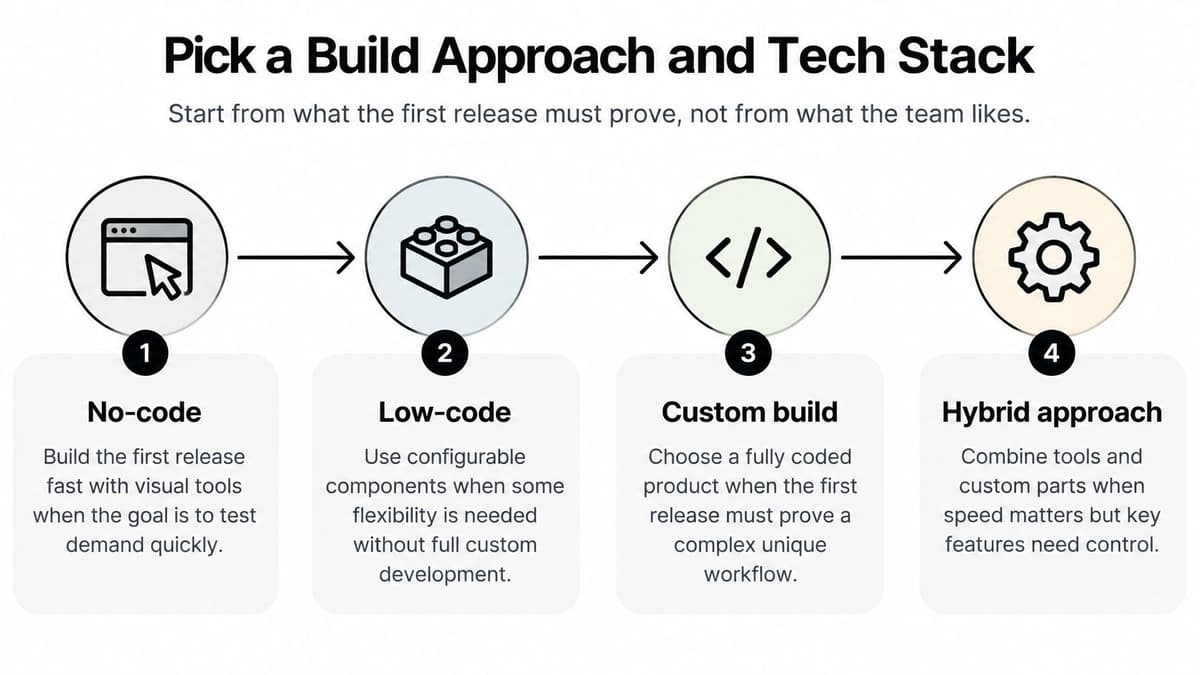
Start from what the first release must prove, not from what the team likes. The diagram below sets out the four routes founders usually choose between.
| Approach | Best when | Main trade-off | Typical fit |
|---|---|---|---|
| No-code builder (Webflow, Bubble) | Test is marketing-led and due within four weeks | Limits on custom logic and scaling | Waitlists and landing-page pilots |
| Web app on Next.js with a managed database | Custom workflows, plus search visibility matters | Needs a developer for ongoing changes | Most SaaS MVPs |
| Cross-platform mobile (React Native, Flutter) | Users mainly on phones, one codebase wanted | Store review and device testing overhead | Consumer and field-service apps |
| Native mobile (Swift or Kotlin) | Deep device features are the product | Two codebases and higher cost | Hardware-linked or sensor-heavy products |
A no-code builder is the right answer when the test is about demand, not technology. If a landing page and a manual process behind it can answer your riskiest question in three weeks, building custom software to answer it in twelve is waste dressed as ambition.
For most SaaS MVPs, a web app on a framework such as Next.js with a managed database is the sensible default. You get custom workflows, one codebase, and pages search engines can index. If you're weighing how the pieces fit together, our explainer on web application architecture for scalable products walks through the layers in plain terms.
Go cross-platform when your users live on phones, such as field engineers or delivery drivers. Pay for native Swift or Kotlin only when deep device features, like background sensor access or tight hardware integration, are the product itself. "Our users might prefer an app" isn't a reason to double your codebase.
The Build Loop
Whatever you choose, run the same loop. Prototype in Figma, test the clickable version with users, build a thin production slice, measure it, then repeat. In our Production step, we design and build the project with regular updates, and I'd hold any team to that standard. A stakeholder should see working software every one or two weeks, not a reveal at the end when changes are expensive.
Don't build for scale that doesn't exist. You don't need microservices, a data warehouse, or multi-region deployment to serve forty beta users. You need code your team can change quickly when those users tell you something surprising.
Minimum Technical Baseline Before Launch
- Authentication and role-based access so users only see their own data.
- HTTPS everywhere and secrets kept out of the codebase.
- Automated backups that someone has restored from.
- Error monitoring so you hear about failures before users report them.
- Analytics on the core task, not just page views.
- A documented API if integrations are part of the promise.
One rule settles most stack arguments. Choose the stack your team can change fastest for the next three months.
Launch a Private Beta and Read the Signals
Your first release goes to a small invited group, not to the public and not to your whole waitlist. The UK Service Manual guidance on how the beta phase works describes teams first releasing privately to a limited, invited group so they can collect feedback, improve the product, and verify that it can operate at scale, with public beta only after that evidence is gathered.
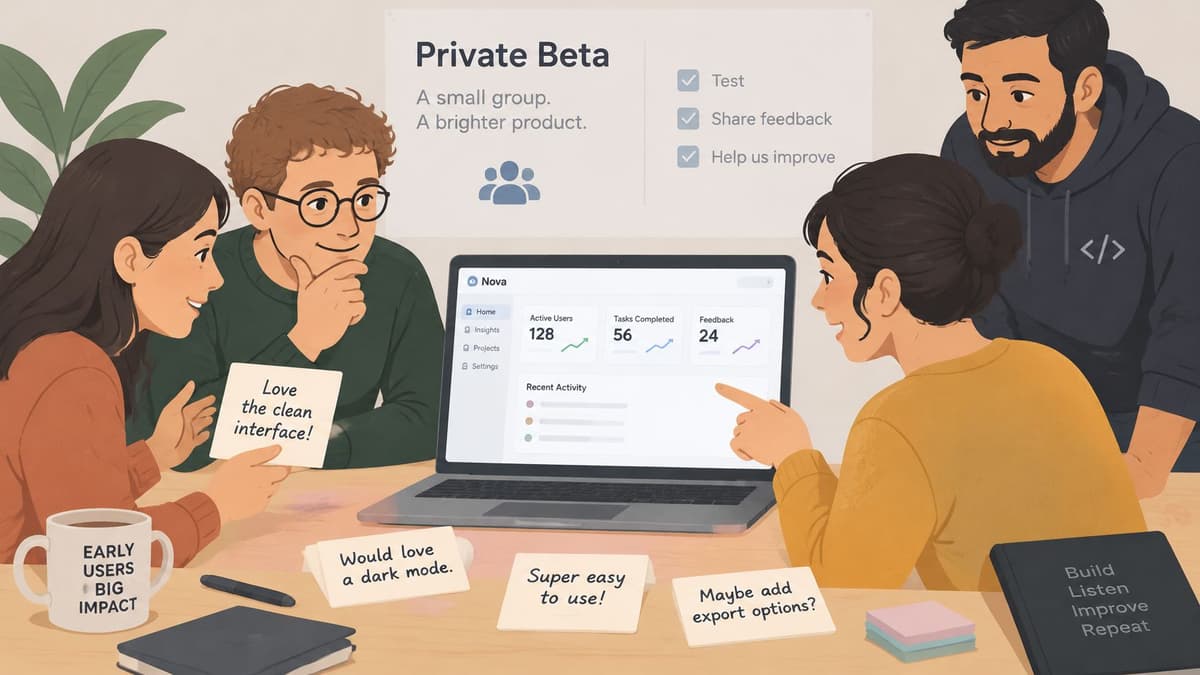
That sequencing protects you twice. You learn in a controlled setting, and you don't burn your one first impression on avoidable faults. The photo below is the part founders underestimate. Beta is a team reading signals together, not a launch announcement.
Launch Checklist
Before the first invite goes out, confirm analytics events fire on the core task, a feedback channel is visible inside the product, error monitoring is live, and backups have been tested by restoring them. Prepare a handover pack too. At Launch, we help launch the project and leave it in a state a team can run, with documentation, deployment steps, and admin access held by the company rather than the builder. Demand the same from any supplier.
The following walkthrough shows how a staged beta review works in practice.
| Metric | Question it answers | Example threshold | How to track |
|---|---|---|---|
| Activation rate | Do new users finish the core task? | 40% of invited users complete it | Event at task completion |
| Time to first value | How long until users reach the core outcome? | Under 2 days from sign-up | Session timing from sign-up |
| Week-4 retention | Do users come back without prompting? | 20% of activated users | Cohort report |
| Support tickets per 100 users | Can people understand the product unaided? | Under 10 | Helpdesk tag on the core flow |
| Paid or signed pilots | Will users commit money or time? | 3 signed pilots from the beta group | Billing record or signed letter |
Write each threshold down before the beta starts and review cohorts weekly rather than averaging across the whole test. Averages hide whether you're improving. Activation tells you whether the product works, retention tells you whether it's valuable, and support volume tells you whether people can understand it without help.
Add an adoption check before the beta closes. Ask five to ten target SMEs whether they can set up and use the product within one working week without the builder present. The UK Government business systems integration summary of responses captures the context behind the UK SME Digital Adoption Taskforce finding in 2025 that products often feel designed for larger firms, switching costs can be high, and smaller firms frequently lack implementation support. A product that works in your test session can still fail in an SME's hands, so measure onboarding time, setup effort, and training needs as beta metrics, not afterthoughts.
Decide Whether to Scale, Pivot or Stop
The beta ends in a decision, and the rules for that decision were written in discovery. If you're inventing criteria after seeing the data, you'll invent criteria that flatter the data.
Scale when every threshold has been met for two consecutive weekly cohorts and support load is falling. Two cohorts matter because one good week can be a friendly user group or a founder hand-holding accounts. Falling support load tells you the product is becoming self-explanatory, which is what makes growth affordable.
Pivot when activation is strong but nobody pays or signs. Users finishing the task tells you the problem is real and the workflow works. Nobody committing tells you the segment can't pay, the buyer isn't the user, or the price doesn't match the value. That's a repositioning problem, not a rebuild. Change one variable, usually segment or pricing, and rerun the test.
Stop when interviews stop reproducing the problem or your kill rule has been triggered. Stopping feels like losing months. It saves the larger amount you'd have spent scaling something nobody needed, and it frees the same team to test a better hypothesis.
Momentum is not evidence. A busy roadmap can carry a weak product for quarters before the numbers force the conversation.
What to Do This Week
Book the decision before the beta ends. Four actions, in order:
- Write the decision date in the calendar now, while it's still cheap to keep.
- Name the owner who makes the call if the data is mixed.
- List the three numbers that will drive the decision, taken from your thresholds.
- Send a one-page memo to the team after the call stating go, pivot, or stop, and why.
If the decision is to scale, build the next release from the beta feedback log rather than the original backlog. Your backlog was written before real users arrived. Staff the post-launch work using the team models compared earlier, and note that support packages cover maintenance after launch in addition to a scoped project, while an all-in-one retainer can include maintenance, research, A/B experiments, marketing material, documentation, servers, deployments, meetings, customer support, design, and consultation.
Keep each post-launch release small, measure it against the same thresholds, and repeat the decision cycle. MVP product development doesn't end at launch. It becomes a habit of spending money only where evidence points.
If you're planning a first release and want the evidence gates, specification, and build handled as one accountable process, Digital Souls Studios LTD designs and builds MVPs, SaaS products, and web applications from specification through launch and ongoing support. Tell us the one workflow your first users must finish, and we'll help you scope the smallest release that proves it. Start the conversation at Digital Souls Studios LTD.