26th November 2026 · 16 min
Single Tenant vs Multi Tenant: Which Fits Your Business

When a supplier says their platform is "single tenant", which part of the system do they mean: the application, the database, the backups, or just your login? Most buyers never ask, and the answer changes the price, the risk and the exit route.
The label on its own tells you very little. A shared platform with tested separation can be safer than a dedicated environment running on a weak administrator password. What matters is which components need isolating, what evidence proves the isolation works, and what that isolation costs as a separate line on the quote. Most UK buyers land somewhere in the middle, not at one end of a binary choice.
Table of Contents
- Single Tenant and Multi Tenant at a Glance
- How Each Model Works in Plain English
- Isolation, Security and Compliance Compared
- What Each Model Costs and Why Prices Differ
- Scalability, Performance and Noisy Neighbours
- Which Model Suits Which Business
- Maintenance, Upgrades and Leaving a Supplier
- Choose a Model and Brief Your Supplier
Single Tenant and Multi Tenant at a Glance
Single tenant means each customer runs on an environment kept for them alone. Multi tenant means many customers share one platform, with their records kept apart by software controls the supplier has to prove.
| Criterion | Single tenant | Multi tenant |
|---|---|---|
| Data isolation | Dedicated environment for one customer | Shared platform, records separated logically and proven by the supplier |
| Security responsibility | Clearer data boundary, every control still verified | Supplier runs shared controls, you verify tenant separation |
| Upfront cost | Usually higher | Usually lower |
| Ongoing cost | Higher, duplicated environments | Lower per customer, costs spread across many |
| Maintenance | Each environment patched and monitored | Supplier maintains one platform for all customers |
| Upgrades | Timing can often be negotiated | Same release for every customer, little choice of timing |
| Scalability | Add dedicated capacity as demand grows | Scales on shared capacity, with noisy-neighbour risk |
| Customisation | High | Limited to what the platform allows |
No single row settles the decision. Weigh them against how sensitive your customer data is, how fast usage will grow, and how much technical ownership your team can realistically carry. The sections on isolation and security, cost drivers, noisy neighbours, business situations and maintenance expand each row into something you can put in front of a supplier.
Reading the table without getting stuck
Two rows trip buyers up most often. Customisation looks attractive until you remember that every bespoke setting has to be maintained and migrated later. Security responsibility looks lighter on the multi tenant side, but the verification work moves from running controls to auditing someone else's.
If you want a second technical perspective before a supplier call, see ThreatExploit AI's tenancy breakdown, which sets out the architectural differences in more depth than a sales deck will.
Buy multi tenant for standard work unless a contract, a regulator or a speed guarantee forces dedicated capacity.
That's the sentence a founder can repeat out loud in a procurement meeting, and it holds up in most cases.
How Each Model Works in Plain English
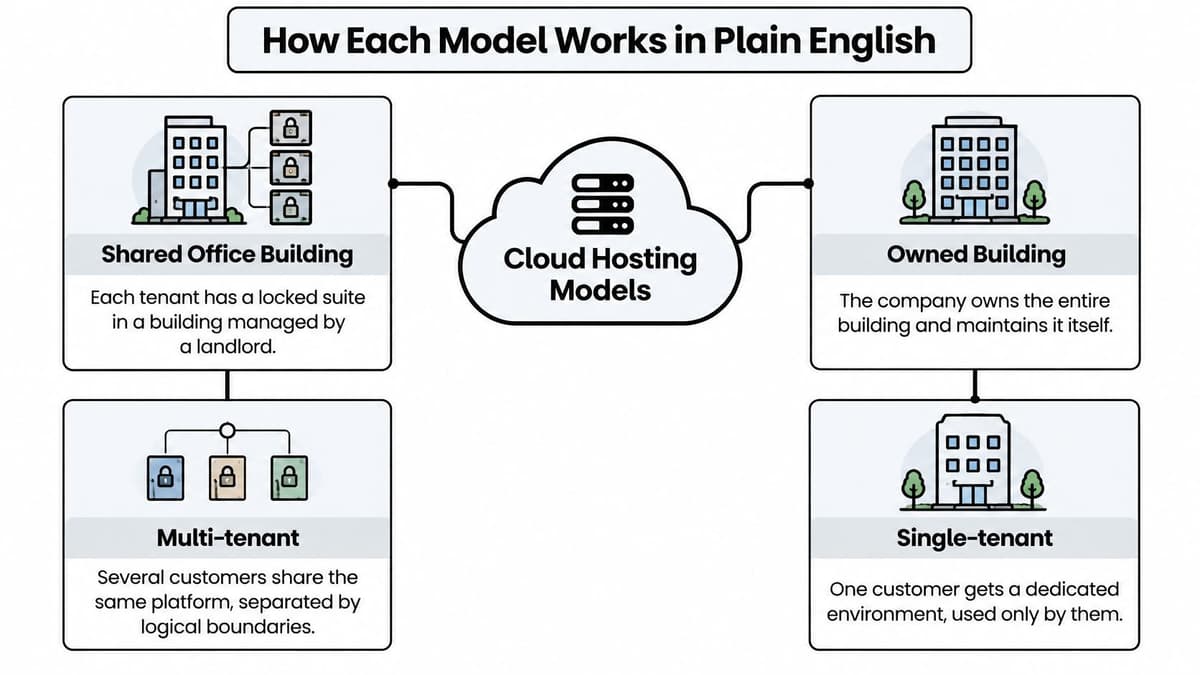
Think of a shared office building where each company has a locked suite, versus a building your company owns outright and maintains itself. Both give you working space. The difference is who else is in the building and who fixes the roof.
Multi tenant: the supplier runs one platform for many customers, each with their own login and records kept apart. Single tenant: you get an environment run for you alone, hosted either by the supplier or by a hosting provider you choose.
What UK businesses actually run
The UK Business Data Survey 2024 found that 35% of businesses handling digitised data stored and processed it on premises, while 19% used a public-cloud provider and 13% used a private-cloud provider. In the survey's broader classification, 21% stored and processed data only in an enterprise data centre, compared with 19% that used only external data centres.
Size shifts the picture sharply. The same survey found 48% of large businesses used a public-cloud provider, against 19% across all surveyed businesses. Shared infrastructure is normal, not exotic, and it's the default for most software you'll be quoted this year.
The models differ in who shares the building, not in how good the software is.
Three facts that settle the label
Sales language stretches "single tenant" to cover almost anything. Three facts cut through it, and you can get all three in one email:
- Where the data sits. Which country, which provider, which database, and whether that database holds other customers' records too.
- Who controls upgrades. Whether you can defer a release, or whether changes arrive on the supplier's schedule for everyone at once.
- Who shares the runtime. Whether the application, the background processing and the support tooling serve other customers alongside you.
A supplier that answers all three plainly is usually one you can work with. A supplier that answers with the word "secure" and nothing else hasn't answered at all.
Isolation, Security and Compliance Compared
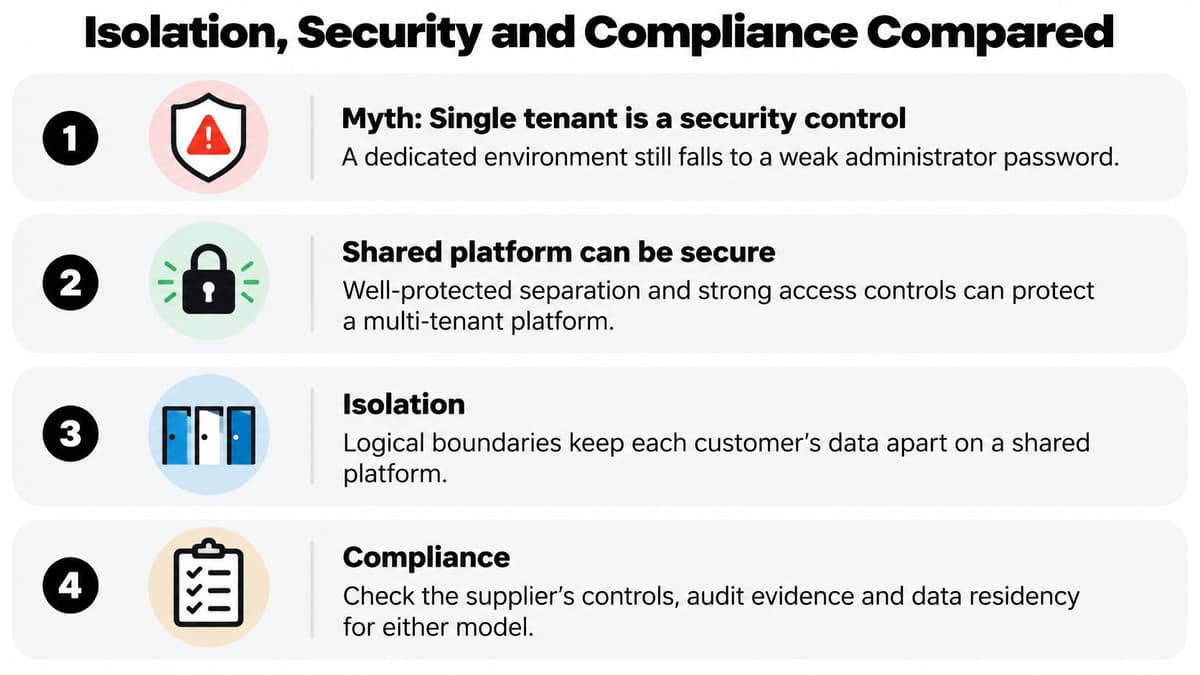
Single tenant isn't a security control. A dedicated environment still falls to a reused administrator password, an unpatched server or a phishing email, and a shared platform can be well protected when its separation is designed and tested properly.
Where separation actually happens
The National Cyber Security Centre's cloud security principles treat separation between customers as fundamental: a malicious or compromised customer must not be able to access or affect another customer's service or data. That separation may need to cover code, storage, networks and identity management, not just one of them.
The terminology trap sits right here. The NCSC advises buyers to establish what a supplier means by "tenant", "account", "organisation", "subscription" and "resource group". A product marketed as single tenant may give you a separate database while the application, network and management controls stay shared. That's a real benefit, but it's a narrower one than the label suggests.
What UK rules expect of you
GOV.UK guidance on securing SaaS tools states that SaaS use must comply with the Data Protection Act, GDPR guidance and the government's Security Policy Framework, and recommends assessing providers against the NCSC Cloud Security Principles. The obligation stays with your business whichever model you buy.
Operational discipline matters as much as architecture. The Cyber Security Breaches Survey 2025 found 43% of businesses experienced a cyber breach or attack in the previous 12 months, and tenancy labels don't change that exposure.
Say a support team stores customer messages in a shared helpdesk. The useful questions aren't "is it secure?" but whether records are separated per customer, whether access controls are tested, and what happens when a separation failure is found. Teams moving customer email off shared sending infrastructure face the same discipline, and this practical account of switching off Amazon SES safely shows the sort of migration checks worth copying.
The evidence to demand
Ask for an architecture diagram that shows:
- Tenant boundaries and database isolation, drawn rather than described.
- Identity controls and encryption, including who holds the keys.
- Backup and restore scope, so you know whether restores are per customer or platform-wide.
- Deletion, incident handling and cross-tenant access logging, with retention periods stated.
Acceptance test: ask for evidence that no tenant administrator can read, alter or export another tenant's records through search, exports, background jobs, caches, logs or support tooling.
What Each Model Costs and Why Prices Differ
The headline subscription fee hides most of the story. A multi tenant subscription spreads infrastructure, power, security work and operations across many customers, so the price per customer falls. A single tenant setup duplicates environments, patching and capacity planning, so cost rises even when the software looks identical on screen.
Shared facilities are why that economics works at scale. Research cited by Oxford Economics in the Powering the UK Data Boom report estimates the UK had 52 data centres in 2000 and approximately 266 by 2024, and specialist facilities of that kind spread power, cooling, connectivity and physical security across many tenants.
The drivers to price in one place
Get a supplier to quote against each of these rather than a single per-seat number:
- Users and stored data volume, the two that scale your bill fastest.
- Integrations with the systems you already run, priced per connection.
- Hosting location and compliance evidence, including audit reports and any customer-specific retention.
- Customisation and support hours, which is where dedicated environments get expensive.
- Your own staff time for assessments, access reviews and supplier meetings.
Exit costs arrive later and rarely appear on the quote: data export, migration, and the staff hours to run both systems in parallel. A sensible software project planning process puts those lines in the budget before signing, not after.
Two situations, two answers
An online shop weighing a cheap shared subscription against a seasonal peak is usually buying capacity it doesn't need for ten months of the year. Shared pricing wins there, provided the peak is tested. A finance team weighing audit evidence against a dedicated environment is buying paperwork and provability, and that's a legitimate reason to pay more.
Where building beats buying, Digital Souls Studios LTD publishes fixed ranges: a custom AI support agent at £3,000, a custom AI agent from £3,000 to £10,000, an automated development team at £5,000, and an all-in-one retainer from £1,000 to £15,000 a month, with the fee depending on the requirements.
Ask any supplier to price isolation as its own line. Then you're comparing a shared service and a dedicated environment on total cost, risk and effort, not on the monthly fee alone.
Scalability, Performance and Noisy Neighbours
Shared systems aren't automatically slower. A well-run multi tenant platform with enforced limits will often outperform a small dedicated environment nobody is monitoring. The specific risk is this: a noisy neighbour, meaning one customer's heavy use slows everyone else on the same shared system.
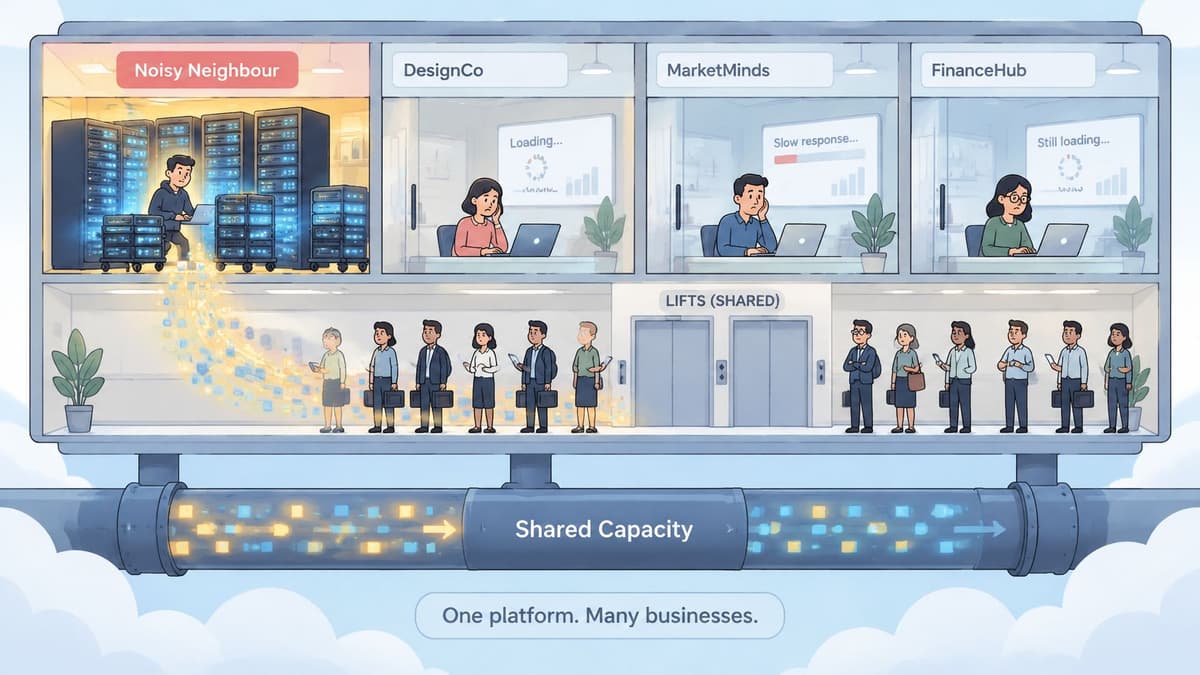
For a shop, that means a neighbour's surge could slow checkout, support replies or reporting. It's a revenue problem, not only a data problem.
The controls a shared supplier should have
The ICO's cloud computing guidance for organisations sets two linked obligations: safeguards must prevent one customer accessing another customer's personal data, and one customer's activity must not adversely affect another customer's service. The NCSC expects the same separation on the security side.
In practice that means per-customer quotas, rate limits, separated workloads, queue controls, and monitoring per customer of processor use, memory, database connections, storage, requests, error rates and response times. The Department for Work and Pensions cloud security standard goes further, requiring providers to prevent co-tenants monopolising shared bandwidth or CPU, with resource isolation covering customer data, virtualised applications, operating systems, storage and virtualised network infrastructure.
The test to ask for
Skip average speed benchmarks. Ask for load tests reporting p95 and p99 response times, meaning the times that 95 and 99 out of every 100 requests come in under, measured both under normal traffic and under a deliberately heavy workload from one tenant. Error rates belong in the same report.
A seasonal shop needs that peak test before Black Friday, not after. A growing support team needs to know what happens when message volume triples in a fortnight. Understanding your own web application architecture makes those conversations far shorter, because you can name the component that has to hold up.
Practical rule: multi tenant suits predictable demand with enforceable limits; single tenant suits variable demand or strict speed guarantees. Ask for the isolation controls and the p95 and p99 figures in writing, in the same document.
Which Model Suits Which Business
| Business situation | Better fit | Main reason |
|---|---|---|
| Support team handling routine customer emails | Multi tenant | Standard workflows and lower cost per user |
| Online shop with seasonal peaks | Multi tenant, if load tests pass | Shared capacity must be proven under peak demand |
| Finance team holding bank and payroll data | Single tenant or audited multi tenant | Sensitive records need proven separation |
| Founder with no technical team building a first product | Multi tenant | Less infrastructure to own and maintain |
| Public-sector or regulated service | Single tenant | Contract and audit demands are stricter |
| Large customer needing guaranteed speed | Single tenant | Dedicated capacity makes performance predictable |
| Customers with mixed data sensitivity | Hybrid | Share the application and isolate the sensitive database |
A support team answering routine emails gains nothing from a dedicated server. The workflows are standard, the data is ordinary customer correspondence, and the per-user saving is real money. A founder building a first product is in the same position: owning infrastructure means owning patching, monitoring and capacity planning, which is a job, not a feature.
The online shop is the interesting middle case. Shared capacity is usually the right commercial answer, but only once the peak test has been run against the shop's own checkout and reporting flows.
The hybrid most buyers actually need
The decision isn't one switch, it's a list of components: application, database, file storage, backups, encryption keys, and the region where data sits. A common pattern keeps the application shared under tenant-scoped permissions, while a large or sensitive customer gets its own database, its own encryption key, or its own deployment.
That preserves most of the shared economics. It also adds to the bill and the calendar, because every isolated component is provisioned, patched and tested separately, and each one needs its own restore test. Buyers comparing shared and dedicated enterprise systems can use this breakdown of cloud ERP costs explained to see how those line items stack up in a real product category.
Two worked comparisons make the trade-off concrete. A finance team holding payroll data moves from a standard shared subscription to an audited multi tenant platform with a dedicated database, paying more for evidence rather than for raw isolation. A founder stays fully multi tenant until the first enterprise contract asks for separation, then buys one isolated database instead of a whole new environment.
Maintenance, Upgrades and Leaving a Supplier
Someone has to keep the system running, and the contract should name them. In a multi tenant product the supplier patches one platform for everyone, so fixes land quickly, but upgrade timing is theirs and a change can arrive mid-quarter. In a single tenant setup each environment needs patching, monitoring and backups separately, either by the supplier under contract or by your own team.
Ask who is on call, and what response time is written into the agreement rather than promised on a call.
Before you switch anything on
The ICO's guidance on complying with UK GDPR when using cloud systems says an organisation must carry out a DPIA screening assessment (a short check on whether a full data protection impact assessment is needed) before introducing a new cloud system. Where high risks remain unmitigated, the organisation must consult the ICO before processing begins.
That guidance also flags supplier switching and vendor lock-in. A customized single tenant environment can make migration, upgrades and replacement suppliers dependent on bespoke configuration, which is a cost you pay on the way out.
The maintenance checklist
- Patch cadence and upgrade notice, in days, written down.
- Backup restore tests, with a stated frequency and a named owner. A backup nobody restores isn't a backup.
- A named contact and escalation route, not a shared inbox.
- Exit terms: export format, notice period, how long exports stay available, how deletion is evidenced, and whether backups are deleted too.
- The cost of running a duplicate environment during transition, which is the line most budgets miss.
A finance team mid-contract needs the upgrade notice period more than anything else, because a change to reporting during year-end is a genuine operational risk. A founder who has outgrown a supplier needs the export format and the migration assistance clause, and needs them before the renewal date, not after it.
Choose a Model and Brief Your Supplier
Four inputs decide this, and none of them are technical: How sensitive is the customer data? How concentrated are your customers, since one large client can dictate terms? What performance guarantee have you promised? And how much technical ownership can your team carry week to week?
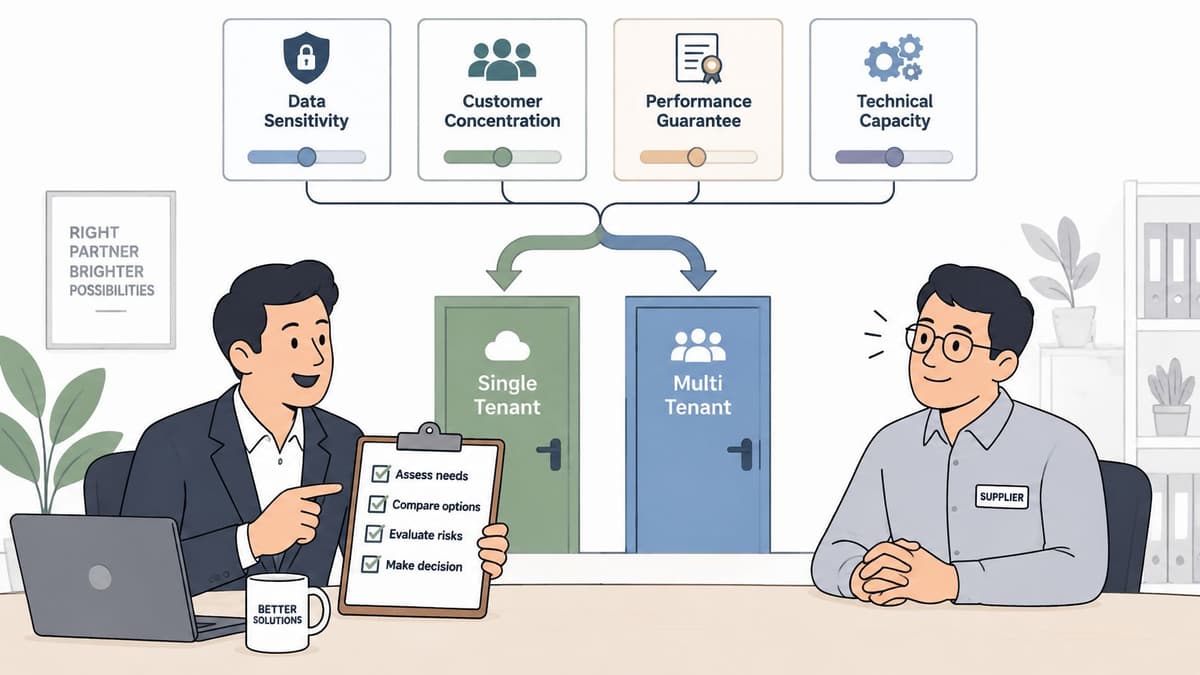
The rule of thumb: buy a multi tenant product for standard work and a small team, ask for a single tenant or dedicated option where a contract or regulator requires it, and bring in a specialist studio when software must fit a system you already run or when there's no in-house team to maintain what gets built. Digital Souls Studios LTD, a London software studio, covers end-to-end product builds and MVPs alongside internal tools and software that has to fit a system the client already runs, and its software and AI development services can be scoped around these requirements before a build starts.
Five questions to take into the meeting
- Where does separation happen: application, database, storage, backups, keys, region?
- What does the architecture diagram show, and can you have a copy?
- What tested evidence of isolation exists, including through exports, logs and support tooling?
- What were the load test results at p95 and p99, under normal and abusive tenant load?
- What happens to your data at contract end, including backups?
Write the answers into a short requirements document rather than leaving them in email threads. A worked software requirements specification example gives you a structure to copy, and it makes competing quotes comparable.
If a supplier can't answer these five in ordinary language, that's a commercial warning sign regardless of the tenancy model. Send your project outline and the answers you've had so far through the Digital Souls Studios contact page for a view on which components need isolating and what that should cost.
Digital Souls Studios LTD builds and maintains software, websites and AI systems for businesses without an in-house technical team, which makes it a practical partner when a tenancy decision turns into a build or a migration. Its scoped projects run from specification through launch, so isolation requirements, hosting location and exit terms get defined before anyone writes code. Describe the data you hold and the customers you serve at Digital Souls Studios LTD and get a straight answer on whether shared, dedicated or a hybrid fits.